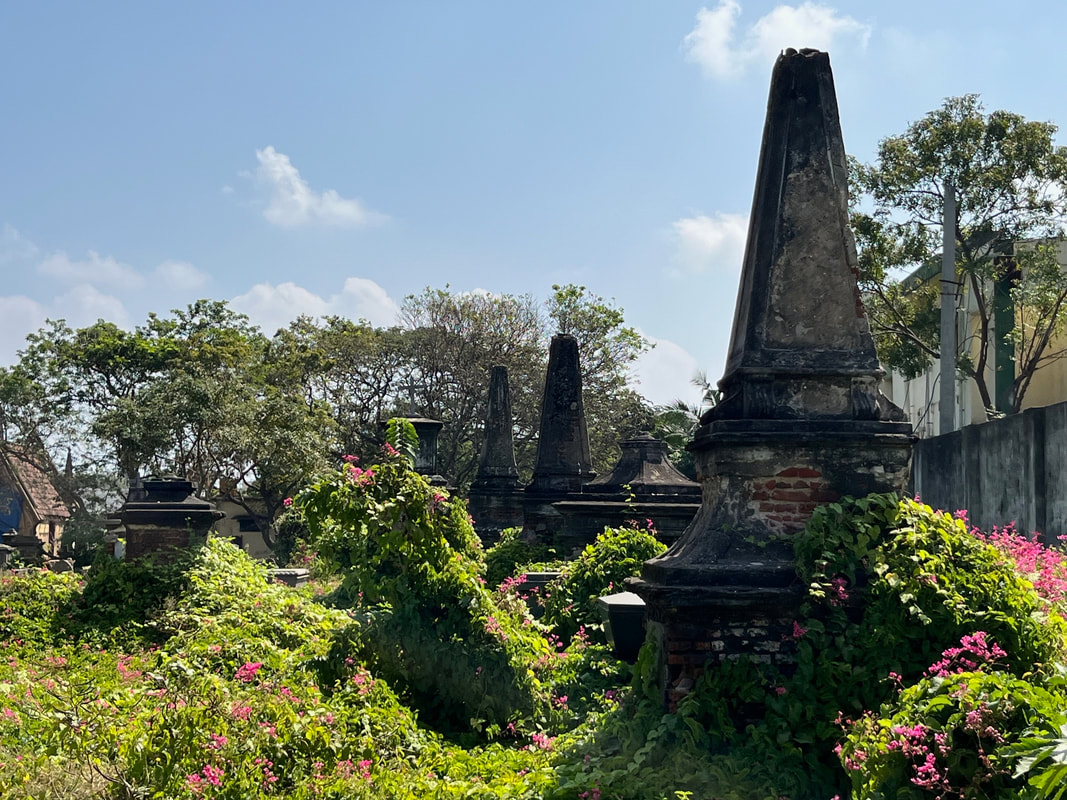
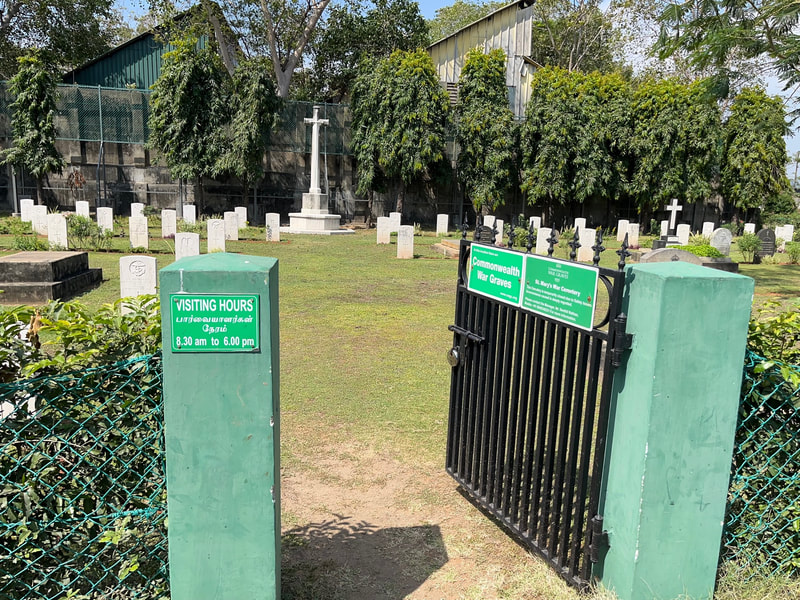
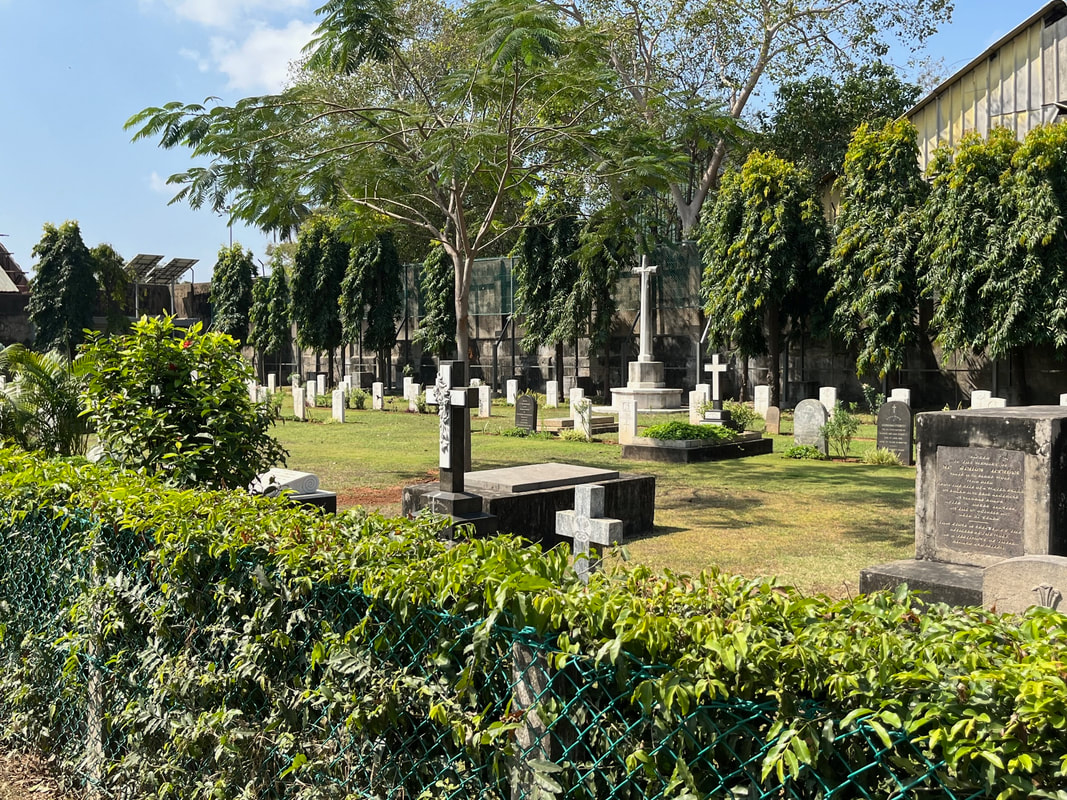
 What a place! This is the unkempt, desolate beauty of St Mary's burial ground in the Island district of Chennai. It's not the oldest Anglican cemetery in Chennai - but it is, I believe, the biggest of the Raj-era Christian burial grounds in the city. As you can see, much of it is overgrown - some of the monuments are in deep disrepair, and have been for a while, and there's a problem with vandalism and trespass. BACSA, the British Association for Cemeteries in South Asia, is supporting conservation work here. But this astonishing, sizable site - surely the most important colonial-era burial place in India after Park Street in Calcutta - gets next-to-no visitors. That's in part because hardly anyone knows it's here - even some of those who know of it, can't find it - and when you do reach the place, it's not exactly welcoming for visitors. 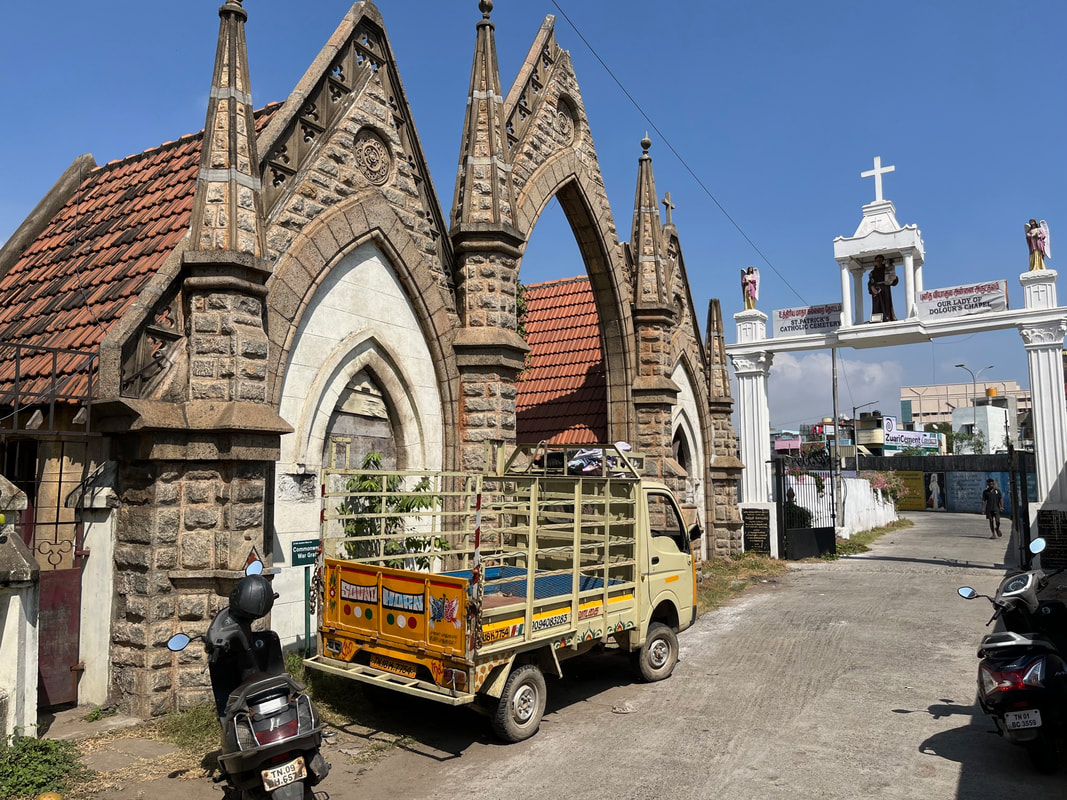 This is the entrance to the cemetery - on a slip road off a very busy flyover (in the distance you can see the gateway to a Catholic cemetery and church). There's next-to-no signage outside, only a small plaque saying there are Commonwealth War Graves here. Inside, there's no signage at all - no map, no note of significant burials, nothing. 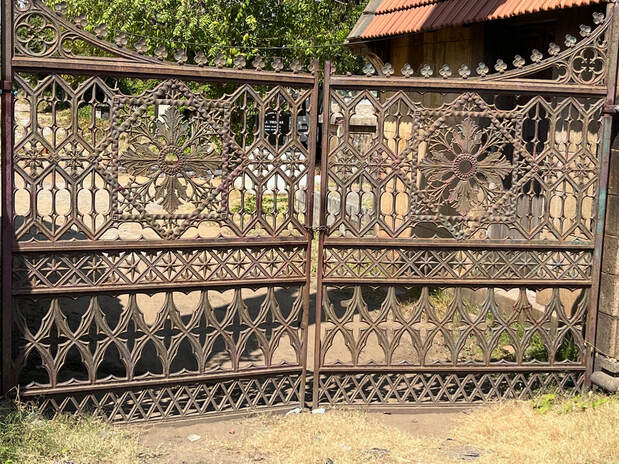 The gates to the cemetery are permanently padlocked. You enter through an unmarked pedestrian gate - the red metal gate you can just spot on the far left of one the photos above. This video may help you to find the place and navigate your way in to the burial ground. Intitially the British used a guava garden as a burial spot - that's on what is now the site of Chennai's High Court. Many of the old gravestones were moved to the fairly cramped grounds of St Mary's church in Fort - a beautiful church, still very much in use, and the oldest Anglican church in India. This overspill burial ground in the Island opened in the 1760s, and for the next sixty years - until the opening of St George's Cathedral - was the main place of burial of the British elite here. By the end of the nineteenth century, the number of burials here started to fall away. On the far side of the cemetery from the entrance, there are two well-kept Commonwealth War Grave compounds. The burial ground is still used for occasional interments. I understand it continues to fall under the jurisdiction of St Mary's church, which is now part of the Church of South India. The main focus of the current conservation work is the Anderson memorial, the burial place of the distinguished botanist and physician James Anderson (1738-1809). The memorial desperately needs a helping hand. 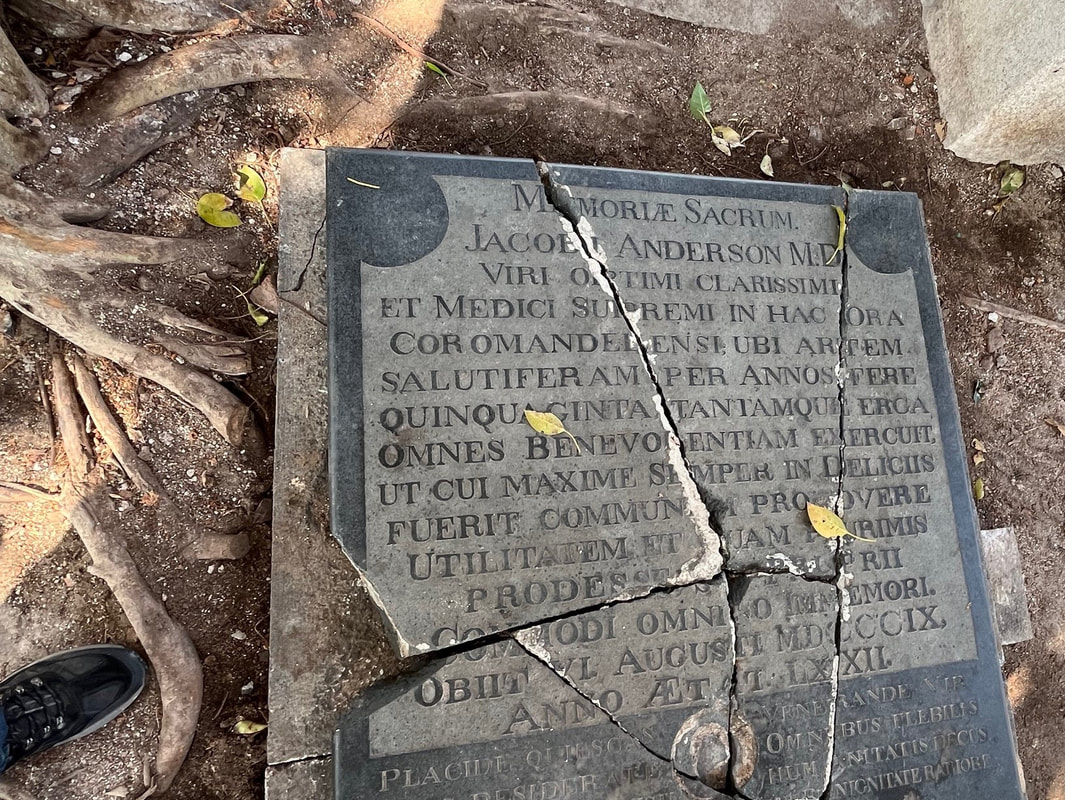 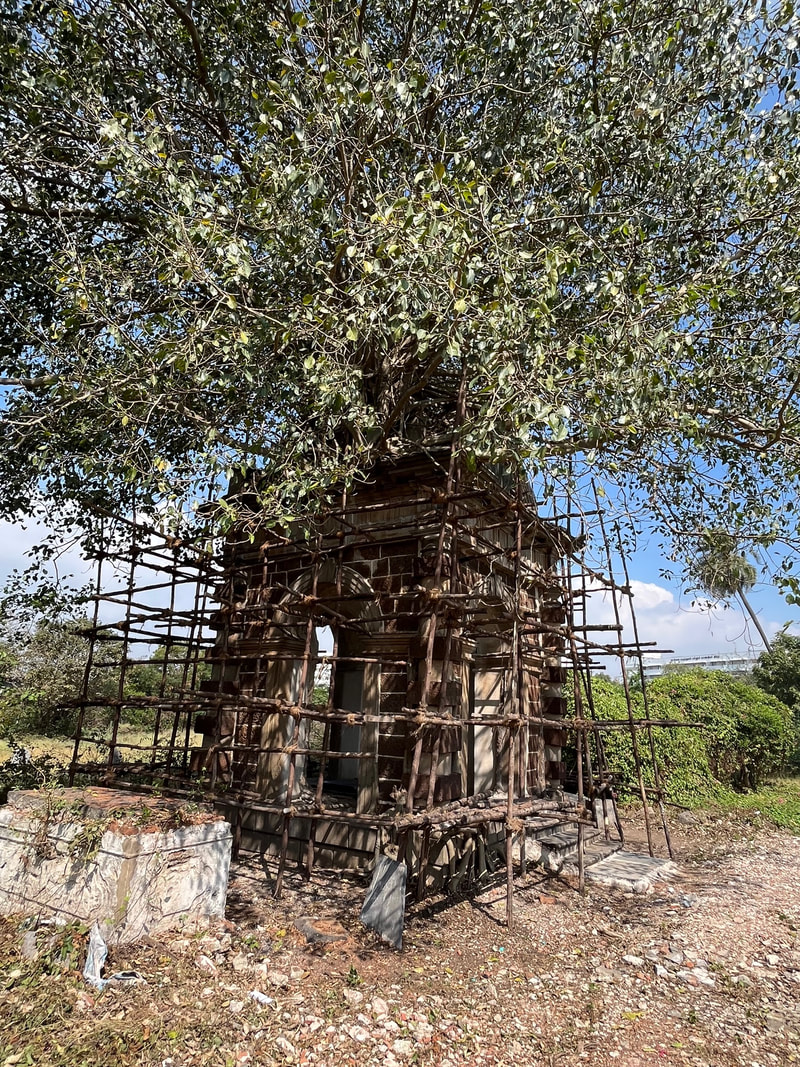 The work so far has included repointing the exterior, a new application of lime mortar wash to the interior, and remaking the steps up to the memorial. The granite slab in Latin is badly damaged and also urgently needs conservation work. The big problem is the tree growing out of the upper part of the memorial, and the shrubs and trunks which have become completely entwined with the structure. This mingling of the living and the dead is of course itself elegiac, and the task is to conserve rather than to restore the most notable memorials. But the vegetation makes it impossible to replace some of the stonework which has been displaced and lies around the memorial, and it also may frustrate installing a glass canopy to protect from rainwater seepage. One of the more remarkable aspects of the memorial is the name 'Anderson' which appears on all four sides of the memorial, in four different languages and scripts: English, Urdu, Tamil and (we think) Telugu. Quite a statement of acculturation! 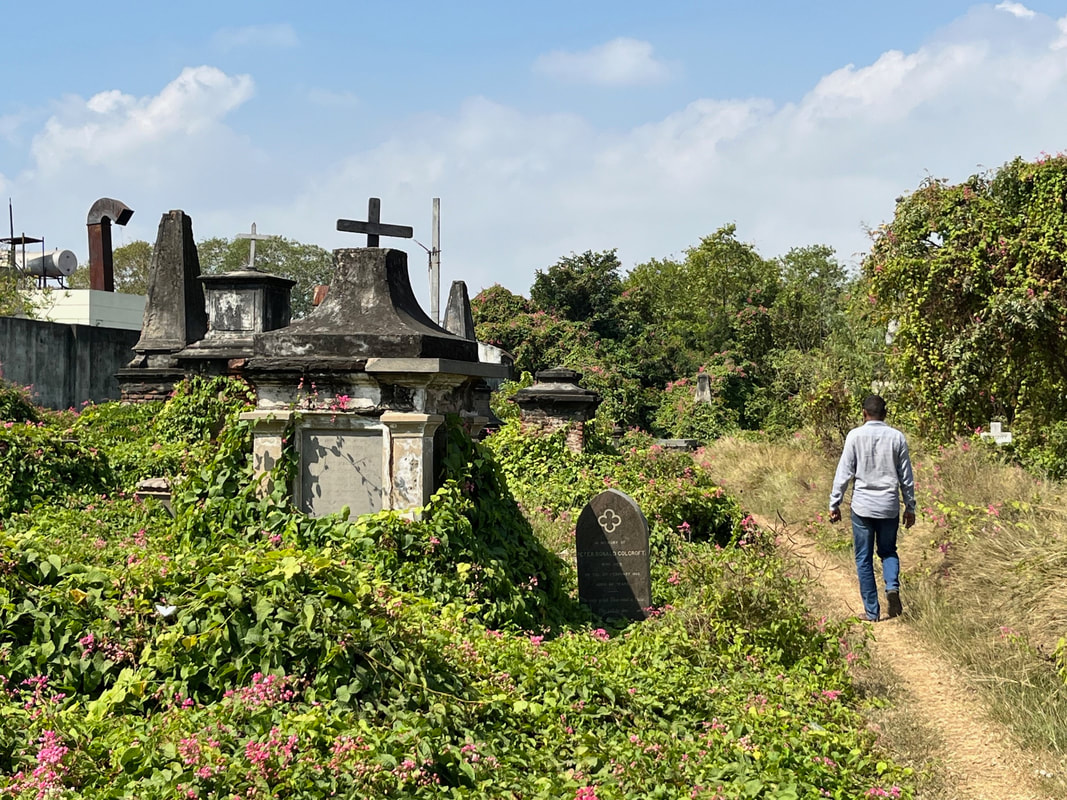 As part of the conservation work, the broad main path through the cemetery is being cleared and resurfaced in stone. This photo shows a narrower, unmarked path off to the left. It heads towards the war graves - two plots, broadly one from the First World War and the other from the Second World War.
One disappointment: the plaque marking the grave of Adela or Violet Nicolson, who wrote transgressively as Laurence Hope, is lost under this sea of vegetation. I have visited this grave in the past and placed flowers, but for the moment it's submerged. She deserves better. 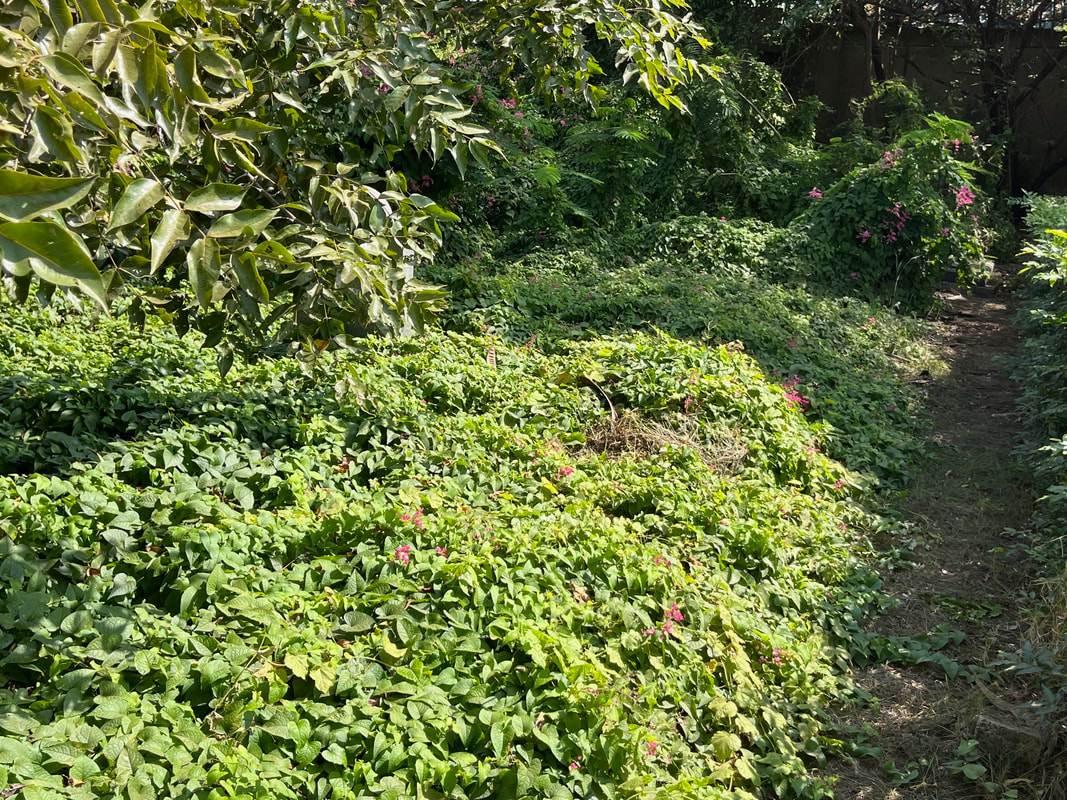 My thanks to Sravani Naraparaju, architect and conservator, who is leading on the conservation work and very kindly showed me round. And to Anil Mahto, who is the supervisor of the small team who are doing the heavy lifting.
1 Comment
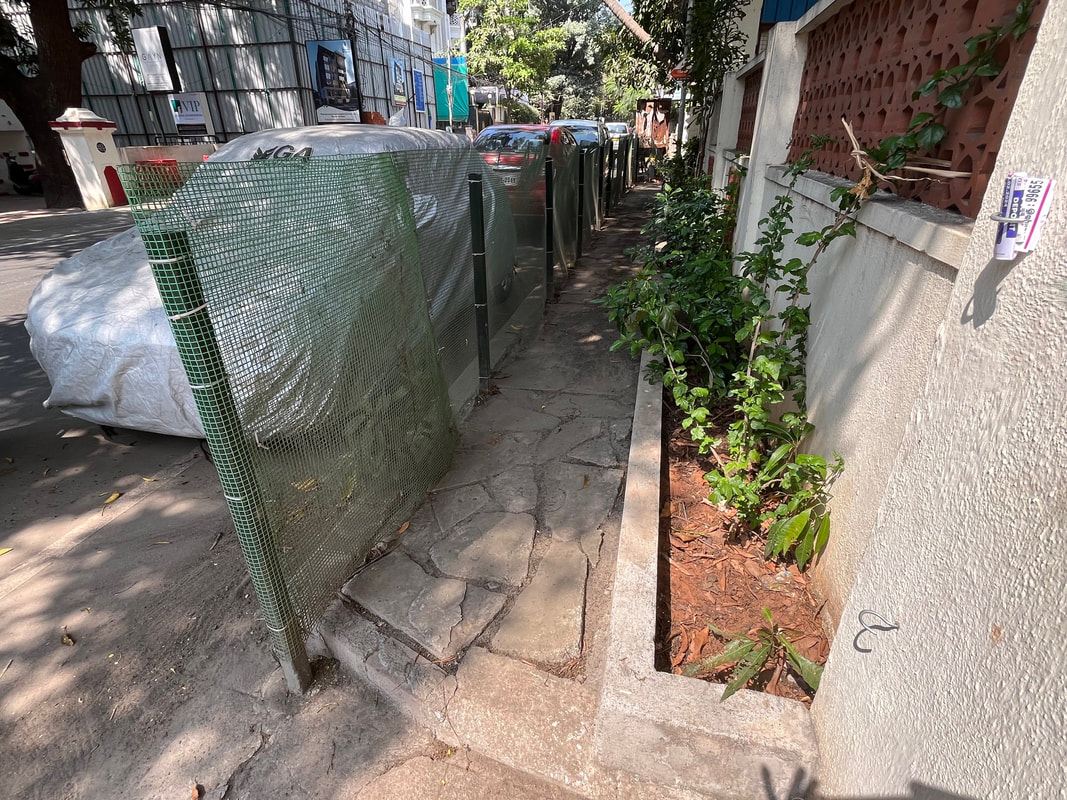 Labour under no illusions - Chennai's pavements are not designed for pedestrians. If you try to promenade along the pavement, you have to watch out for trees taking up the entire width ... parked cars making the sidewalk all but impassable ... stray scooters, parked or deserted or somewhere inbetween ... mounds of excess building materials ... and then there's the press wallah stalls (for the ironing), the sabzi wallah stands (selling vegetables), the roadside shrines (selling, well, you decide) ... the heaps of discarded vegetation ... the hazard of cracked, or missing, manhole covers ... and of low-hanging electricity wires ... and then the sleeping dogs, the starving dogs, the mating dogs. I'm not complaining - OK, I am complaining, but not too loudly. Because in Chennai so much of life - rest, recreation, retail, labour - happens outdoors, there's always something to see, even in a stroll around manicured middle-class parts of town. I like that. But to walk - regarded here as a little bit of an eccentricity - you have to take to the road. And that really is hazardous. In the food chain of Chennai road users, pedestrians are right at the bottom, They are given no quarter. Walking the streets of Chennai, cyclists and scooters often quite literally brush past. So too on occasions do impatient cars and autos. And let's not talk about the buses. 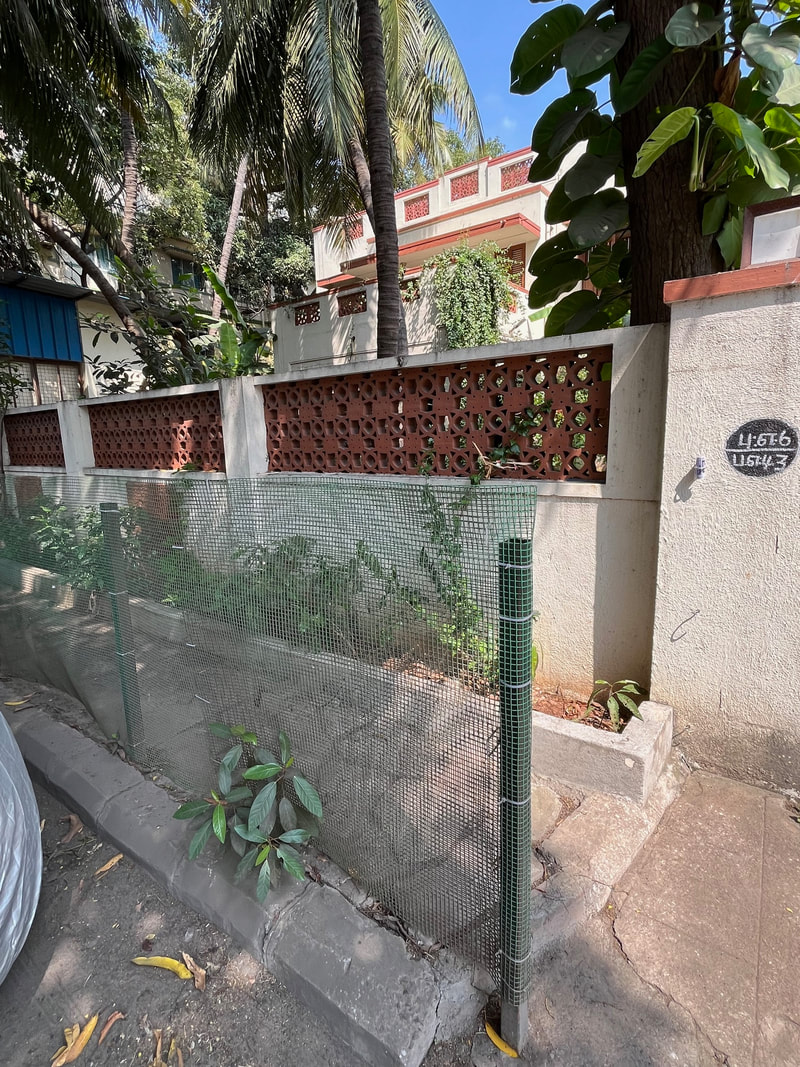 But now I've come across another obstacle ... what looks to be a mini landgrab, a pavement privatisation, a sidewalk denied to walkers, on a street close to where I stay. A wire fence has come up, complete with sturdy metal posts, annexing part of the pavement to the adjoining house. Remember the enclosures in England which turned common land into private fields - well, it seems to be happening here with sidewalks. I haven't examined the issue in great detail. I am not accusing aynone of wrongdoing and would never dream of using the term 'encroachment' - perhaps this stretch of the pavement is indeed privately owned, or permission has been granted to put up the fence. All I know is that for the pedestrian, it makes a stretch of sidewalk even more inaccesible. 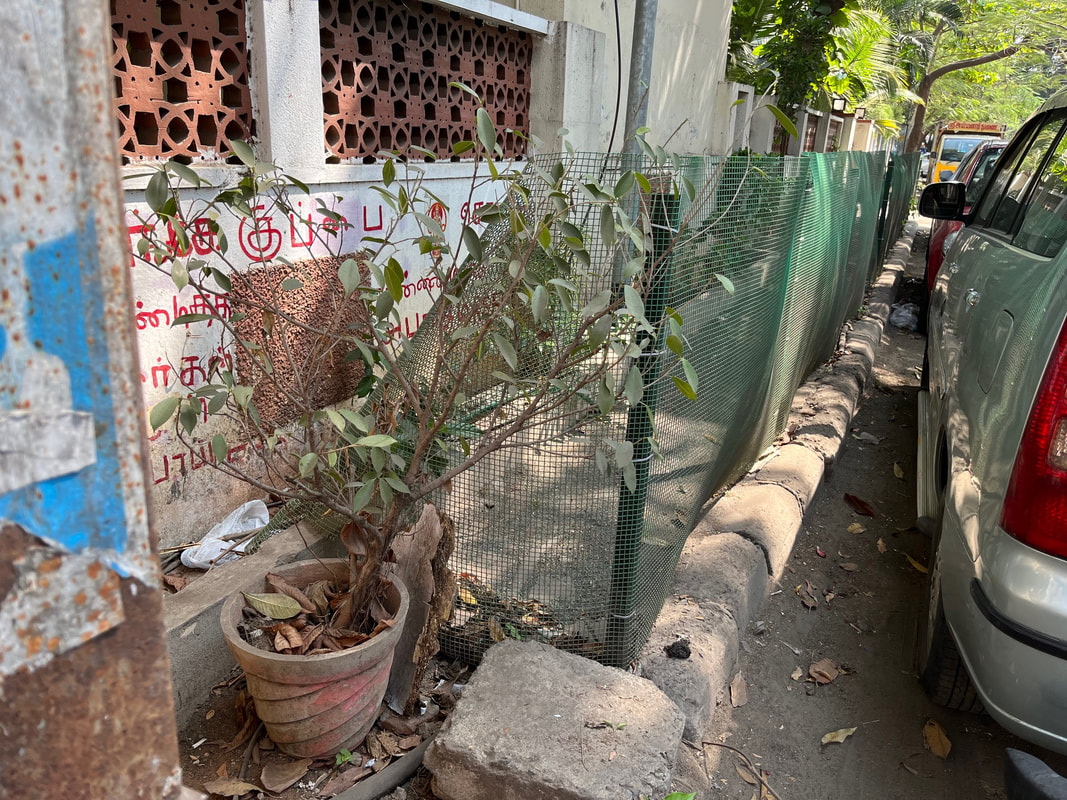 At first I wondered if the wire fencing was intended to stop scooters parking on this stretch of pavement, and was designed to help rather than hinder the walker. But no, the fence is capped off at one end. No through sidewalk! I know this is not the most pressing issue facing the city. But please, can I plead for sidewalks that we can walk on!! 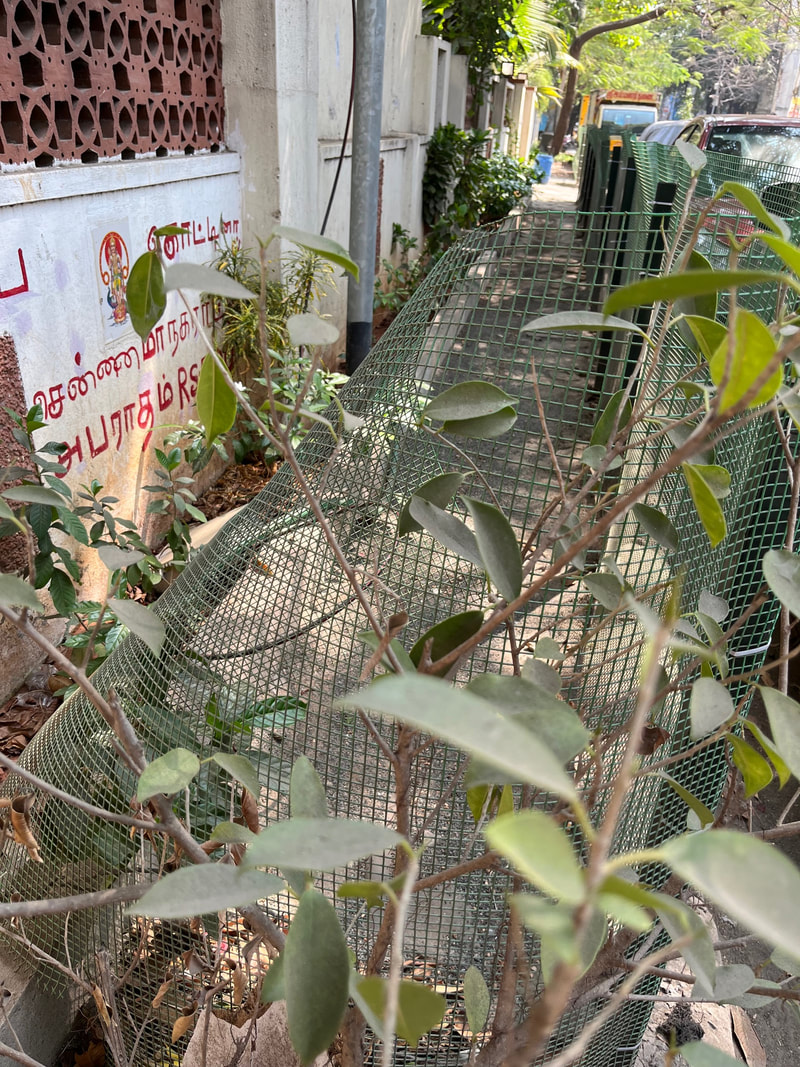  Chinese dentists are still quite a thing in India. I went for a heritage walk in Chennai this afternoon - and came across three Chinese dental surgeries. But then, we were walking along China Bazaar. We gathered, thirty or more heritage enthusiasts, at one end of Evening Bazaar. This broad avenue is at the landward side of Fort St George, the initial British settlement in what was Madras. 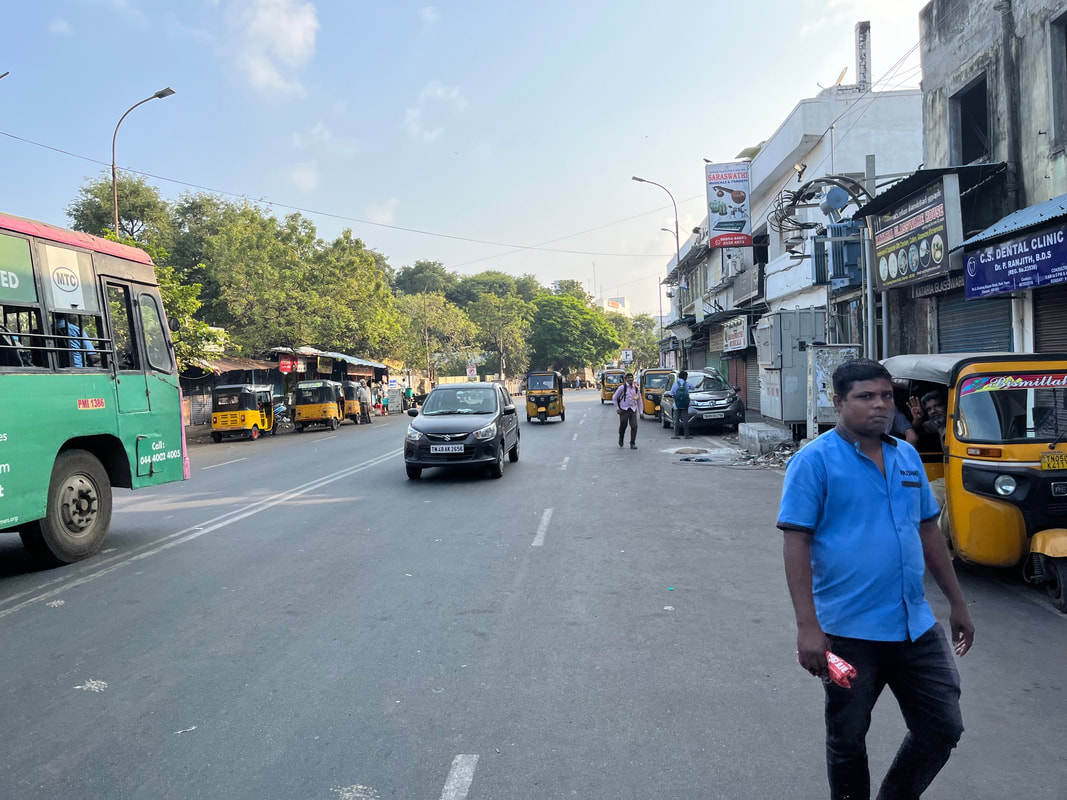 This was initially known as Thieving Bazaar- a thieves market, reselling all the stuff that conveniently fell off the catamarans which brought ashore the cargo from seagoing vessels. 'Thieving Bazaar' became the altogether more poetic 'Evening Bazaar'. That has subsumed stretches of what was, and to some still is, China Bazaar. And then the street turns into Rattan Bazaar, taking its name from the flexible palm wood which is so versatile for furniture and flooring.  It's largely coincidence that there's a cluster of Chinese dental practices on China Bazaar. The old street name was probably derived from a market in ceramics rather than the place.. And the name long predates the Chinese dentists who started coming to India perhaps a century ago - initially dominating the upper echelons of dentistry in Calcutta before branching out to other Indian cities.   There's not a lot beyond the old street lay-out which takes us back to the original bazaar. But some of the surviving buildings from the first-half of the last century have more than a bit of style. 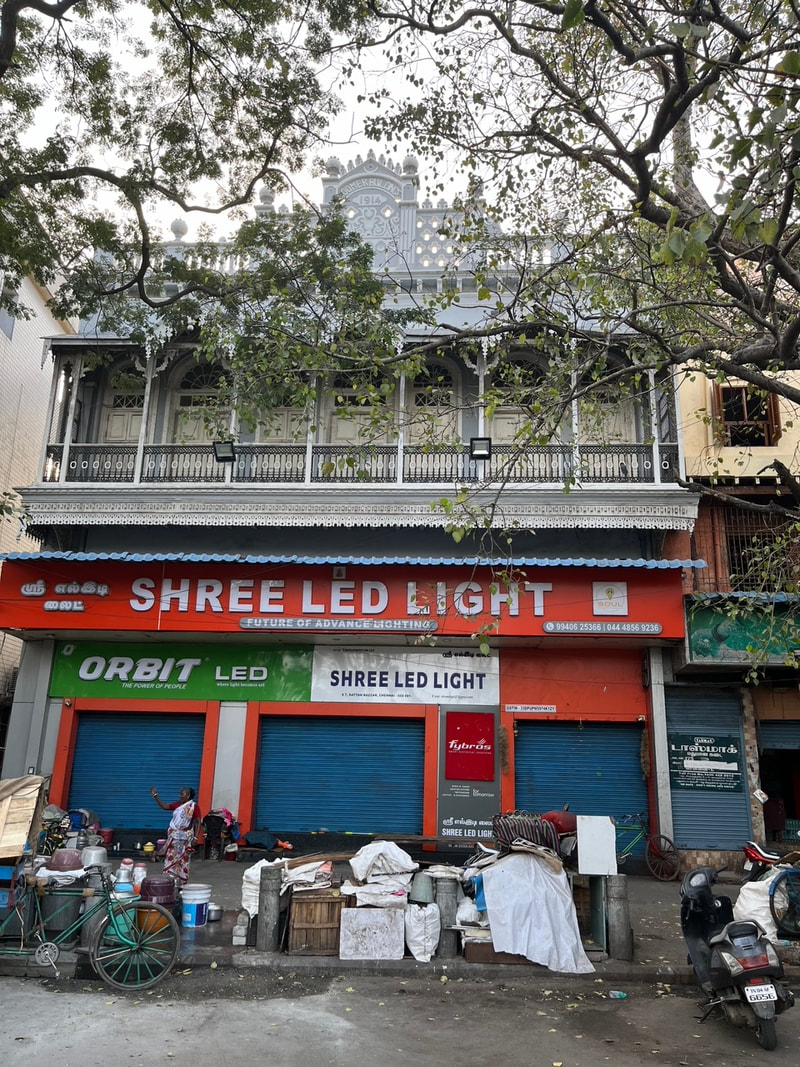 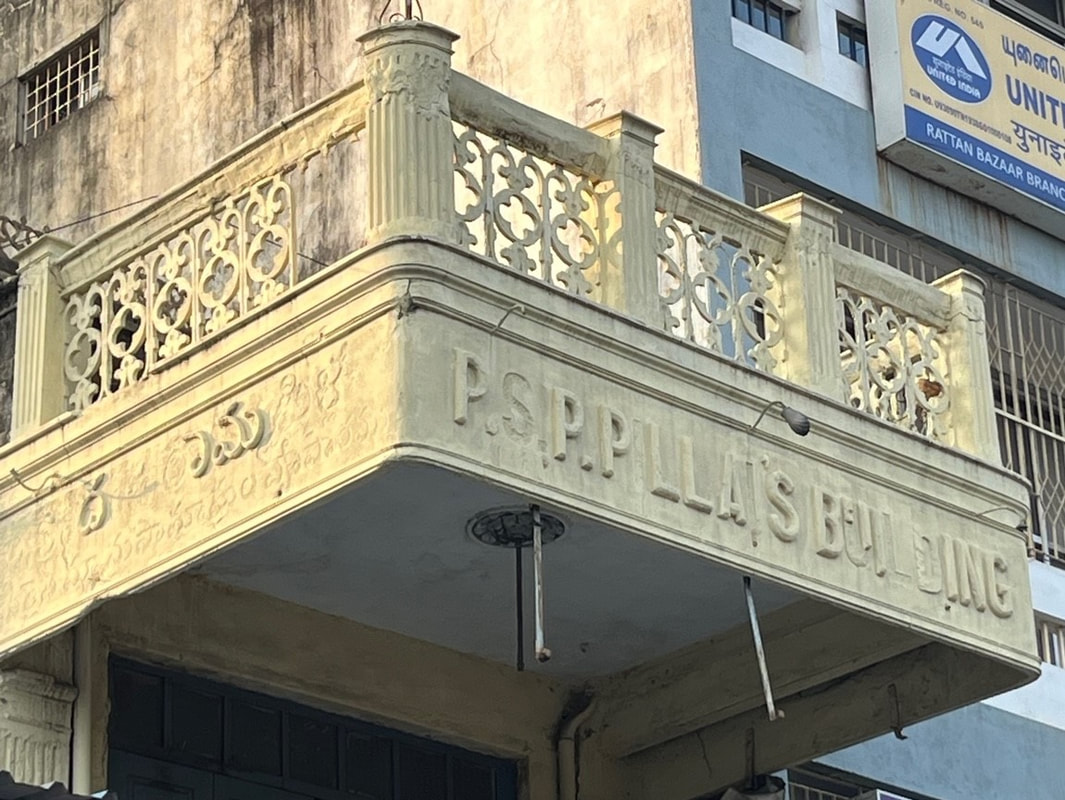 We started the walk close to the Memorial Hall, still owned by the Church of South India but clearly in deep disrepair. It was built in 1857. What was it memorialising? 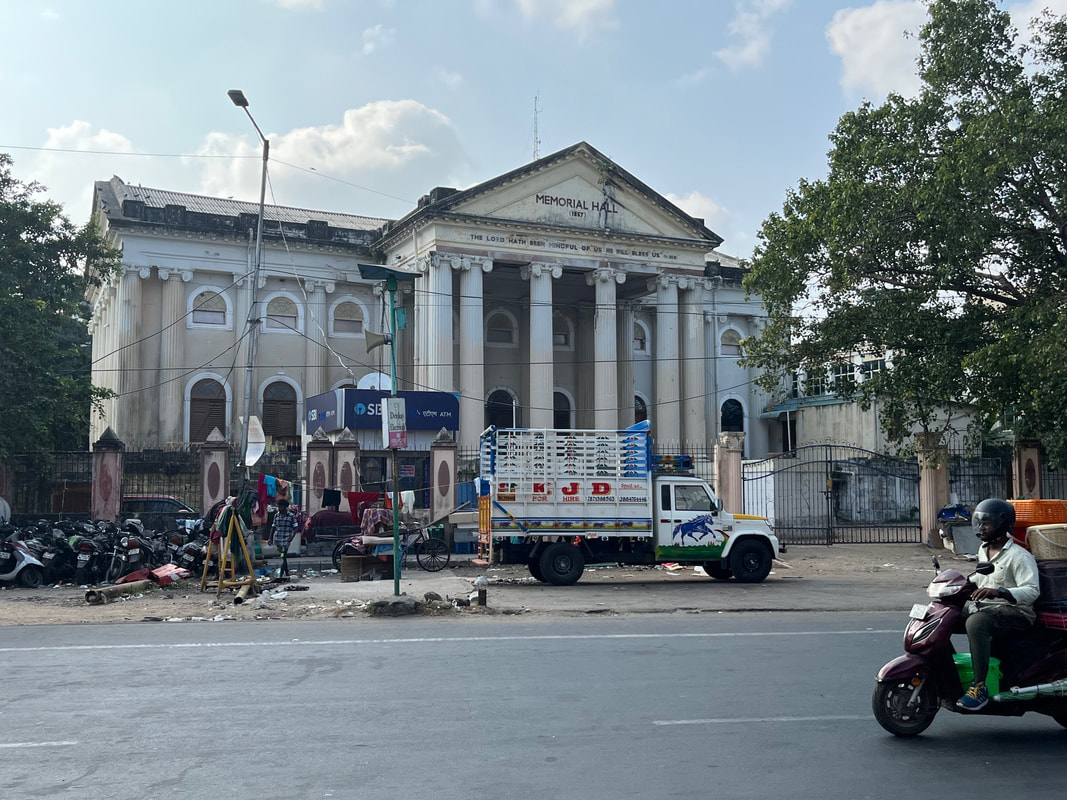 1857 ... ring a bell? The hall was built to give thanks for Britain's victory in the great rebellion of that year, what was once called the Indian Mutiny and is now sometimes known (equally unreliably) as the First War of Independence. 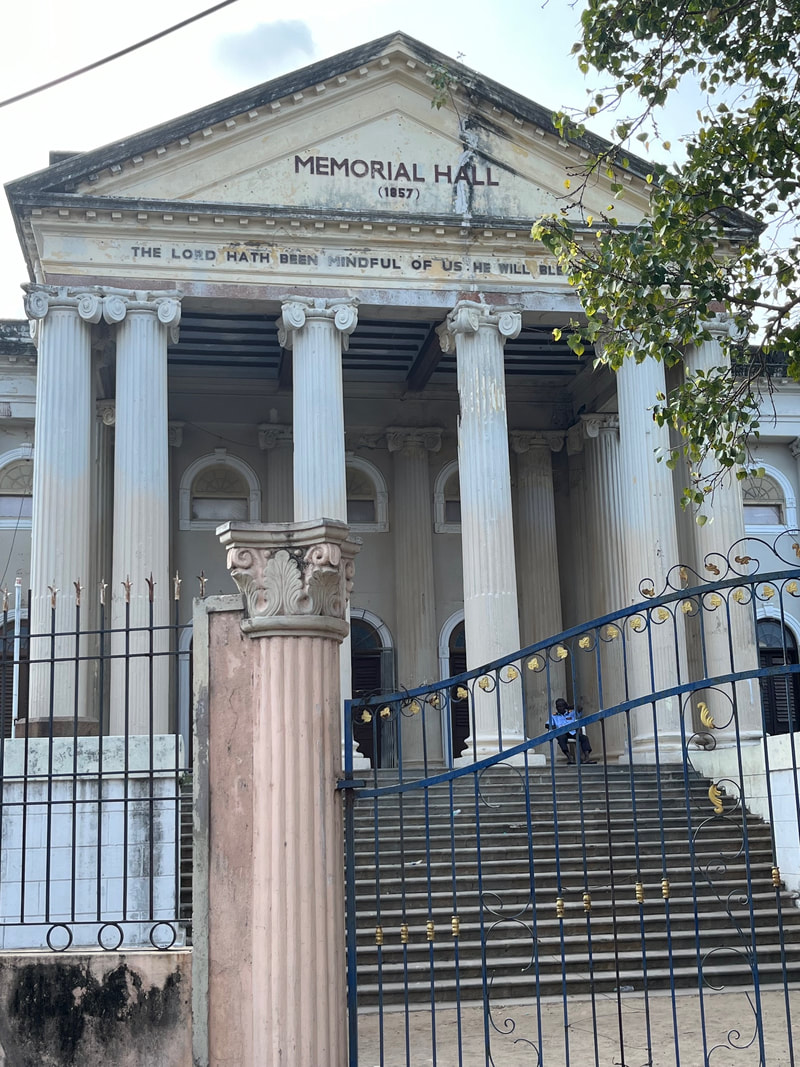 At the other end of the walk, we encountered the statue of King George V, who visited Madras in 1911, the year of the great Delhi Durbar. The king bestowed his name to what was once known as 'black town' - to distinguish it from the township where the whites lived inside the walls of Fort St George. It's now Georgetown.. A pity that a bush is growing up the royal leg - that people piss here in the morning - and get pissed here in the evening. But these are the hazards that befall forgotten emperors. 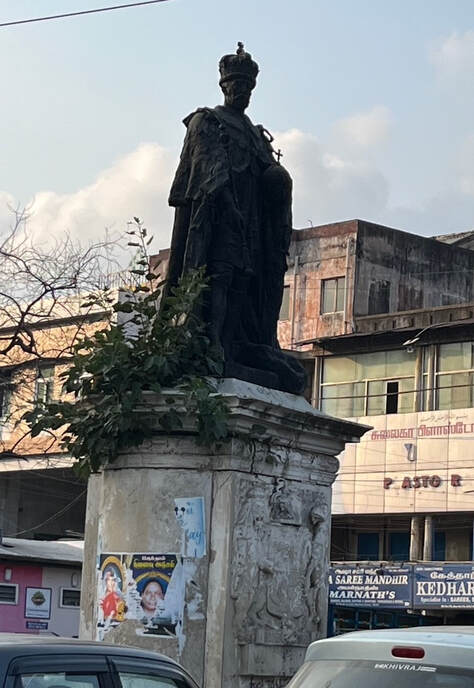 The king looks out on what was once the leading school for local boys - built about 1850, its architecture influenced by classical Greece, and now about as stranded on the tides of time as classical Greek 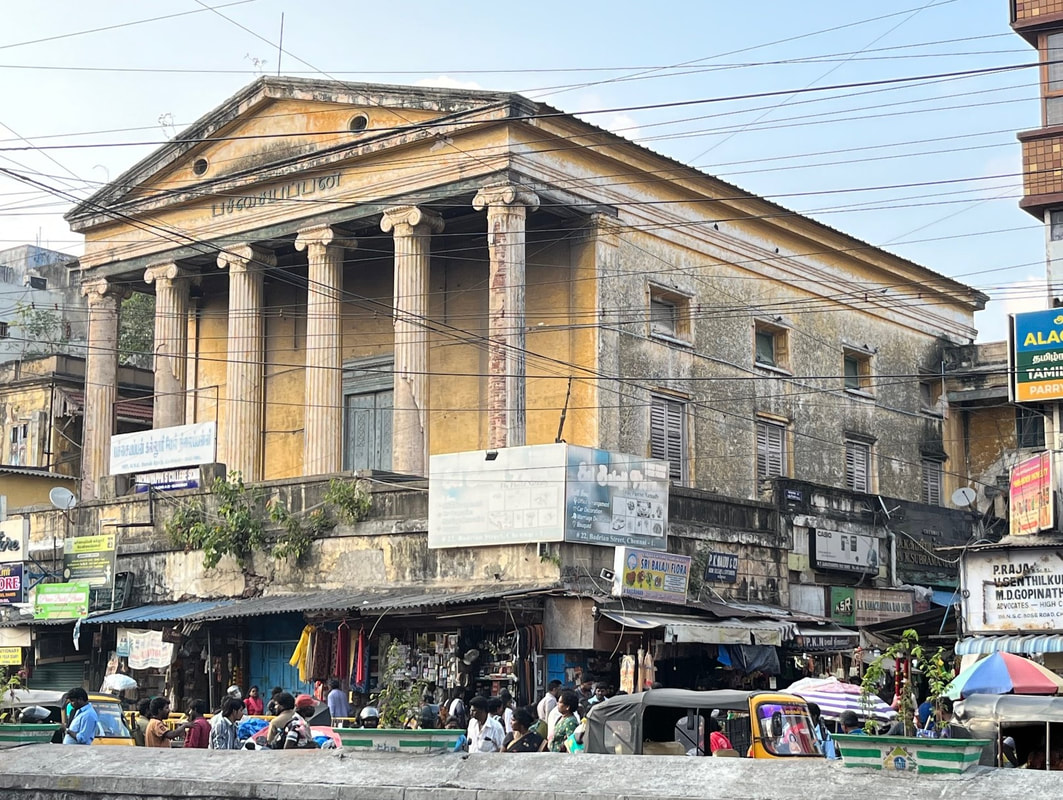 The rosewood furniture and fittings are said to be still in place inside. But as the door is firmly locked, we'll have to talk our guide's word for that. The walk was organised by Chennai Past Forward and led by the incomparable, legendary, Sriram V. Thank you, Sriram!
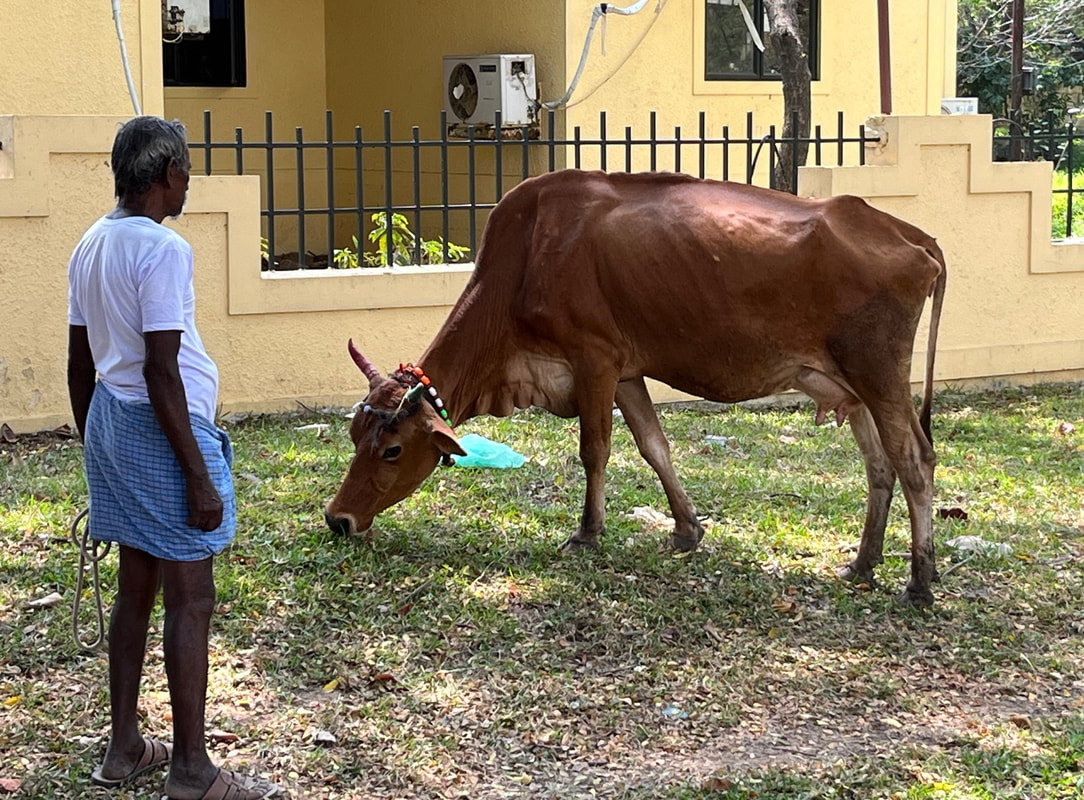 The urban cowkeeper is an occupation which is dying out in much of India. Once it was entirely normal to see a cow strolling through city streets and snacking on the rubbish which accumulates in the gutters. Now the press of vehicles, and the meagre economics of small-scale cowkeeping, have made the big city cow, and city cowkeeper, something of a rarity, at least in the country's principal urban centres.. 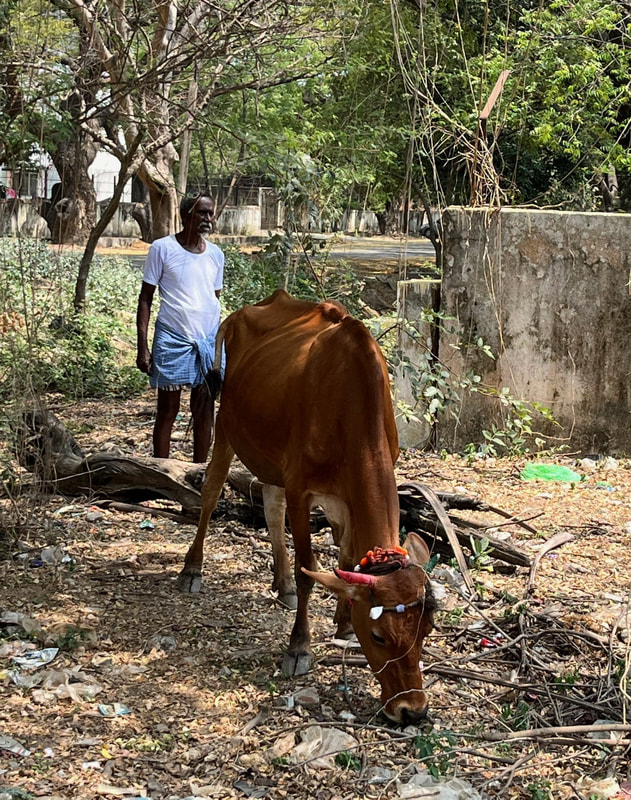 Near the college where I teach, in an area of Chennai where the roads are quiet and where there's a bit of greenery, it's still fairly standard to see cows and their keepers. It's usually a job for older men - they often are just caring for a couple of cows, and I suspect they are doing the work out of custom and habit as much as to earn a living. These two cows caught my attention because they are so clearly well cared for - with painted horns, and in one case a necklace to match. 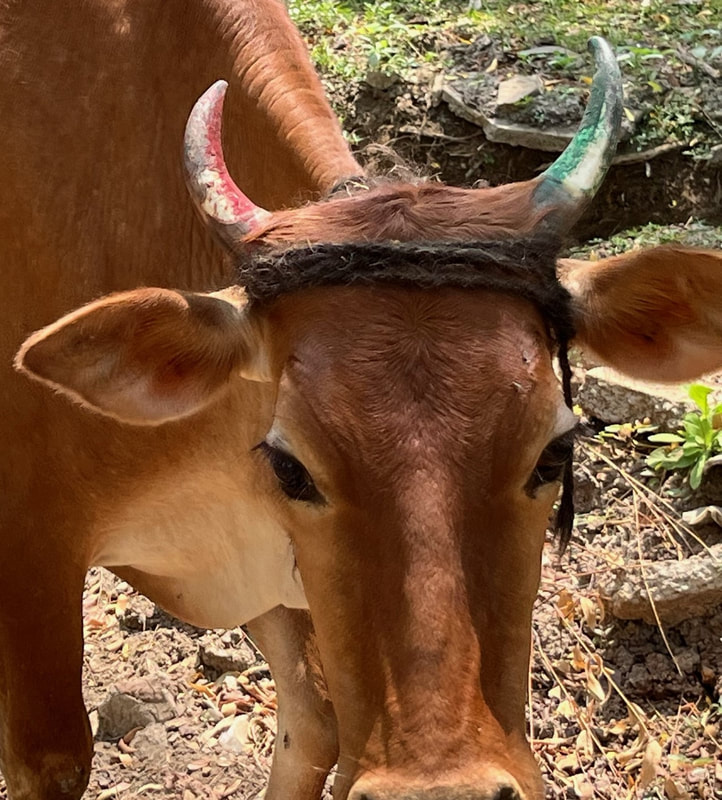 I asked what the cows were called. But my query, in basic Hindi (yes, I know the cowkeeper was almost certainly a Tamil speaker), drew the one word response: 'cow'. In English! And I never discovered the name of the cowkeeper himself. 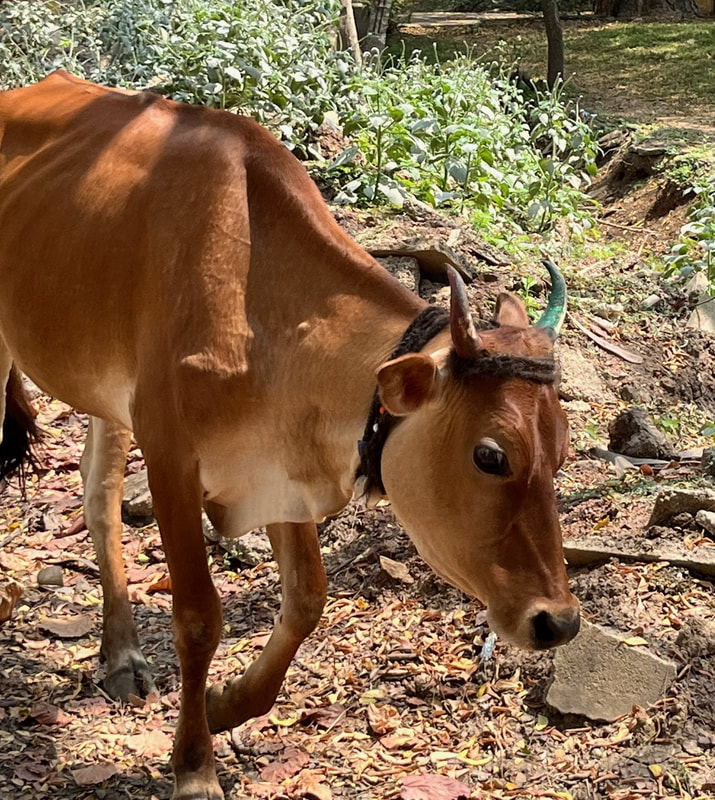 There's a little bit of grass for the cows to graze, but they also stick their noses into a lot of the rubbish which, alas, is strewn along the roadsides. Not very appetising! At least not for me - it seems to work for the cows. The two cows took divergent routes -within sight of each other but not exactly close grazing companions. But I finally managed a shot which included both beasts and their keeper. 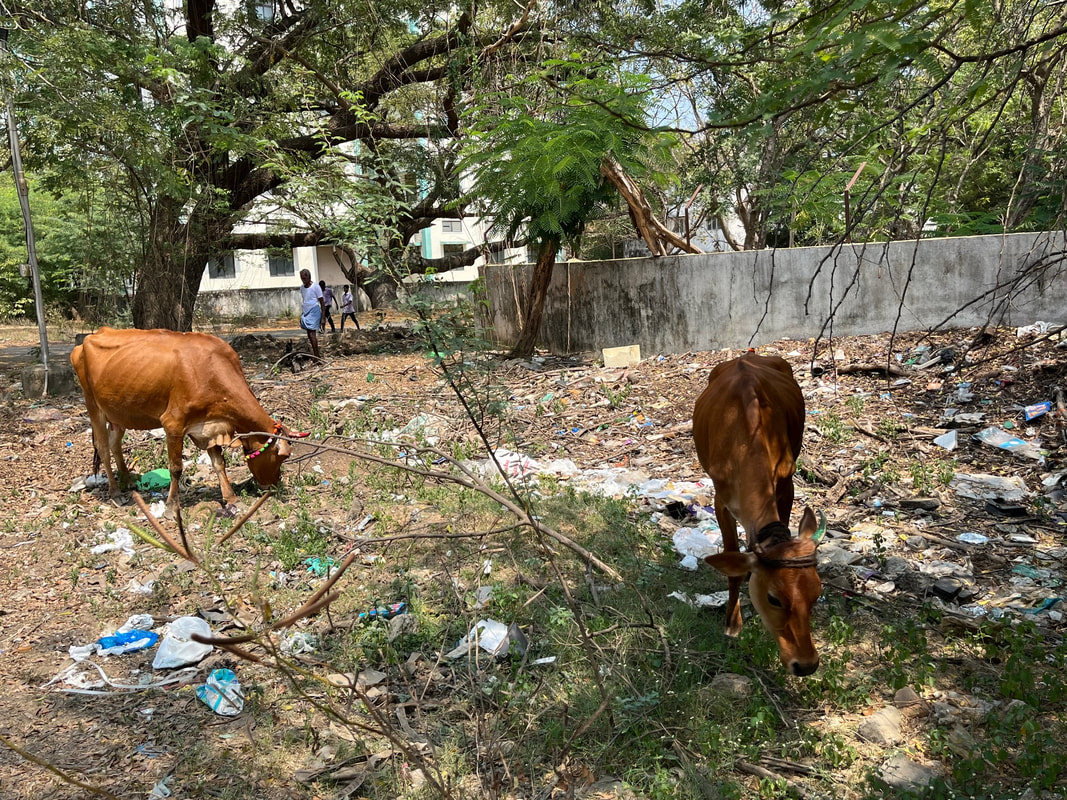
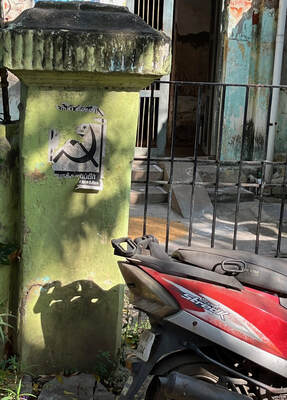
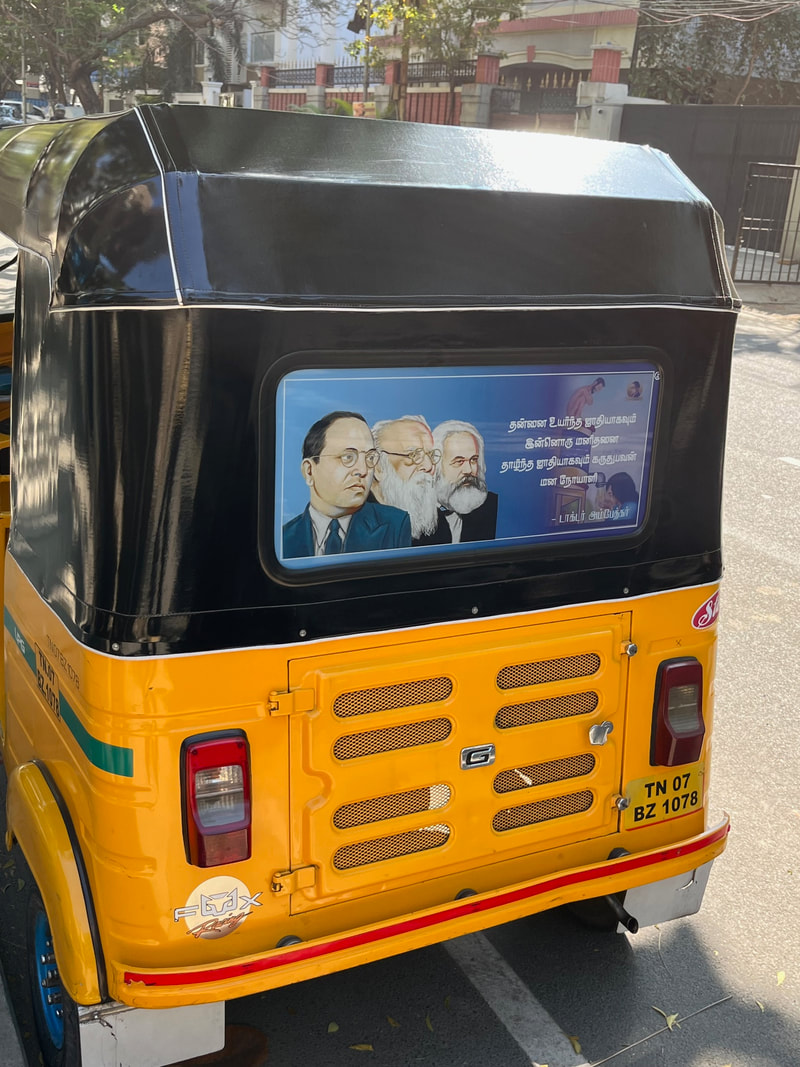
It's the small things that often bring delight. On the tiled entrance to the college where I teach, I noticed the other day something small scurrying and hopping around. I thought it was a beetle. Wrong! It was a tiny frog about the size of my thumbnail. And of course, I got my phone out and filmed it. 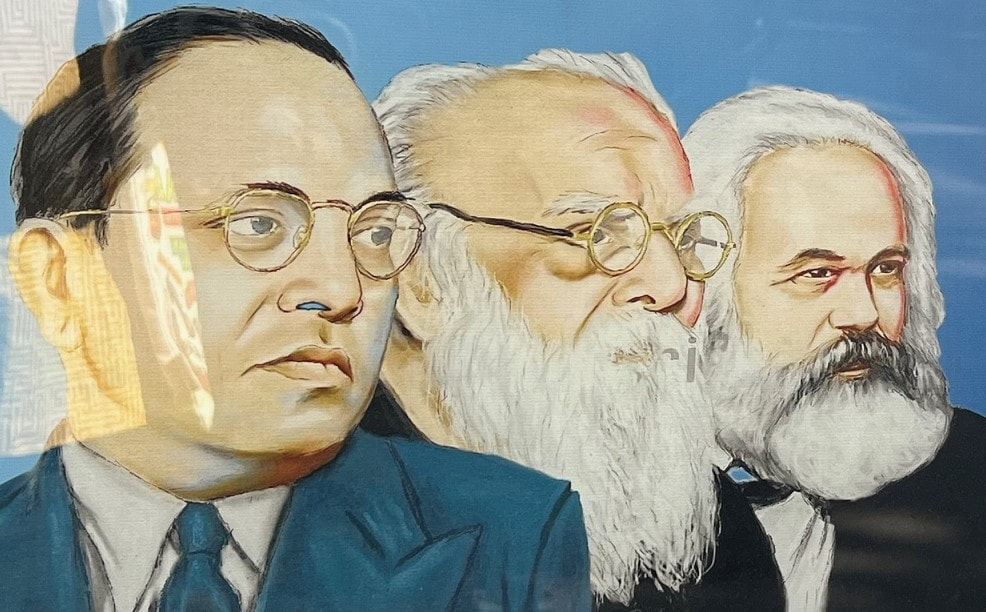 My first day back in Chennai, a wonderful city where I'm teaching for an eighth successive year. And what do I come across just outside where I am staying? This unholy trinity: Ambedkar, Periyar, Marx. 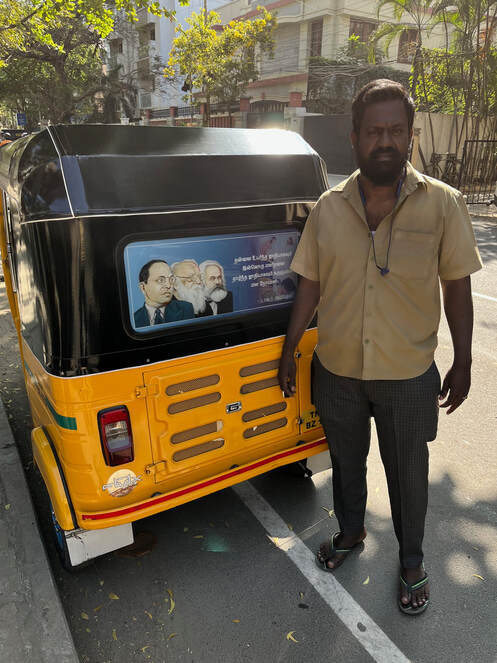 They were on the back of Ganesh's auto-rick. And he was very happy to get out of his auto - I confess I interrupted his snooze - to be photographed with his political icons. B.R. Ambedkar (1891-1956) is the great political hero of India's Dalits and a distinguished jurist who was the main figure in the drafting of India's constitution. Periyar (1879-1973) is regarded as the founder of the Dravidian moverment in Tamil Nadu, and renowned as an opponent of caste privilege and as a crusading atheist. And Karl Marx (1818-1883) is the German-born political philosopher who gave his name to Marxism and is regarded as providing the ideological foundations of communism. The quote in Tamil which accompanies the three stylised portraits is from Ambedkar. 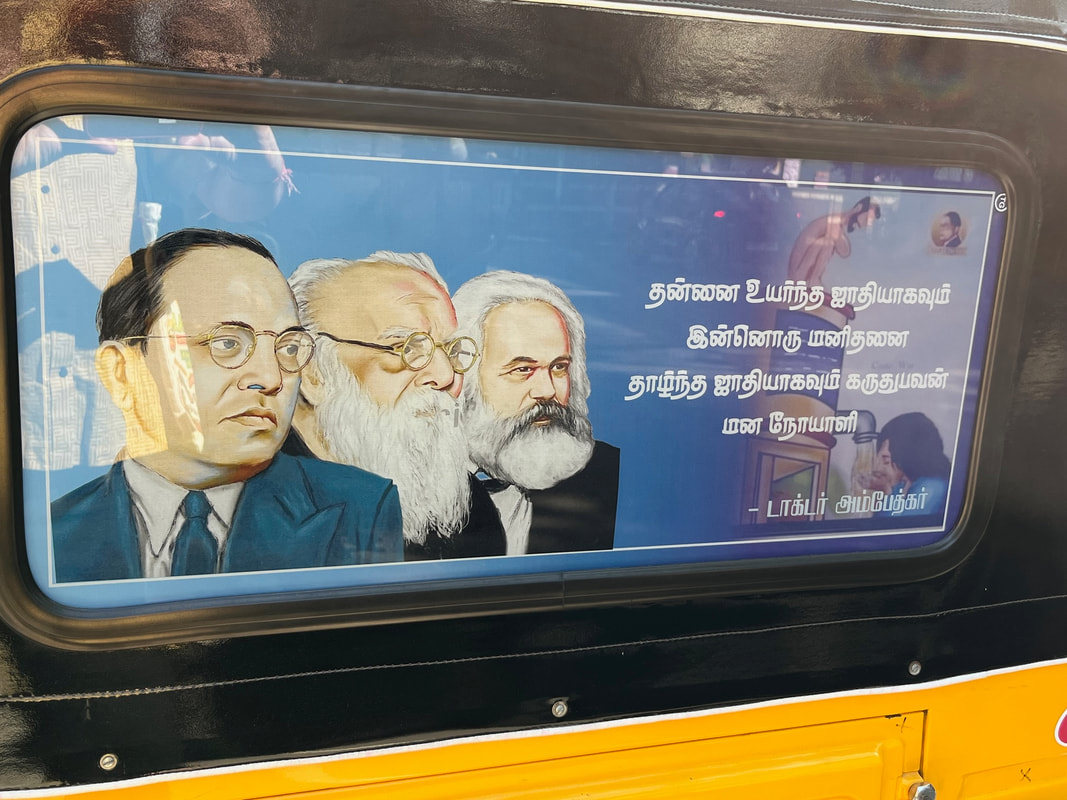 When you think of communism in India, Kerala springs to mind - the only state which currently has a communist chief minister; and also West Bengal, which was for decades a CP stronghold, though not any longer. But of the five seats in the directly elected house of the Indian Parliament currently held by the Communist Party of India (Marxist) and its rivals the Communist Party of India, four represent constituencies in Tamil Nadu. That's not because Tamil Nadu is inclining to the hard left, more a result of both parties' place in an alliance led by the DMK, the centre-left party which currently dominates Tamil politics.
To be honest, there's not much to suggest that either Marx or the hammer and sickle is making much of a mark in politics here.
But it's heartening to come across this gathering of the historical greats in an unexpected place - on the back of a Chennai auto-rick!  At Canterbury cathedral the other day, I came across this memorial. A soldier who died 'in the strict and manly discharge of his duty' in Bosenden - or Bossenden - Wood. The wood is in Kent, and it was the setting in May 1838 of what's often described as the last battle fought on English soil. The unfortunate Lieutenant Bennett was the only military casualty. 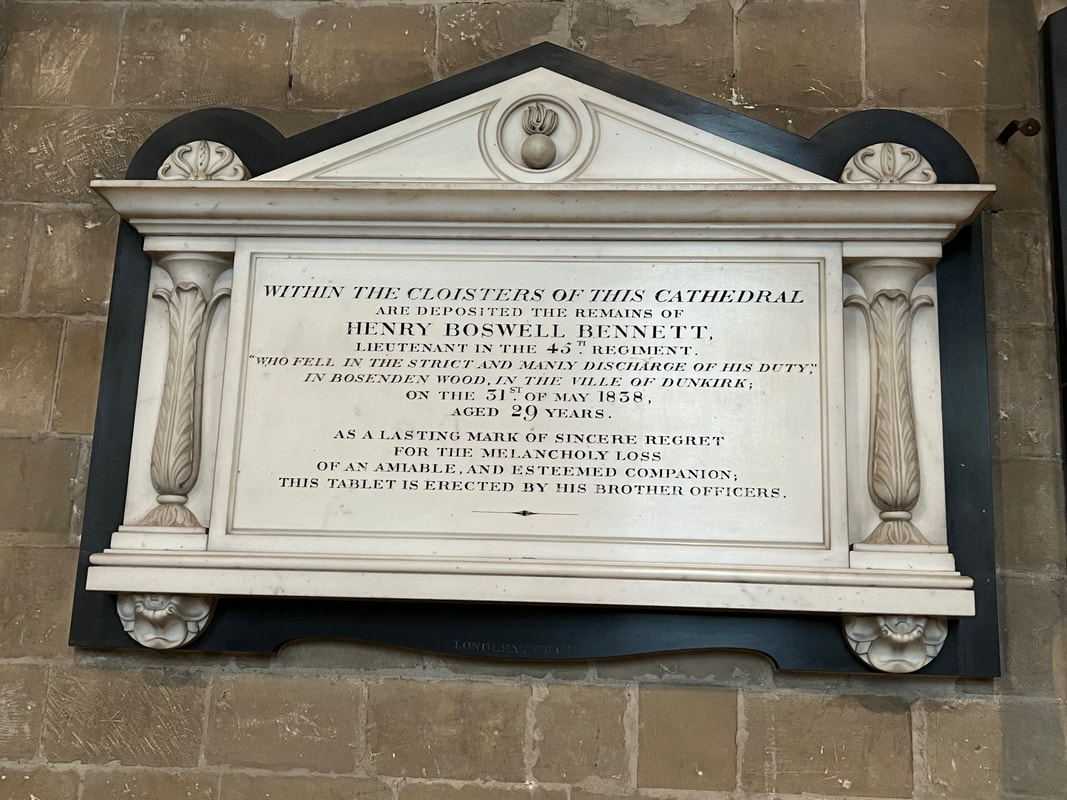 Bennett was shot by the self-styled Sir William Courtenay, who led a movement among local agricultural labourers which was in part millenarian and in part a response to new and hated Poor Laws. Courtenay had earlier shot and killed the brother of a parish constable who was trying to execute an arrest warrant. When word of that killing reached Canterbury, a detachment of about a hundred soldiers - among them Lt. Bennett - was sent to apprehend him. The Battle of Bossenden Wood lasted just eight minutes. Several dozen of Courtenay's followers took part. Having shot Bennett, Courtenay was himself killed, as were eight of his supporters, 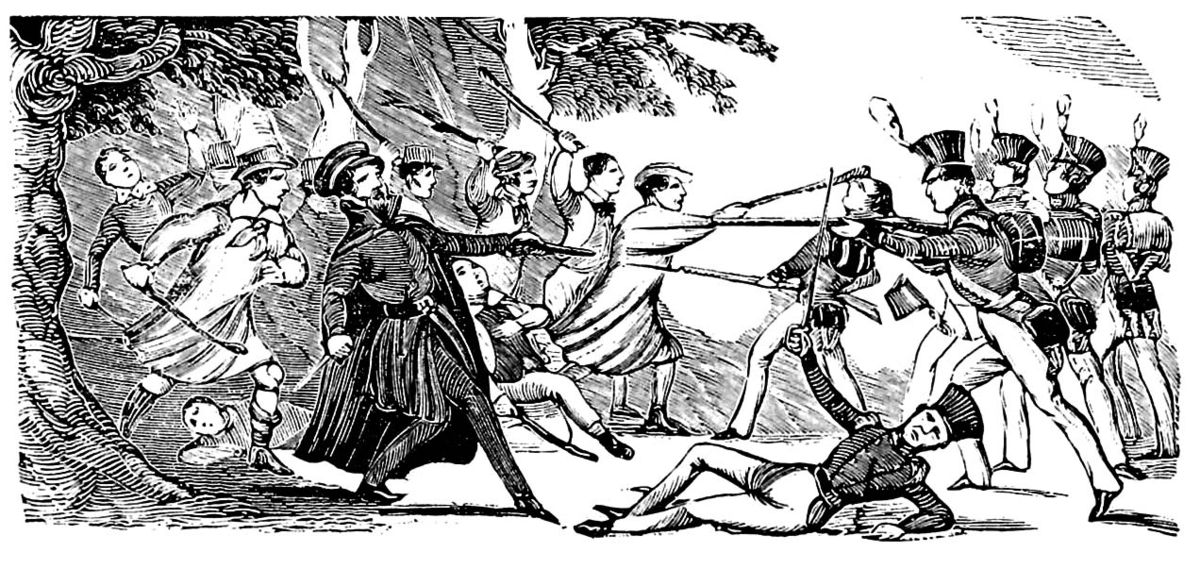 Among the band of malcontents, only Courtenay (real name John Nichols Tom) and perhaps one of his followers had firearms; the rest were armed with nothing more than sticks.
So this was hardly Waterloo - but it's where England's long and forlornly unsuccessful tradition of armed uprisings met its Waterloo,
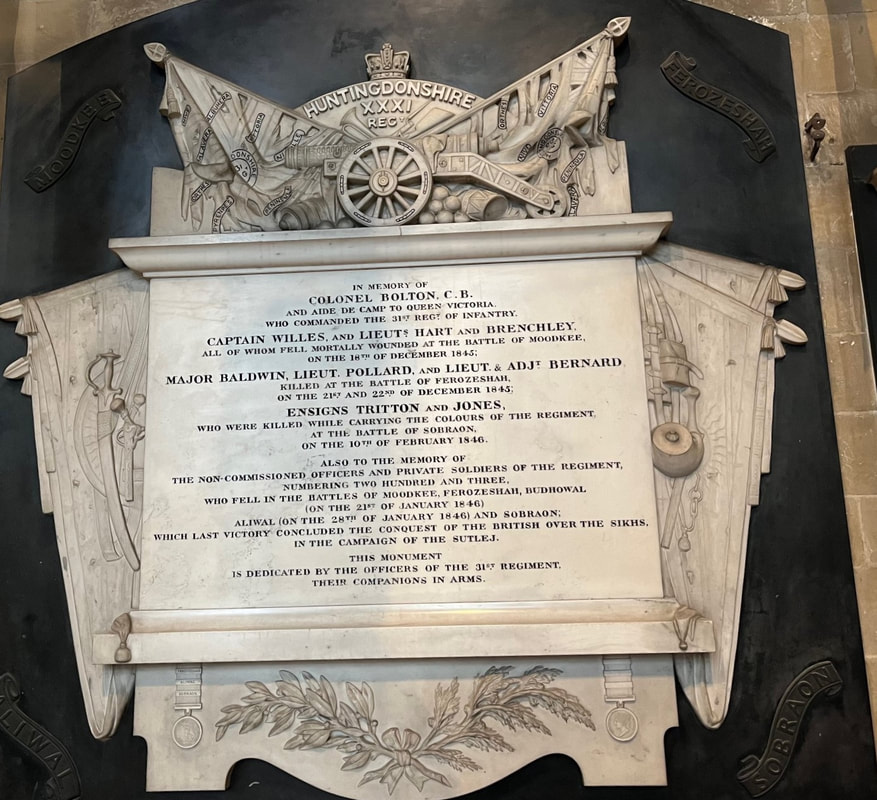
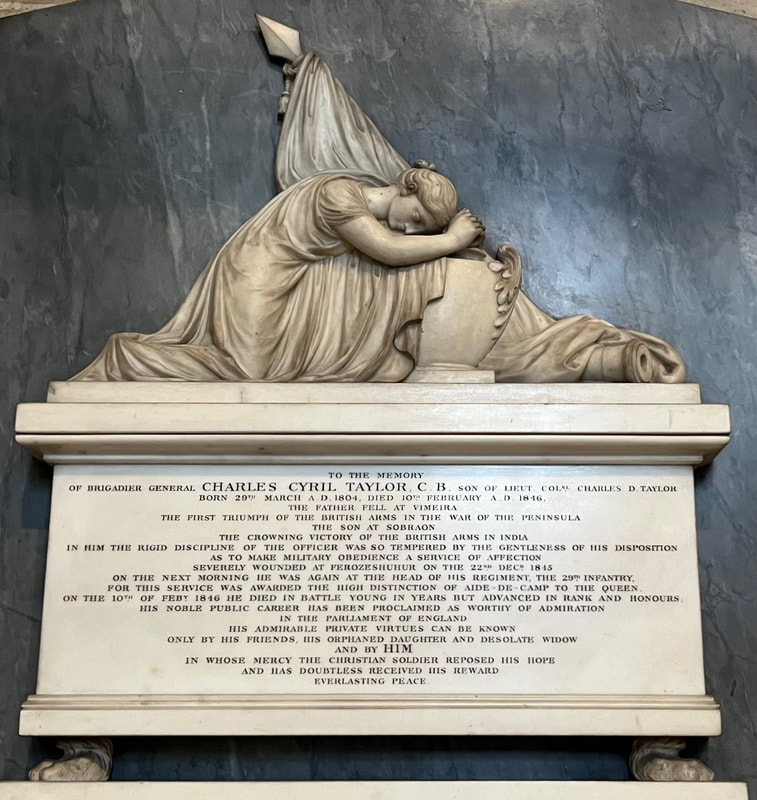
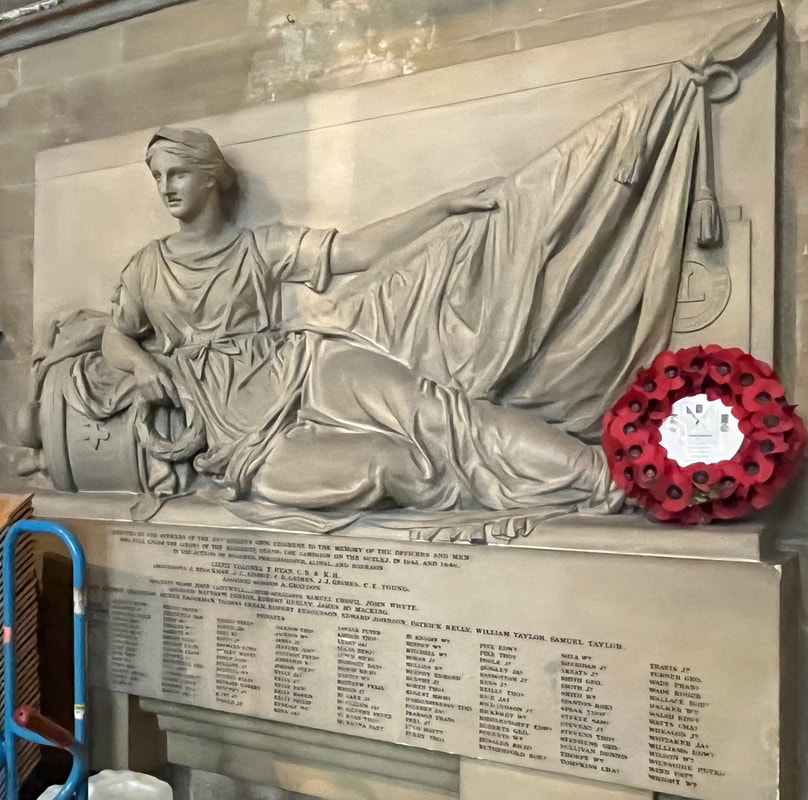
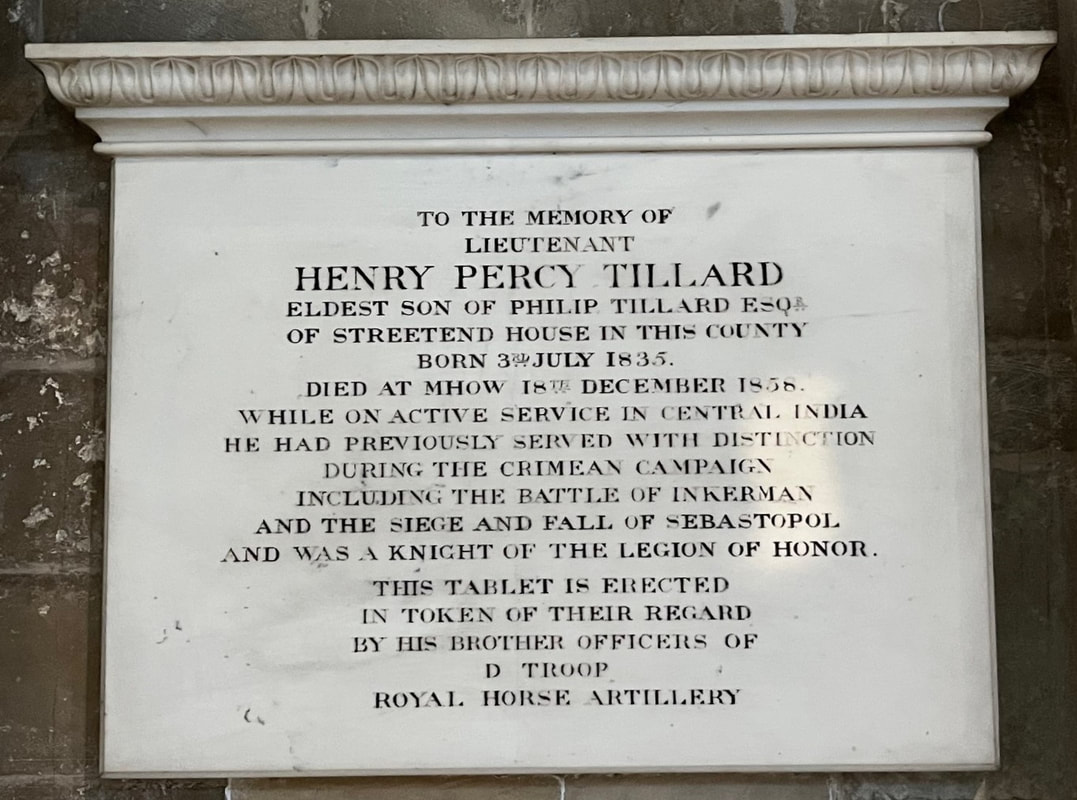
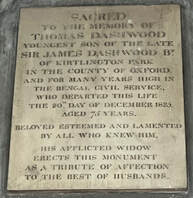
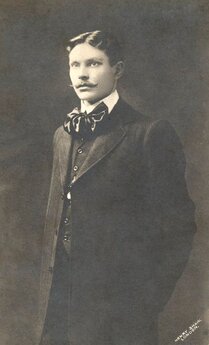 Fritz Svaars Fritz Svaars It’s taken more than a century for Fritz Svaars’ last letter to reach his family in Latvia. He wrote it a day or two before his death while hiding in a lodging house in London’s East End. Svaars was a Latvian political exile, an anarchist, wanted for his role in the murder of three London police officers during a botched robbery attempt. His letter home was both an extenuation of his conduct and a farewell. ‘[T]hey are looking for us everywhere’, he wrote – the ‘whole of London is buried in police’. He knew the chances of escape were slim. ‘Two weeks I’ve been on the run. How much longer I can manage, I don’t know’, Svaars scribbled. ‘If I’m lucky then I’ll still live and I’ll share joy and sadness with you, and if not, you also know that at some time that same hour will come to you and you’ll be ashes the same as everyone.’ 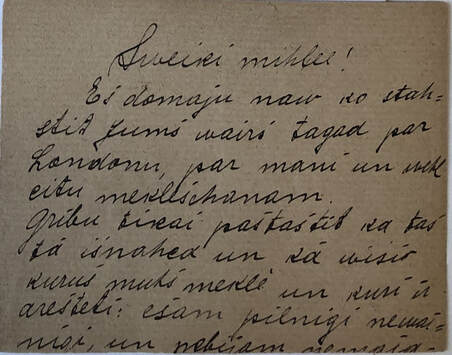 Part of Fritz Svaars' final letter - London Metropolitan Archive As a precaution, Svaars placed the letter in an envelope addressed in Latvian, contained in another envelope with an address written in Russia, the language of Latvia’s then rulers. He entrusted this letter to a comrade to send back to the Baltic. That comrade was an informer. He handed over the letter to the police and also passed on word of where the two wanted men were hiding - in a second floor room at 100 Sidney Street in Stepney. That led – on 3rd January 1911 - to the most sensational shoot-out in London’s history. Two gunmen with semi-automatic pistols and a seemingly inexhaustible supply of ammunition kept police and troops at bay for six hours in what became known as the Siege of Sidney Street. Bullets ricocheted off the walls; East Enders thronged in their thousands to catch a glimpse of the drama; reporters secured a vantage point on the roof of a local pub; as many as five newsreel operators filmed silent footage of the encounter. Winston Churchill, then the Home Secretary, rushed top-hatted to the scene. When the besieged house caught fire, Churchill personally forbade the fire brigade from dousing the flames. The charred remains of Svaars and his fellow gunman were found amid the embers. He had died of smoke suffocation. 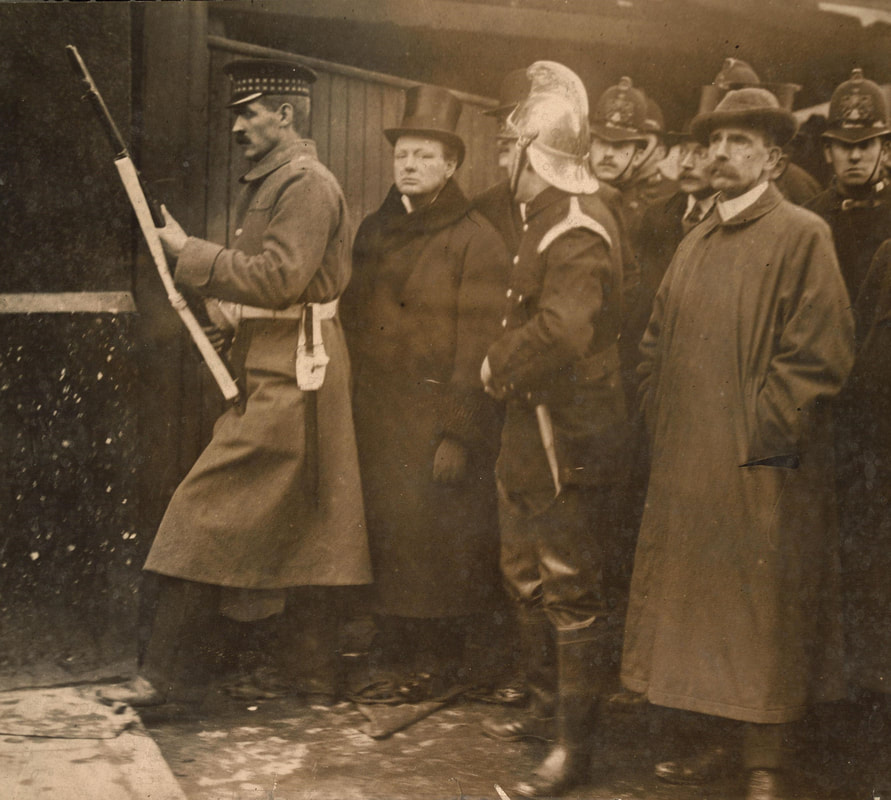 Winston Churchill with top hat at Sidney Street - Illustrated London News Svaars’ six-page handwritten letter is now lodged in the London Metropolitan Archive, amid the voluminous archives of the City of London Police. These police records are the main source for my book, A Devilish Kind of Courage: Anarchists, Aliens and the Siege of Sidney Street. Two weeks before the shoot-out, City police had interrupted an attempt by an armed gang to burrow into a jeweller’s shop in Houndsditch. The robbers shot their way out, killing three police officers and seriously injuring two others – the worst single incident in the history of London’s police. The gunmen also inadvertently shot and injured one of their gang, George Gardstein, who died the following morning in lodgings shared by Fritz Svaars and another of the anarchist group known only by his assumed name of Peter the Painter. 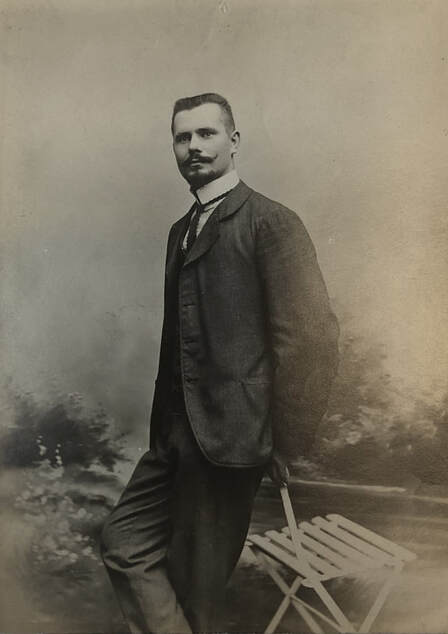 Peter the Painter - London Metropolitan Archive Many of the photographs and other documents seized by the police as they searched suspects’ rooms are among the police records. The images are bewitching. Among them are studio photographs of young men and women taken in what is now Poland, Ukraine, Belarus or Latvia – frustratingly, almost all are unlabelled, though a few have brief jottings in Latvian, Russian or Yiddish. 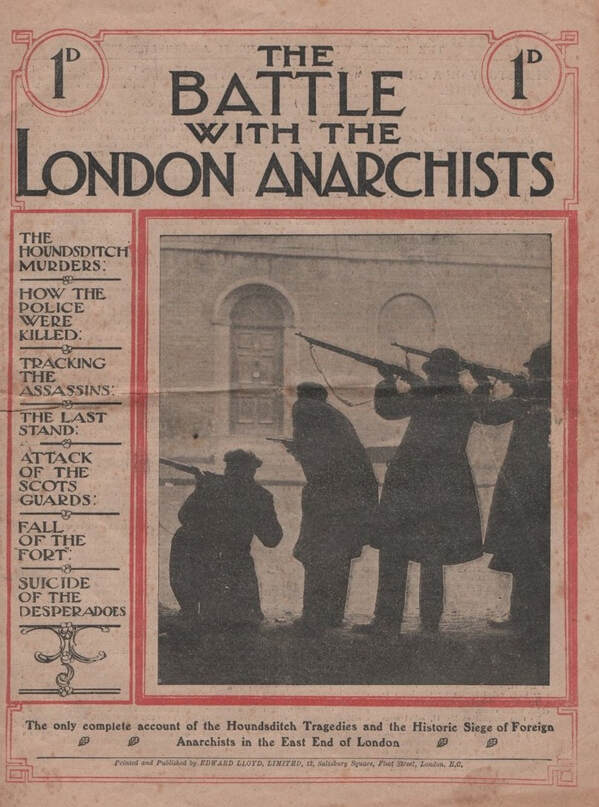 I had the good fortune to have a friend, Tania, who spoke Latvian. She helped me to translate the Latvian inscriptions on some of the photos. Then, as the book was going to press, she got in touch with exciting news. She’d just been in the Latvian capital, Riga, and by chance she had met a woman who was related to Fritz Svaars (known in the Latvian style as Fricis Svare). 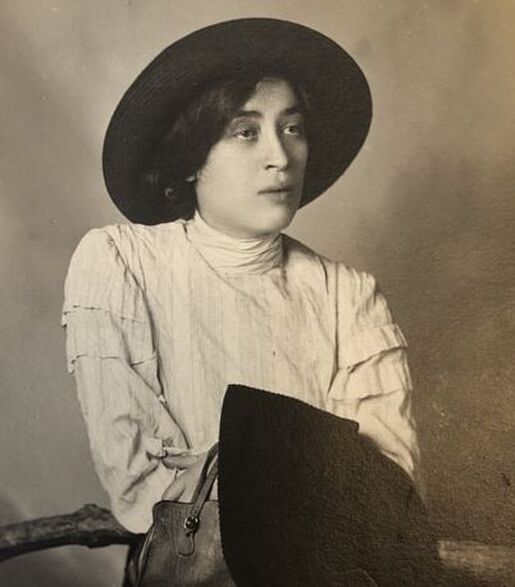 Luba Milstein, who lived with Fritz Svaars in London - London Metropolitan Archive Over Zoom, Liene, an estate agent in Riga, and her mother, Margarita, a maths professor, told me of their connection to the Svaars family. Margarita is the great-granddaughter of Fritz’s sister, Olga – the older woman had helped care for Margarita when she was a young child. The family still has a bible inscribed by Fritz’s father, a policeman, and a rich cache of sepia-tinged photos. As Margarita was growing up, no one spoke much about Fritz. Family elders said he had been ‘lost in the war’ – though they never said which war or where and how he died. During the decades that Latvia was under Soviet rule, loose talk about an armed anarchist forbear could bring unwelcome attention. Once Latvia gained independence in the early 1990s, there was more scope to talk about the past. Margarita became aware that one of her relatives had been a Latvian nationalist and leftist, a rebel, who met a violent death abroad. 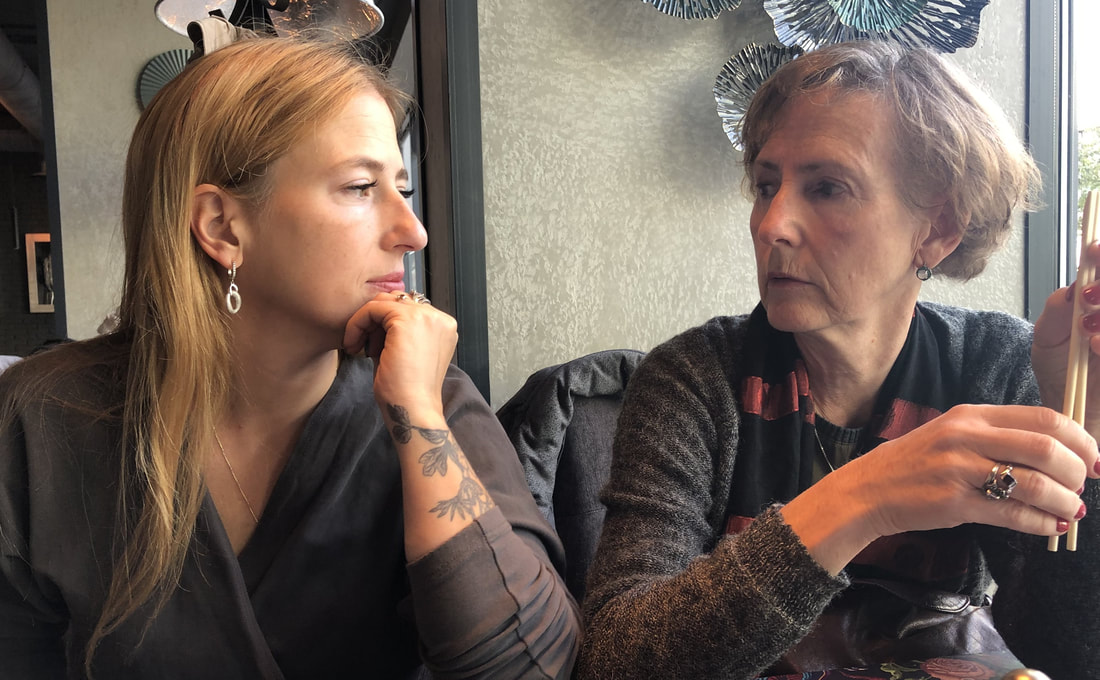 Liene (left) and Margarita - photo: Andrew Whitehead Although my book was written and ready to publish, with no prospect of including more than the briefest mention of the family in Riga, I wanted to see Liene and Margarita – and to give them a copy of Fritz’s plaintive and painful letter. It was about time that missive was delivered to its intended recipients. We met in a smart Chinese restaurant in Riga, a city of great architectural distinction in spite of the wars repeatedly waged over it. Margarita and her daughter shared what they knew of Fritz – that he had been active in Latvia’s unsuccessful revolution in 1905, which demanded both social justice and an end to the rule of the Russian Tsar, and that like so many young Latvians of that era he was forced to flee. Margarita struggled at first with the archaic form of Latvian that Fritz wrote in. ‘The letter has a feeling of doom’, she said having managed to make sense of it. ‘There’s a feeling of likely death – a sense of fear. It’s quite depressing.’ 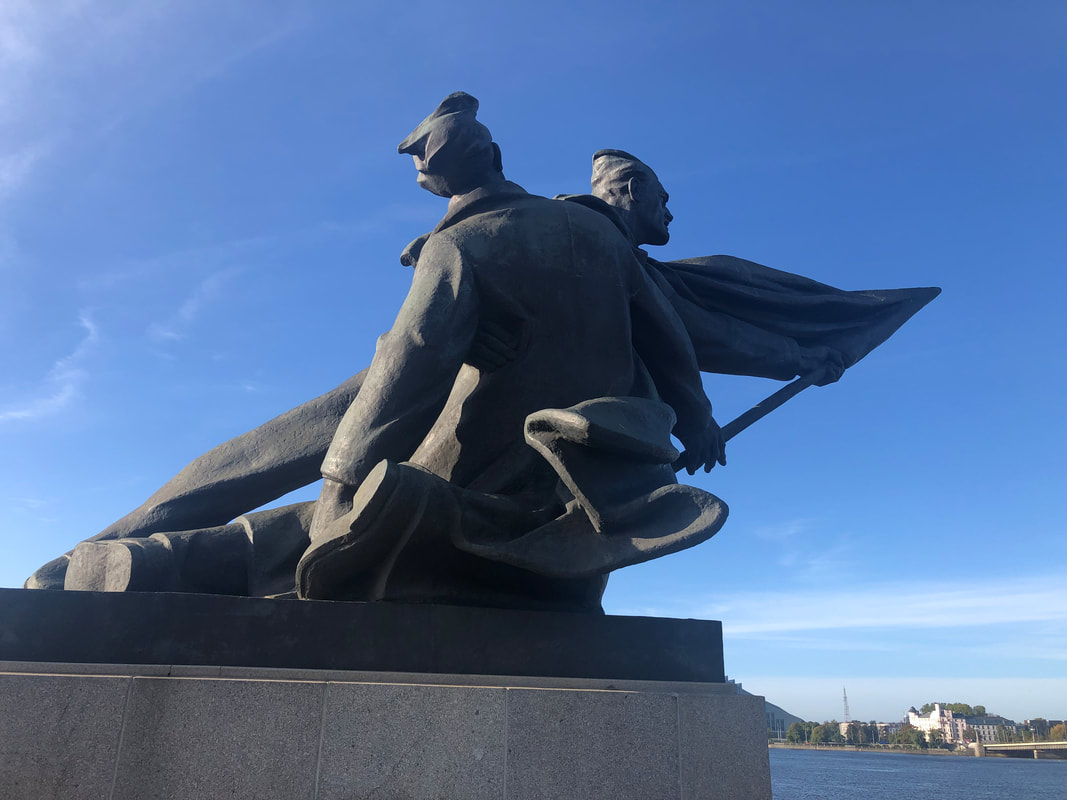 Monument in Riga to the dead of the 1905 Revolution - photo: Andrew Whitehead Liene and Margarita are neither proud nor ashamed of their gun-toting forbear. It’s part of Latvia’s tormented twentieth century history – a nation repeatedly occupied and fought over. They were anxious to understand more about Fritz and his comrades, what propelled them to become gunmen, why they were in London and how he died. I promised them they would be the first to get a copy of my book. It’s on its way. 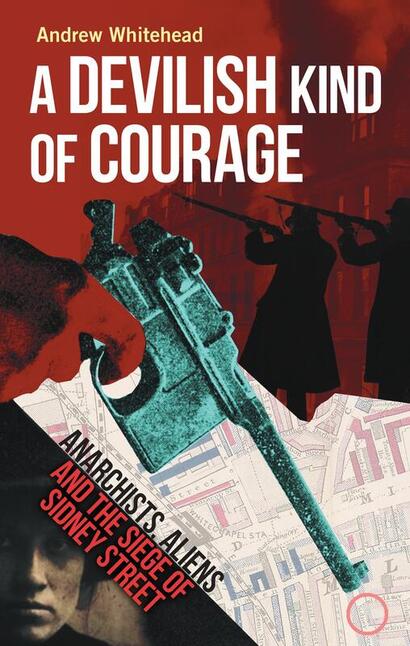 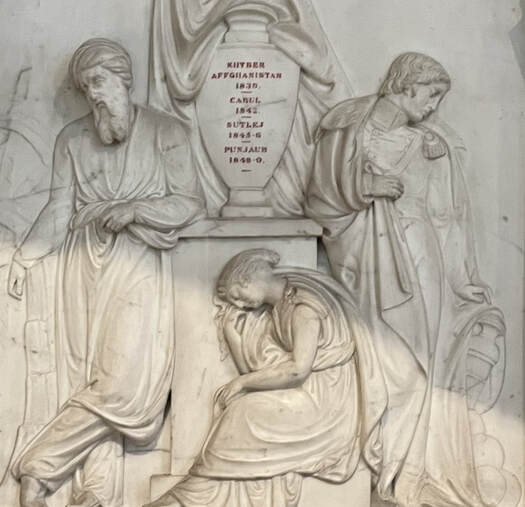 I went to Canterbury Cathedral today for the first time in many years. And walking round this august and ancient church, undeniably beautiful and sacred, I was struck by how many of the plaques and monuments harked back to the era of the Indian Raj. 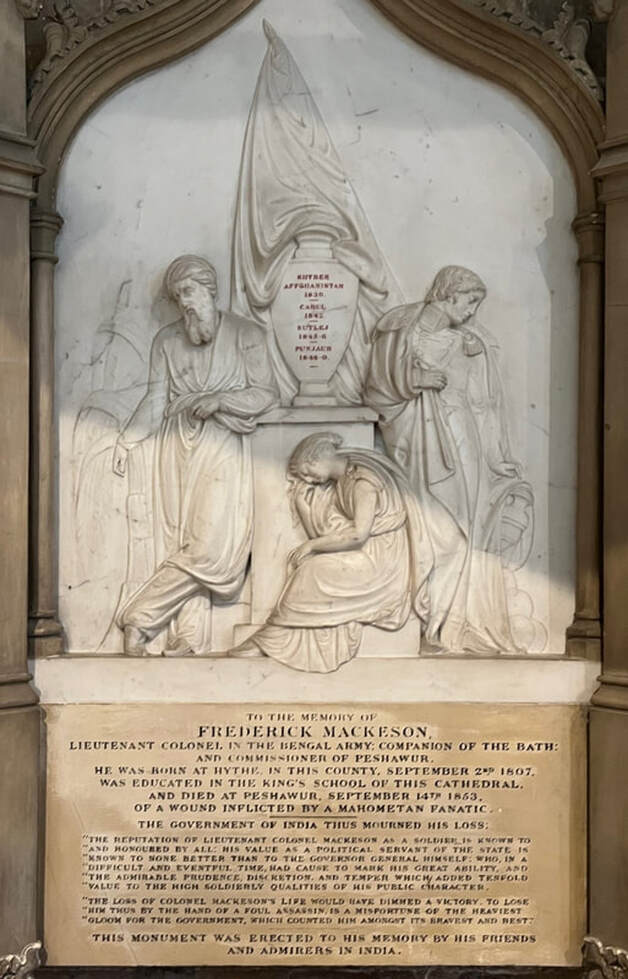 So many regimental and personal memorials make reference to Punjab, Bengal, Afghanistan - here they all are. Look on them, and weep. 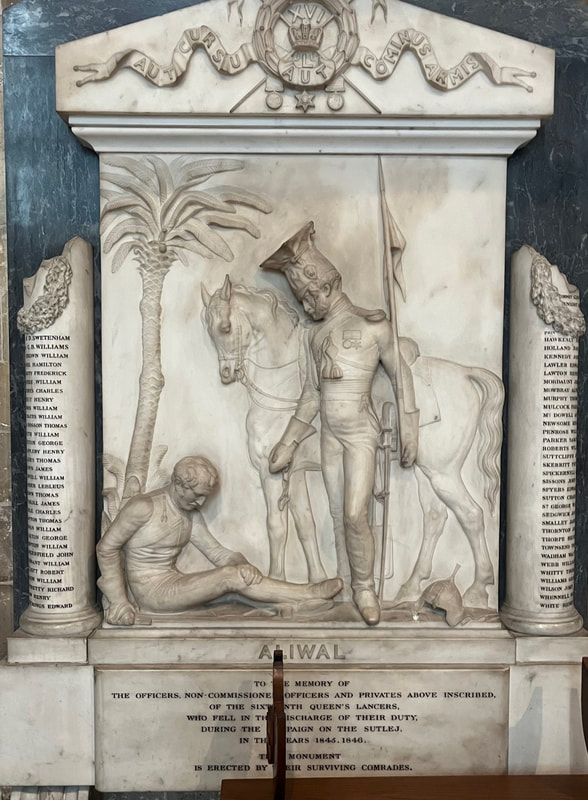 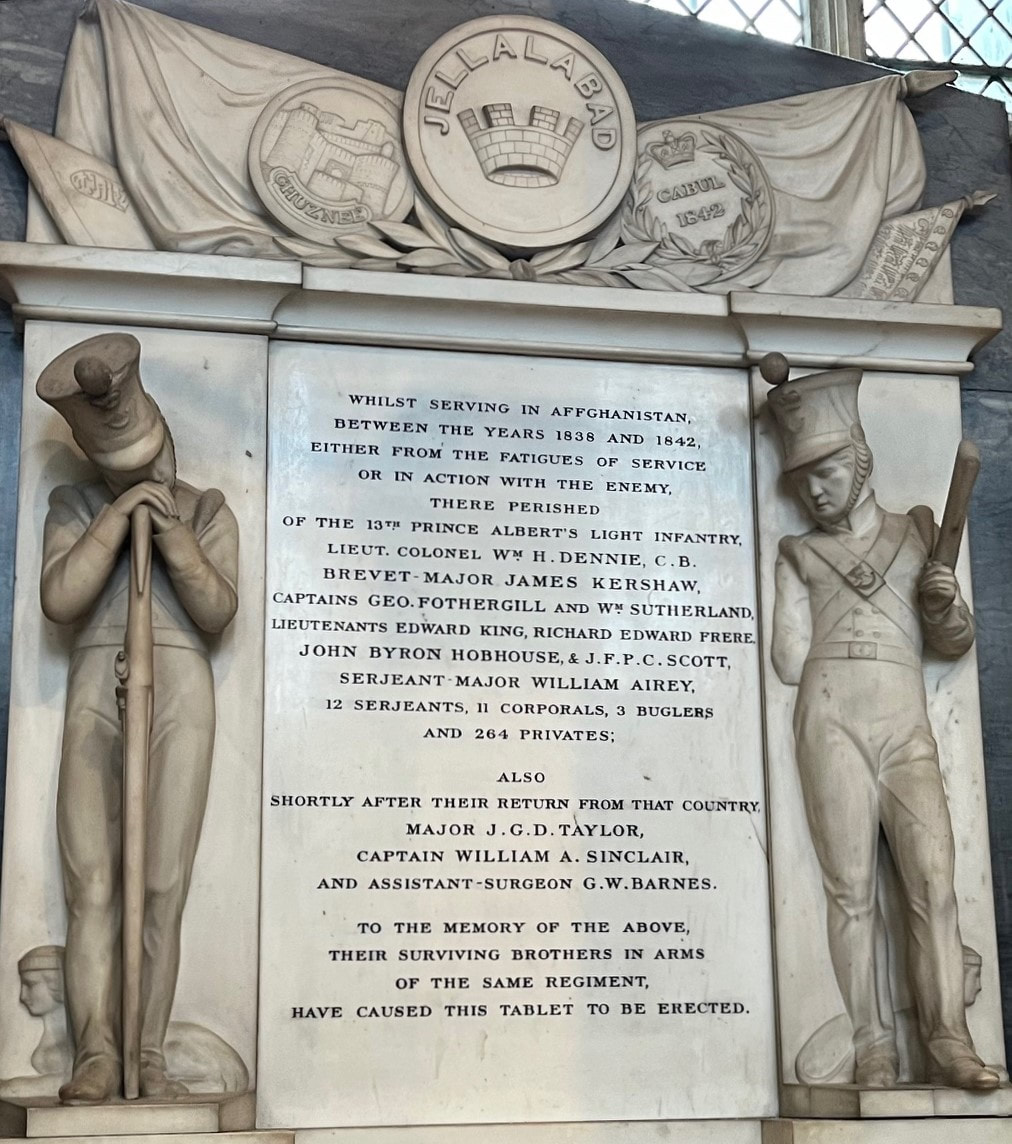 It brought to mind this old and splendid verse: I met a traveller from an antique land Who said: Two vast and trunkless legs of stone Stand in the desart. Near them, on the sand, Half sunk, a shattered visage lies, whose frown, And wrinkled lip, and sneer of cold command, Tell that its sculptor well those passions read Which yet survive, stamped on these lifeless things, The hand that mocked them and the heart that fed: And on the pedestal these words appear: "My name is Ozymandias, king of kings: Look on my works, ye Mighty, and despair!" Nothing beside remains. Round the decay Of that colossal wreck, boundless and bare The lone and level sands stretch far away. — Percy Shelley, "Ozymandias", 1819 edition 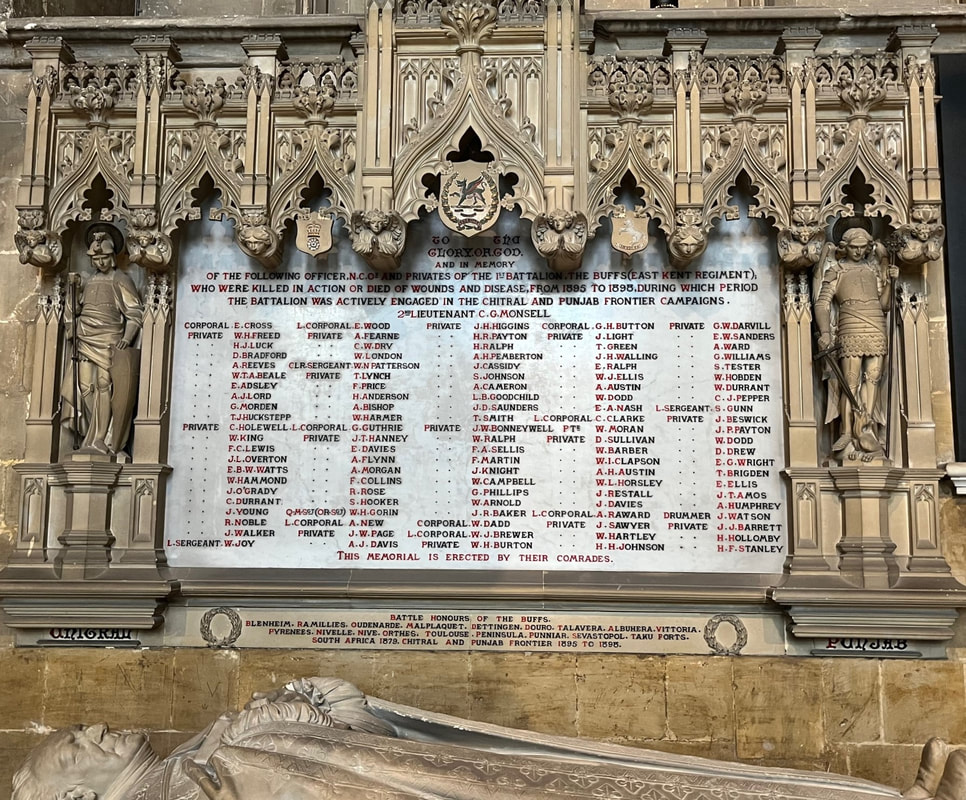 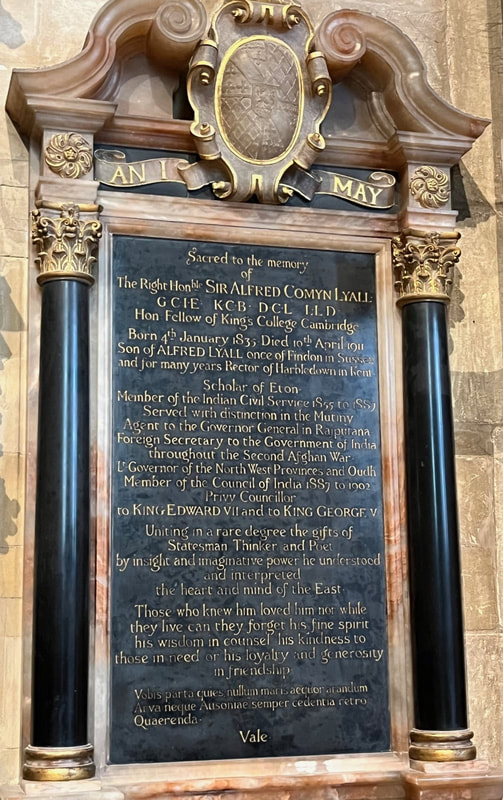 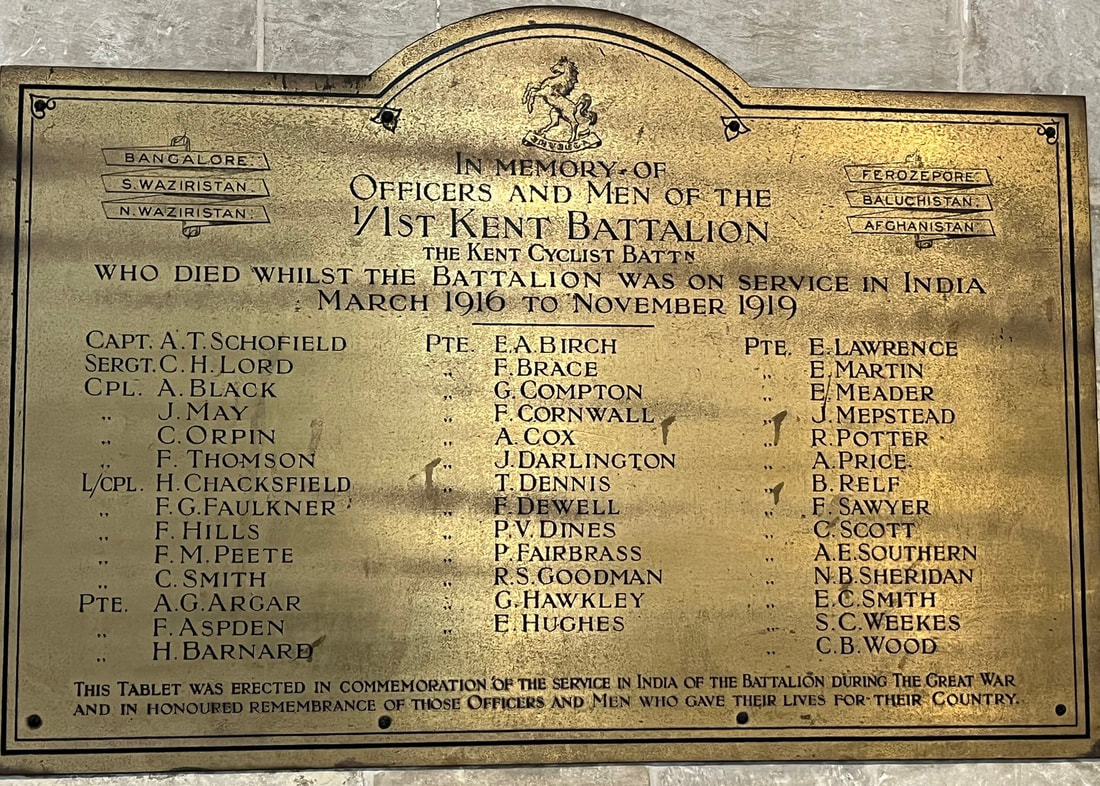 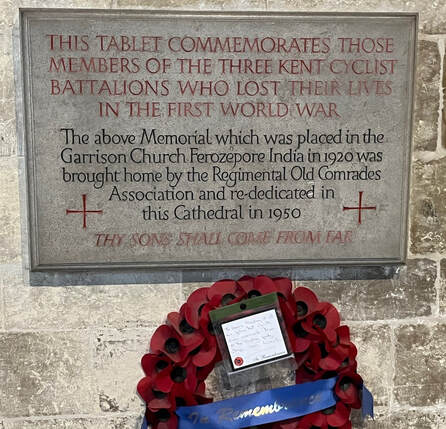
   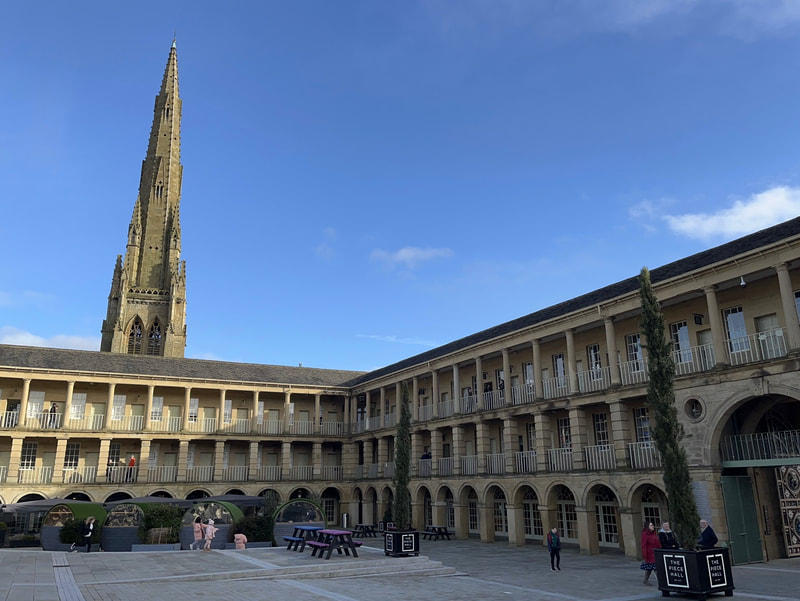 This is simply sublime! I can't think of a more commanding piece (no pun intended) of Georgian architecture. The Piece Hall at Halifax in West Yorkshire opened in 1779. Hundreds of small cloth manufacturers, handloom weavers, each had a room here which they used to sell pieces of cloth. It survives not simply in tact - a huge courtyard with galleried rooms on all four sides - but in a splendid state of conservation. The Piece Hall is more 'Gentleman Jack' than 'Last Tango'. And it is much used - there are shops and restaurants, it hosts music events, it's at the heart of today's Halifax. 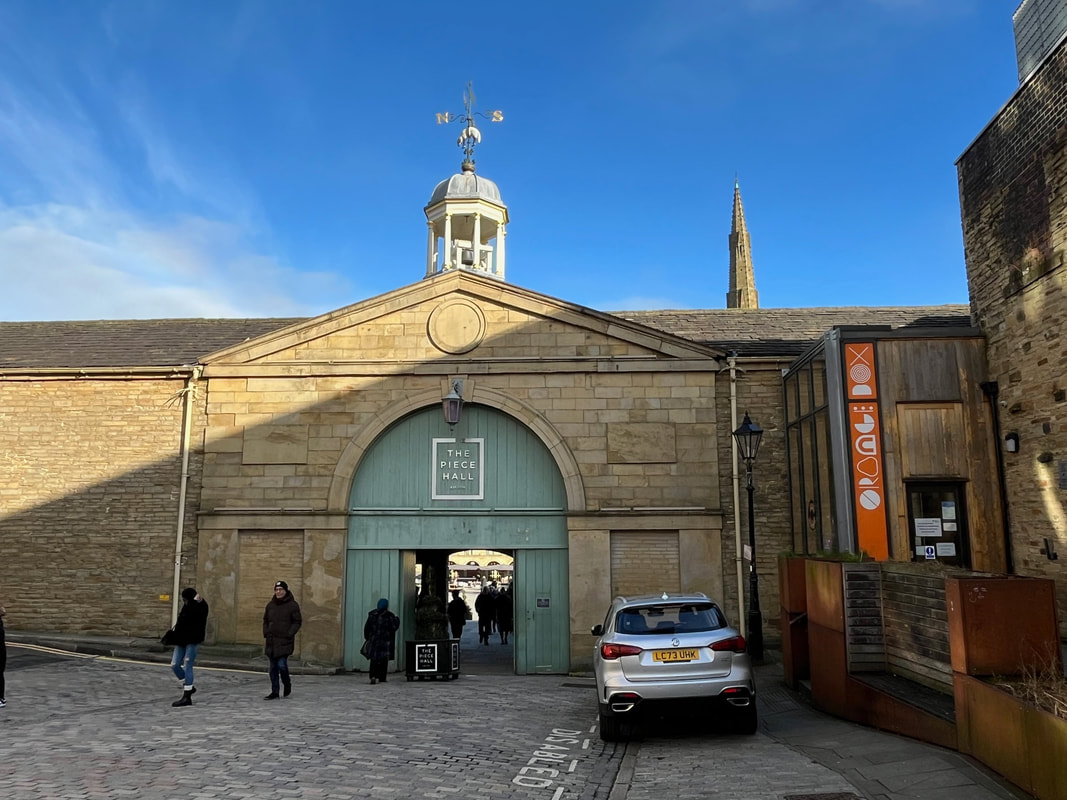 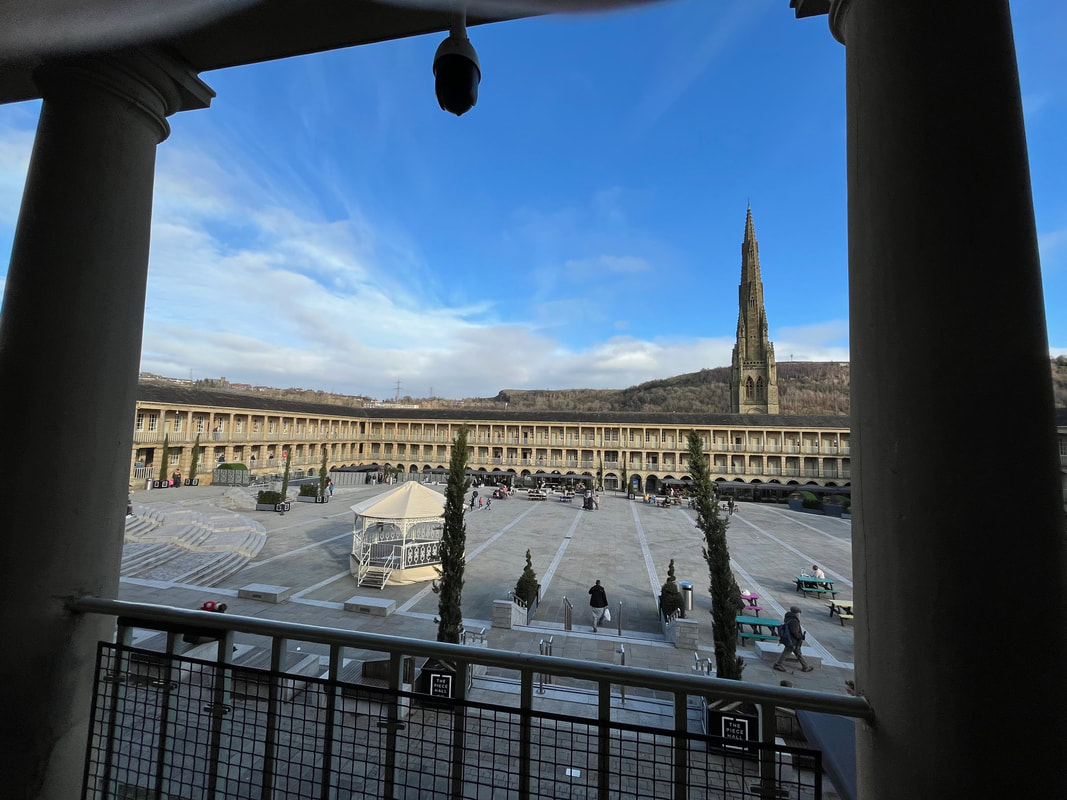 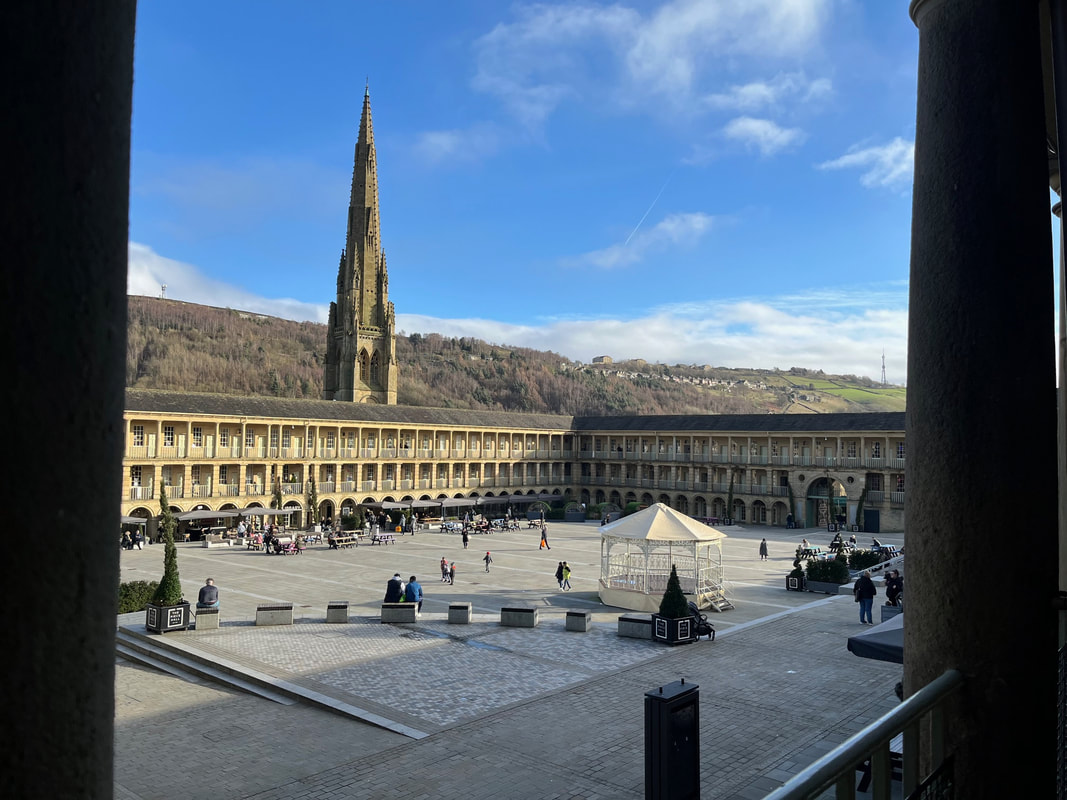 Halifax has many other fine buildings - on a sunny day, it's a real pleasure to walk round. The town hall is a touch wacky - opened in 1863 and designed by Charles Barry, (in)famous as the architect responsible for the Houses of Parliament. 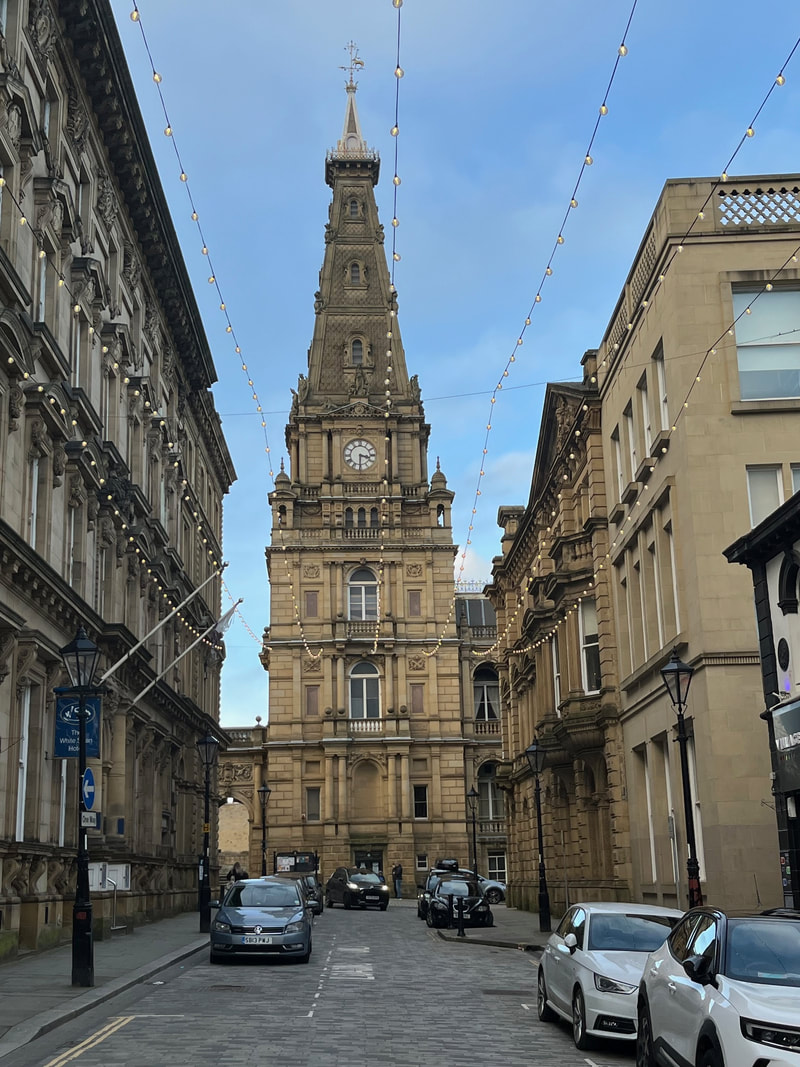 The town hall stands on Crossley Street. Crossleys carpets - once the biggest carpet manufacturer in the world - used to dominate the town. Sadly Crossleys' home, Dean Clough Mills, built from the 1840s, closed in 1983. Happily, the mills were saved from demolition and have been repurposed. And they are awesome - imposing and magnificent. My father's career was in carpets and he worked for a while at Crossleys in Halifax. So I was pleased to see Dean Clough still shadowing over the town. 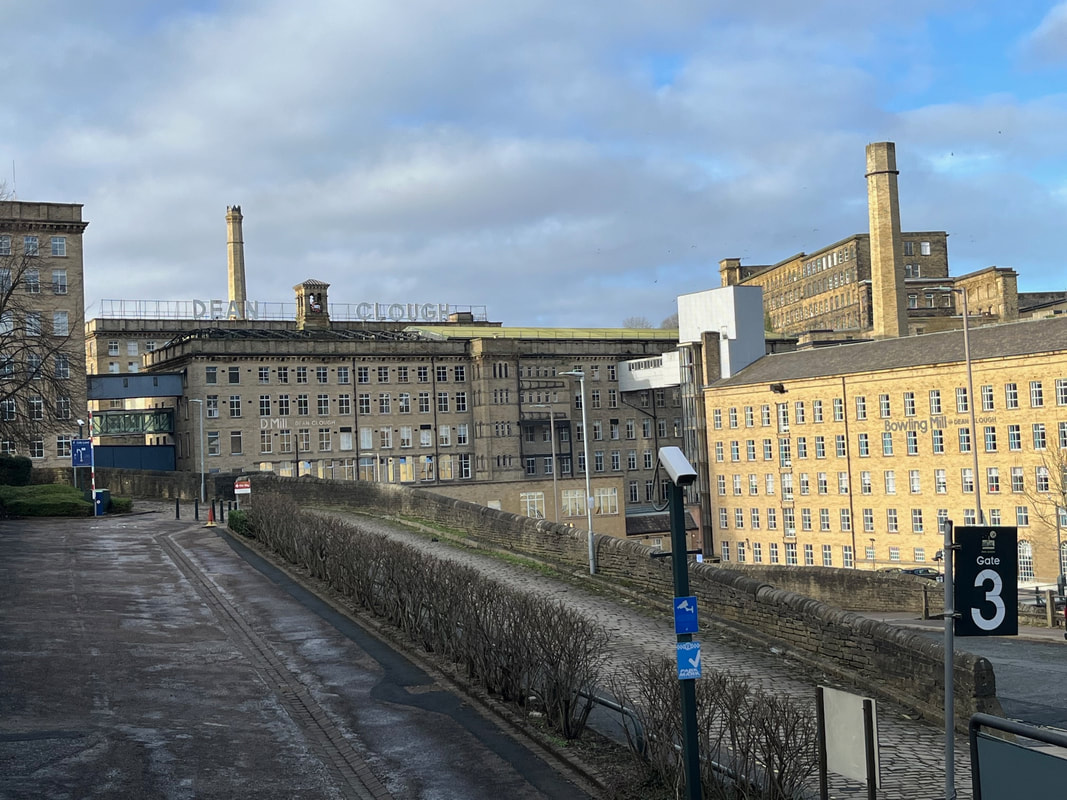 |
Andrew Whitehead's blogWelcome - read - comment - throw stones - pick up threads - and tell me how to do this better! Archives
April 2024
Categories
All
|


 RSS Feed