'Curious Kentish Town'
|
Which Kentish Town rent strike inspired a Peggy Seeger song?
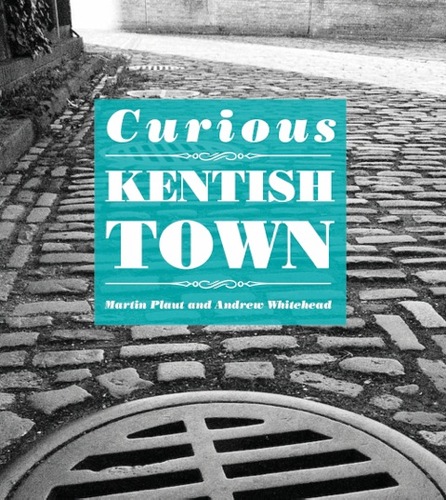
Where does the long lost Fleet river break cover? Have you visited the 'craziest' of London's parish churches? Or followed, quite literally, in the tracks of the piano industry? Do you know about the horse tunnels at Camden Lock ... the ghost sign advertising maids' caps and aprons in Dartmouth Park ... the African revolutionary who made his home near Tufnell Park? All this and much more in Curious Kentish Town - 92 pages, 40 illustrations and a map, and excellent value at £7.95. More details here: http://www.curiouskentishtown.com/ |
NW5 and around
I've lived in NW5 - the Kentish Town postcode - for well over a decade. I really like the area. Not that I would ever say I live in Kentish Town. My nearest tube is Tufnell Park, the closest overground is Gospel Oak, the swimming pool I use is at Archway, and I shop in Fortess Road or Swains Lane as much as on Kentish Town High Street. But let me share with you some of the landmarks in and around my part of NW5 and adjoining areas.
And do also visit the excellent Acland Burghley school history site.
There's also much, much more about the area on my blog: with entries about Crouch End, Dartmouth Park, Hampstead Heath, Highgate, Highgate Cemetery, Holloway, Kentish Town, Stoke Newington, Tufnell Park and Waterlow Park.
And do also visit the excellent Acland Burghley school history site.
There's also much, much more about the area on my blog: with entries about Crouch End, Dartmouth Park, Hampstead Heath, Highgate, Highgate Cemetery, Holloway, Kentish Town, Stoke Newington, Tufnell Park and Waterlow Park.
The Smiley Sun of Dartmouth Park Hill
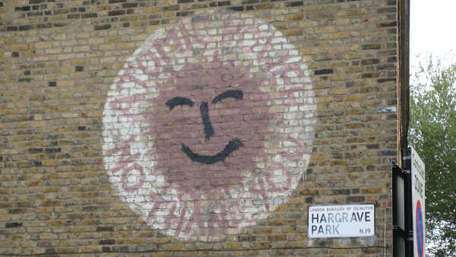
This 'Smiley Sun', a north London landmark, is at the junction of Dartmouth Park Hill and Hargrave Park. I've driven past it for thirty years and now I live just a short stroll away. The wording 'Atomic Power - No Thank You' harks back to the early years of the campaign against nuclear energy.
I've tried to find out a little about the history of this particular wall painting. it seems to date back to the late 1970s, when the squatters and housing action movements were particularly strong in this part of London. The mural was, I have been told, the work of someone known as 'Kelvin the Mushroom Maniac'. Did this person exist? Who was he? And did he really wield the paintbrush? If you know, do let me know.
I've tried to find out a little about the history of this particular wall painting. it seems to date back to the late 1970s, when the squatters and housing action movements were particularly strong in this part of London. The mural was, I have been told, the work of someone known as 'Kelvin the Mushroom Maniac'. Did this person exist? Who was he? And did he really wield the paintbrush? If you know, do let me know.
The full story has now been told in Curious Kentish Town (see the top of this page)
July 2013: after years in pursuit of Kelvin, I have finally tracked him down. A friend of his spotted this website and prompted Kelvin to get in touch with me. Here is his remarkable story of how the "smiley sun" of N19 was born:
Thanks for your interest ... in that 'smiley'!
Well, can't imagine how you ever found out, but you were right, twaz me that scrolled it!
How? Well, a lucky combination of circumstance I guess - A copy of that book [John W. Gofman and Arthur R. Tamplin, Poisoned Power: the case against nuclear power plants before and after Three Mile Island, 1971], a flourishing anti-nuclear movement, and me, a young headstrong hothead in thosde days, in love with life and convinced the world could be saved, (and magic mushrooms).
When? Well, I can pin that down for you too - It must have been (incredibly) - 1976. How am I so certain? Well, the man who told me of your website (born at the end of '75) was a babe in our arms at the time. Homeless and living on £5 a week we heard of the incredible squatting community that thrived in that area at that time - and with a massive sign of relief we moved into that house!
Why'd I graffiti my own house? Hard to say, perhaps having just got back from a nightmare demo at Aldermaston - where I'd experienced the most hideous mushroom induced vision I'd ever had in my life - (before or since) - may have had a little something to do with it! - ...
Where? how? Having come across a few tins of old paint while on another blindingly enlightening anti-nuclear trip I was suddenly seized with the absolute necessity to do something about it then and there - so, in the middle of the night, much to the misgivings of my long suffering wife and convinced I'd be getting busted for it in the morning (if not while doing it) I grabbed a ladder from a building site opposite and dashed it off. (If I'd have known it was to last half a lifetime I may just have taken a little more care over it! I was in such as hurry I remember I nearly fell to my probable death in the process! - anyway,
There's your story.
And Kelvin's email produced, a month later, another memory of the painting of this smiley sun - from Dave Knightshade:
I found your interest in the history of the sun on the corner of Dartmouth Park and Hargrave. I was squatting there when Kevin painted it 1980-ish. It was a thriving community at the time. We opened the back gardens up by removing the fence behind. There was a great garden behind the wall at the top of Hargrave.
If my memory's right, Kevin founded a macrobiotic restaurant in the basement of empty building at the bottom of Queensway called the Magic Carpet in 1972 - famous in the history of a lot of bands from that time. The sun should be listed and he ought to get a blue plaque.
Best wishes, Dave
If you have memories of that time, and of the squatting movement in the area, drop me a line at <awkashmir@gmail.com>
A shadow sign in Dartmouth Park
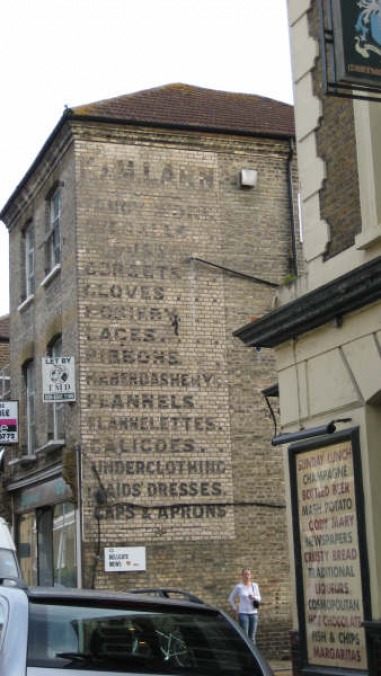
Photo by Samira
This large and sepia-tinged shadow sign is in the heart of Dartmouth Park in North London, taken with the 'Dartmouth Arms' in the foreground.
The building is now an up-market delicatessen, but was once clearly a haberdashery shop run by K&M Larn. As you can see, they sold:
'Fancy work
Overalls
Blouses
Corsets
Gloves
Hosiery
Laces
Ribbons
Haberdashery
Flannels
Flannelettes
Calicoes
Underclothing Maids' Dresses,
Caps and Aprons'.
I guess that most of the nearby houses on Laurier Road, Dartmouth Park Avenue and such like would, in the inter-war years, have had maids - some would have had live-in staff.
This photograph was taken by my daughter. There's another nice image here, taken by Mike Quinn. I've done a web search on 'Larn' and have found nothing about this business. No doubt there would be references in street directories and similar, but in digital terms - apart from these images - it's as if it was never there.
The building is now an up-market delicatessen, but was once clearly a haberdashery shop run by K&M Larn. As you can see, they sold:
'Fancy work
Overalls
Blouses
Corsets
Gloves
Hosiery
Laces
Ribbons
Haberdashery
Flannels
Flannelettes
Calicoes
Underclothing Maids' Dresses,
Caps and Aprons'.
I guess that most of the nearby houses on Laurier Road, Dartmouth Park Avenue and such like would, in the inter-war years, have had maids - some would have had live-in staff.
This photograph was taken by my daughter. There's another nice image here, taken by Mike Quinn. I've done a web search on 'Larn' and have found nothing about this business. No doubt there would be references in street directories and similar, but in digital terms - apart from these images - it's as if it was never there.
Beanfeasts on the Heath
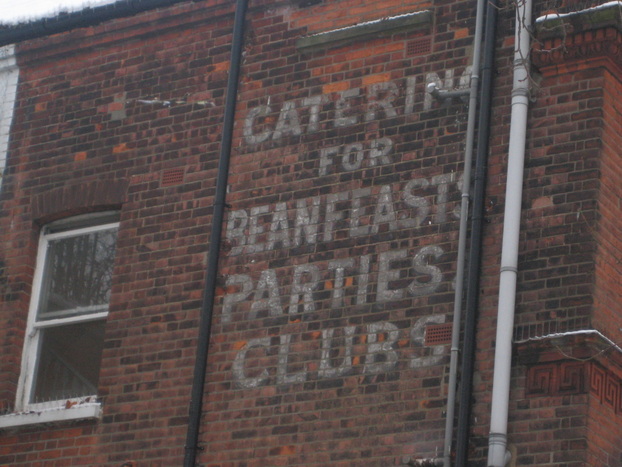
Photo by Samira
One of my favourite shadow signs - that word 'beanfeasts' transports you to another era.
This is taken from Hampstead Heath. It's the back of one of the cafes fronting Highgate Road, near Swains Lane.
A beanfeast was a works outing - often fairly raucous, and paid for by the employer. It's where the word 'beano' comes from.
Thanks Samira!
This is taken from Hampstead Heath. It's the back of one of the cafes fronting Highgate Road, near Swains Lane.
A beanfeast was a works outing - often fairly raucous, and paid for by the employer. It's where the word 'beano' comes from.
Thanks Samira!
Kentish Town of 200 years ago
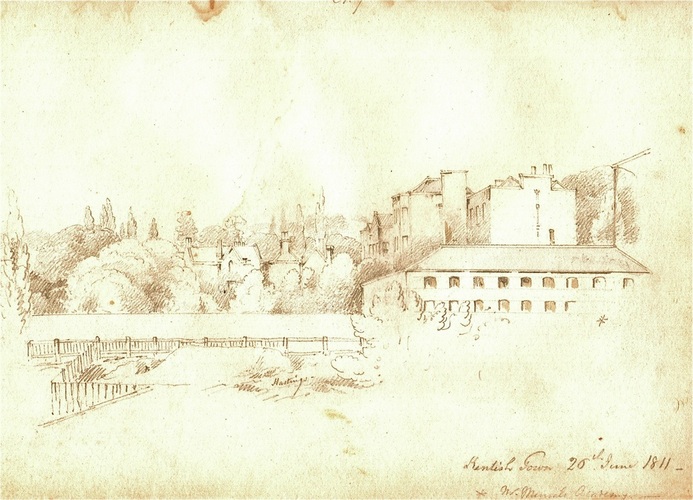
A pencil drawing by the artist Edward Hastings of Mr Mensals Academy in Kentish Town, provided courtesy of a a friend who has just bought this rather wonderful piece of NW5's past.
This pencil drawing is from Hasting's 1811 sketchbook. The drawings in the book cover areas of London which at the time were still recognisable as separate villeges or small towns away from the city. The most frequently sketched areas are Kentish Town, Hampstead, Dulwich and Putney. ,
This particular drawing is of Mr Mensals Academy in Kentish Town. It is signed, annotated and dated 20 June 1811. The school appears to have been near the junction between Highgate Road and Gordonhouse Road.
This pencil drawing is from Hasting's 1811 sketchbook. The drawings in the book cover areas of London which at the time were still recognisable as separate villeges or small towns away from the city. The most frequently sketched areas are Kentish Town, Hampstead, Dulwich and Putney. ,
This particular drawing is of Mr Mensals Academy in Kentish Town. It is signed, annotated and dated 20 June 1811. The school appears to have been near the junction between Highgate Road and Gordonhouse Road.
Tufnell Park's lost landmark
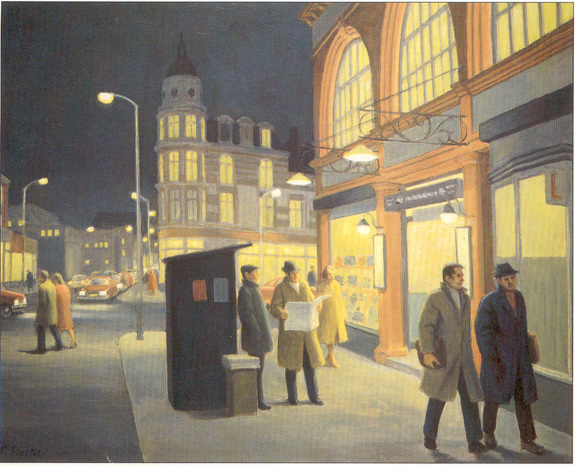
Fermin Rocker - 'Newspaper Kiosk, Tufnell Park', courtesy Philip Rocker
Not many newspaper kioks feature in works of fine art. This painting by my friend Fermin Rocker - who died in 2004 - captures the wonderful paper stall outside Tufnell Park tube station. A stall I patronised every weekday on my way to work. Until the end of last week [Oct 2010].
The stall is now closed - 'until further notice', says the forbidding notice. The staff at the tube station say it has gone for good.
Every morning, I handed over my pound coin for a copy of the 'Daily Telegraph'. "There you are, young man", the older assistant would say when on duty. No one else calls me young these days. And indeed, his tune had changed of late to "there you go, old mate", which is a touch more intimate but less motivating.
You can make out the stall in its modern incarnation in the photo below. They never said it was about to close. It's a sudden death. Part of my routine lost. A much larger part of the stall holder and his colleagues' lives gone. I grieve its passing.
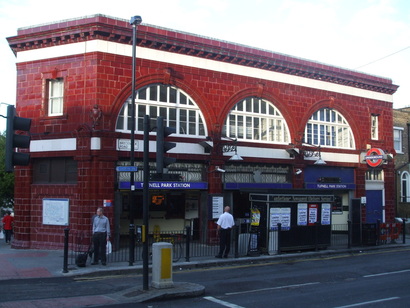
Photo: Sunil 060902 CreativeCommons
And a landmark that still survives - The Blue Carbuncle
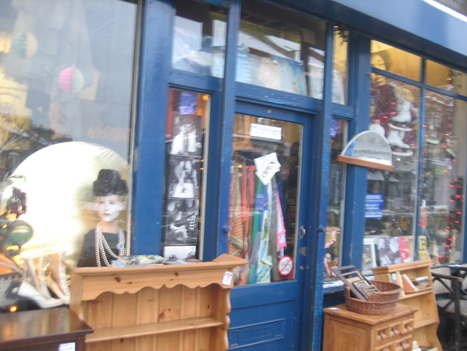
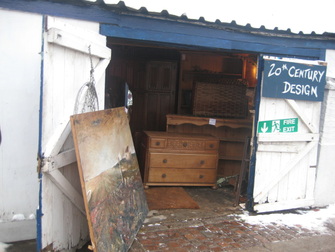
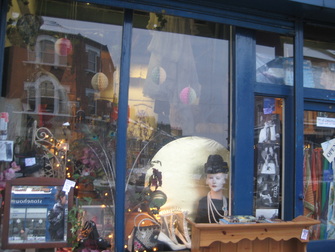
'The Blue Carbuncle' is one of the best known Sherlock Holmes short stories. And also the name of one of north London's classiest second hand stores.
It's on the junction of Cathcart Hill and Junction Road, not far from Tufnell Park and Archway tube stations. I got to going in there because it had a great array of Soviet-era lapel badges. It's fun also because there's a real style in the clothes, the records, the old cameras - not so sure about the furniture, stored in a shed-annex on the Cathcart Hill side.
The building which houses the Carbuncle is said to be one of the oldest fronting Junction Road - and was in danger of redevelopment. Not sure whether that threat has passed.
Samira took these photos - and if you look at the one below on the right, you can just get a glimpse of her in the mirror in the shop window.
Alas, in October 2011 the Blue Carbuncle closed.
It's on the junction of Cathcart Hill and Junction Road, not far from Tufnell Park and Archway tube stations. I got to going in there because it had a great array of Soviet-era lapel badges. It's fun also because there's a real style in the clothes, the records, the old cameras - not so sure about the furniture, stored in a shed-annex on the Cathcart Hill side.
The building which houses the Carbuncle is said to be one of the oldest fronting Junction Road - and was in danger of redevelopment. Not sure whether that threat has passed.
Samira took these photos - and if you look at the one below on the right, you can just get a glimpse of her in the mirror in the shop window.
Alas, in October 2011 the Blue Carbuncle closed.
 |
 |
Elephants on the loose in Kentish Town
Back in 1884, this was. And I know about it thanks to Conrad who tweets as #NW5. It seems that a troupe of circus elephants was parading up Fortess Road when a couple broke loose, stormed up Cathcrat Hill, then turned tail down Pemberton Gardens, and ended up ratehr uncomfortably in a basement there. There's a bit more detail about the story here - and Conrad has posted a half-page from the 'Graphic' in 1884, a set of illustrations depicting this curious incident.

I can't help wondering what Mr Pooter would have made all of this. It's very much his part of town.
The St Pancras rent protests of 1960
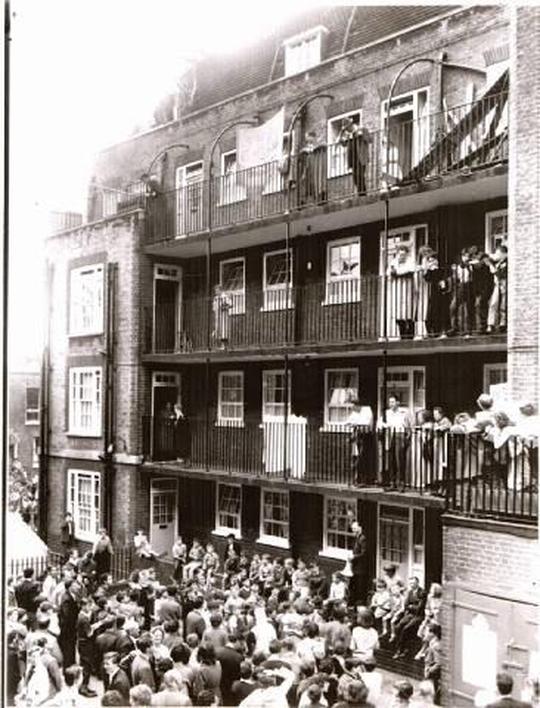
A news agency photo dated 30th August 1960. The caption reads: 'A speaker addresses a gathering at tenement house in London's Kentish Town yesterday where rent rebel Donald Cook is holding out against police.' Cook's flat is top left in the photo. (Thanks to Martin for passing the photo on to me).
The caption doesn't provide the exact location, nor indeed the context. But a bit of sleuthing on the internet reveals that this was one of the key moments in the St Pancras (the borough became part of Camden in the mid-1960s) rent protests of 1960. The rent strike, and the turbulent demonstrations in its support, were one of the biggest waves of social unrest that post-war London had witnessed. Don Cook's widow has recently recalled the events of that summer. There's another account of the strike and the of protest and sympathy actions here .
And there's a Pluto Press pamphlet on the rent strike available online which explains that as many as 2,000 St Pancras tenants went on a partial rent strike that year. Of the events depicted in the photo, the pamphlet explains:
The extension of the eviction order, given by Bloomsbury Court expired at midnight on 28th August. By that time well-constructed barricades had gone up, both at Kennistoun House and Silverdale. Don Cook had 12 pianos in his flat barricading various doors, as well as other old furniture and doors put against windows, and barbed wire and an old bedstead on the roof to discourage bailiffs from entering that way. There were also plans for human barricades; tenants and trade unionists were to be involved in a 24-hour picket of both flats so that, in an eviction attempt, defence and warning could be simultaneous. Preparations were made at Kennistoun House for a bell to be rung and rockets fired if the bailiffs arrived on the scene. On hearing or seeing the warning, workers all over the borough were prepared to down tools and rush to the assistance of the two beleaguered tenants. An intercom system was set up between Don Cook’s flat and the campaign headquarters in another flat in Kennistoun House.
Local trade union support was evident. On Monday 29th August railwaymen of Camden No.2 branch of the NUR held a two-hour token strike; council workers who struck on the next two days went to man the picket lines; and local firemen stated that they would not be involved in any attempt at eviction. Support from the tenants at Kennistoun House was total. On 31st August when half the tenants in the block were supposed to pay their rent, only one old-age pensioner was at the rent office. Banners saying "No Evictions" and "Force the Council to Negotiate" hung from the access balconies
The caption doesn't provide the exact location, nor indeed the context. But a bit of sleuthing on the internet reveals that this was one of the key moments in the St Pancras (the borough became part of Camden in the mid-1960s) rent protests of 1960. The rent strike, and the turbulent demonstrations in its support, were one of the biggest waves of social unrest that post-war London had witnessed. Don Cook's widow has recently recalled the events of that summer. There's another account of the strike and the of protest and sympathy actions here .
And there's a Pluto Press pamphlet on the rent strike available online which explains that as many as 2,000 St Pancras tenants went on a partial rent strike that year. Of the events depicted in the photo, the pamphlet explains:
The extension of the eviction order, given by Bloomsbury Court expired at midnight on 28th August. By that time well-constructed barricades had gone up, both at Kennistoun House and Silverdale. Don Cook had 12 pianos in his flat barricading various doors, as well as other old furniture and doors put against windows, and barbed wire and an old bedstead on the roof to discourage bailiffs from entering that way. There were also plans for human barricades; tenants and trade unionists were to be involved in a 24-hour picket of both flats so that, in an eviction attempt, defence and warning could be simultaneous. Preparations were made at Kennistoun House for a bell to be rung and rockets fired if the bailiffs arrived on the scene. On hearing or seeing the warning, workers all over the borough were prepared to down tools and rush to the assistance of the two beleaguered tenants. An intercom system was set up between Don Cook’s flat and the campaign headquarters in another flat in Kennistoun House.
Local trade union support was evident. On Monday 29th August railwaymen of Camden No.2 branch of the NUR held a two-hour token strike; council workers who struck on the next two days went to man the picket lines; and local firemen stated that they would not be involved in any attempt at eviction. Support from the tenants at Kennistoun House was total. On 31st August when half the tenants in the block were supposed to pay their rent, only one old-age pensioner was at the rent office. Banners saying "No Evictions" and "Force the Council to Negotiate" hung from the access balconies
.
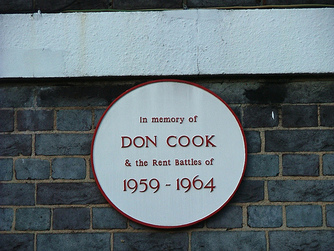
Photo: Nicobibinus, Creative Commons
Kennistoun House is on Leighton Road. And all this provides an answer to something that I have long intended to explore - the story behind this plaque (still evident, and by the look of it cared for) on Leighton Road. It is not at all clear who put up the plaque, but nice that someone took the trouble.
And not to be missed is this Pathe news reel which shows Don Cook - described as a communist and ex-paratrooper - being evicted from his flat in September 1960, and the tumultuous street protests that ensued. Scores of police were involved in keeping order. The newsreel suggests these were the most unruly protests in London since the 1930s.
Don Cook died in December 1986 aged 64.
And not to be missed is this Pathe news reel which shows Don Cook - described as a communist and ex-paratrooper - being evicted from his flat in September 1960, and the tumultuous street protests that ensued. Scores of police were involved in keeping order. The newsreel suggests these were the most unruly protests in London since the 1930s.
Don Cook died in December 1986 aged 64.
Kwame Nkrumah in NW5
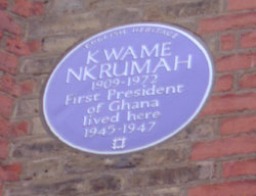
You think you know an area quite well - and then supposedly something pops into vision which makes you wonder whetehr you know it all. I've driven and walked down Burghley Road hundreds of times - but I've only now noticed the blue plaque at No. 60 marking Kwame Nkrumah's stay there just after the Second World War. Nkrumah was the left-wing nationalist who led Ghana to independence - the first of Britain's colonies in sub-Saharan Africa to break free. He was quite a guy - and although he was eventually overthrown and died in exile, he is now warmly remembered in Ghana.
A site devoted to Nkrumah records that in 1945, Nkrumah moved on from New York to London 'with the purpose of studying law and finishing his PhD in philosophy. He thus rented accommodation with a friend at 60, Burghley Rd, Tufnell Park, London and enrolled at Grays Inn.' This was just at the stage when Nkrumah's political ideas were being forged. A decade after he left Burghlely Road, he was - as the plaque says - Ghana's first President.
It seems the plaque is well known to the Ghanaian community and to blue plaque spotters - but it was new to me and perhaps it is to you as well.
A site devoted to Nkrumah records that in 1945, Nkrumah moved on from New York to London 'with the purpose of studying law and finishing his PhD in philosophy. He thus rented accommodation with a friend at 60, Burghley Rd, Tufnell Park, London and enrolled at Grays Inn.' This was just at the stage when Nkrumah's political ideas were being forged. A decade after he left Burghlely Road, he was - as the plaque says - Ghana's first President.
It seems the plaque is well known to the Ghanaian community and to blue plaque spotters - but it was new to me and perhaps it is to you as well.
An NW5 novel
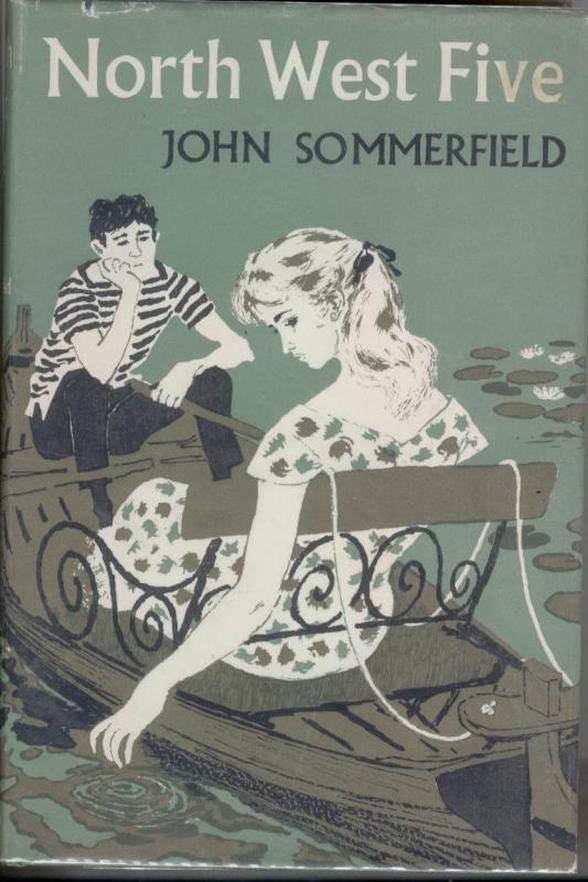
There aren't many novels set in NW5 - but this, as you can tell from the title, is one.
The author, John Sommerfield, lived for many years in Gospel Oak. His novel is a tender account of a working class household in west Kentish Town, and a courtship between Dan, just back from National Service, and Liz. The book was published in 1960.
The cover is charming - though much of the courting recounted in the novel was conducted on Hampstead Heath, where there is no boating lake. It's designed by Stephen Russ.
Sommerfield is a very interesting novelist. He was a Communist and fought with the International Brigade in the Spanish Civil War - he wrote a book about his time in Spain.
His most noted novel was the very experimental, and highly political, May Day, which appeared in1936 and hasbeen republished by London Books.
The author, John Sommerfield, lived for many years in Gospel Oak. His novel is a tender account of a working class household in west Kentish Town, and a courtship between Dan, just back from National Service, and Liz. The book was published in 1960.
The cover is charming - though much of the courting recounted in the novel was conducted on Hampstead Heath, where there is no boating lake. It's designed by Stephen Russ.
Sommerfield is a very interesting novelist. He was a Communist and fought with the International Brigade in the Spanish Civil War - he wrote a book about his time in Spain.
His most noted novel was the very experimental, and highly political, May Day, which appeared in1936 and hasbeen republished by London Books.