Dan Chatterton
To mark the 200th anniversary of Dan Chatterton's birth in August 2020, here's a podcast and walking tour about the man and his politics. Enjoy!
https://www.historyworkshop.org.uk/walking-tour-dan-chattertons-communistic-scorcher/
https://www.historyworkshop.org.uk/walking-tour-dan-chattertons-communistic-scorcher/
.
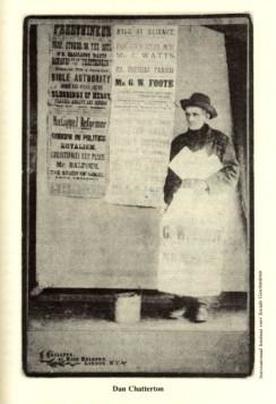
There was something heroic about the life of Dan Chatterton (1820-1895). He lived in great poverty, yet ceaselessly peddled his self-published pamphlets - which became increasingly more ragged in appearance and insurrectionary in tone. He caught the interest of several novelists, and fictionalised portraits of him appear in the works of Richard Whiteing, John Henry Mackay and, arguably, George Gissing.
I wrote an article about Dan Chatterton in History Workshop Journal many years ago, here's a link (and I've posted the text below). His life intersects with many of the key radical political movements of the nineteenth century, from Chartism to the artisan followers of Bronterre O'Brien to the socialist and anarchist milieus of the end of the century.
The image of him on the left is in the Nettlau archive at the International Institute for Social History in Amsterdam.
I wrote an article about Dan Chatterton in History Workshop Journal many years ago, here's a link (and I've posted the text below). His life intersects with many of the key radical political movements of the nineteenth century, from Chartism to the artisan followers of Bronterre O'Brien to the socialist and anarchist milieus of the end of the century.
The image of him on the left is in the Nettlau archive at the International Institute for Social History in Amsterdam.
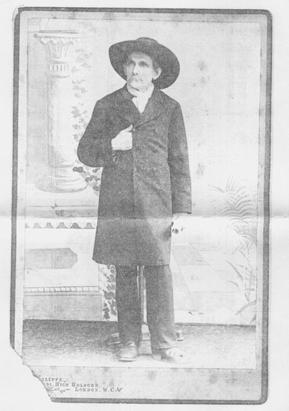
Another photograph of Chatterton, again from the Nettlau archive. He sold what he called 'cabinet photographs' of himself at a shilling each - I assume this is one of them - for his burial fund. It didn't work. He was buried in an unmarked grave,
This is a rather grand, posed image. Very different from the photo above, taken when Chatterton was working as a bill poster. He was brought up as an artisan, but towards the end of his life took a range of low skilled jobs. He also seems to have received some money from the National Secular Society.
The anarchist David Nicoll wrote evocatively of Chatterton in an obituary:
'Who does not remember, in the stormy days of '87, a pale, haggard old man, who used to climb the platform at meetings of the unemployed, or in the closely packed Socialist lecture halls, and pour forth wild denunciations of the robbery and injustice that flourishes in our rotten society, mingled with fearful prophecies of the terrible revolution that was coming. He looked as he stood in the glare of the gaslight, with his ghastly face and flashing eyes, clad in an old grey overcoat and black slouched hat, a red woollen scarf knotted round his neck, like some grim spectre evolved from the misery and crime of the London slums, and middle-class men who had entered the meeting from curiosity shuddered as they murmured to themselves "Marat".
'Yes, Marat come to life again, an English Marat.'
This is a rather grand, posed image. Very different from the photo above, taken when Chatterton was working as a bill poster. He was brought up as an artisan, but towards the end of his life took a range of low skilled jobs. He also seems to have received some money from the National Secular Society.
The anarchist David Nicoll wrote evocatively of Chatterton in an obituary:
'Who does not remember, in the stormy days of '87, a pale, haggard old man, who used to climb the platform at meetings of the unemployed, or in the closely packed Socialist lecture halls, and pour forth wild denunciations of the robbery and injustice that flourishes in our rotten society, mingled with fearful prophecies of the terrible revolution that was coming. He looked as he stood in the glare of the gaslight, with his ghastly face and flashing eyes, clad in an old grey overcoat and black slouched hat, a red woollen scarf knotted round his neck, like some grim spectre evolved from the misery and crime of the London slums, and middle-class men who had entered the meeting from curiosity shuddered as they murmured to themselves "Marat".
'Yes, Marat come to life again, an English Marat.'
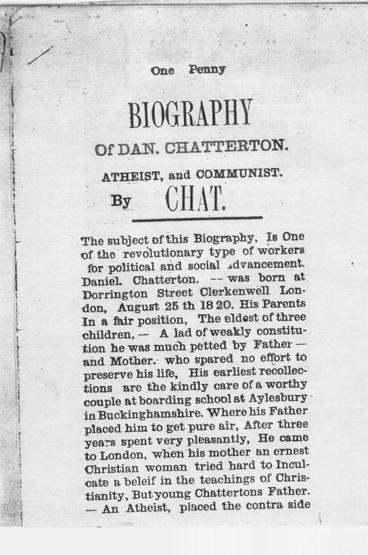
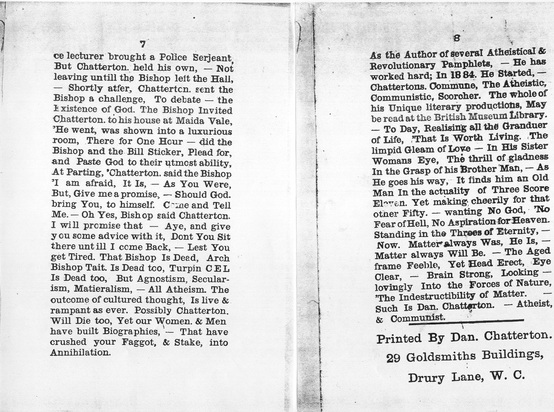
Chatterton's autobiography gives you a sense of both of his style of writing, and of the appearance of his pamphlets and tracts particularly towards the end of his life. He used either very rough paper or cheap yellow tissue, and it was said that he had to press each page with his hands on the roughly set type to get an impression.
The Dorrington Street in which he was born, by the way, is not the street of that name in Holborn, but a street at the back of Mount Pleasant. As far as I can work out, the house where he was born still stands, a few doors from the 'Apple Tree' pub.
His biography provides a lot of personal inforamtion in just a few pages - and those details which can be checked out, such as his account of enlisting during the Crimean War, are borne out by the official records.
Thanks to a reader of this page, I am able to provide a link to an online posting of 'Old Chat's autobiography and to some of his other pamphlets. And I've posted the full pamphlet lower down on this page.
The Dorrington Street in which he was born, by the way, is not the street of that name in Holborn, but a street at the back of Mount Pleasant. As far as I can work out, the house where he was born still stands, a few doors from the 'Apple Tree' pub.
His biography provides a lot of personal inforamtion in just a few pages - and those details which can be checked out, such as his account of enlisting during the Crimean War, are borne out by the official records.
Thanks to a reader of this page, I am able to provide a link to an online posting of 'Old Chat's autobiography and to some of his other pamphlets. And I've posted the full pamphlet lower down on this page.
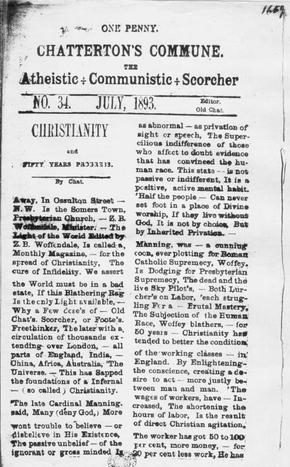
In addition to his pamphlets. Chatterton - or 'Old Chat' as he sometimes styled himself - published every few months a paper called 'Chatterton's Commune, the Atheistic Communistic Scorcher'. He provided all the content. This is one of the more legible copies. Some others were, in essence, handwritten.
The British Library has a full set of 'Chatterton's Commune', which continued publication for more than a decade. It seems that Chatterton himself took care to deposit copies at the Library, where they were - and are - well looked after.
The circulation of the 'Commune' seems to have been very small indeed - perhaps no more than a hundred copies.
Chatterton wrote all the articles, did the typesetting, printed either on very coarse paper or on tissue paper in the most rudimentary of fashions, and then peddled the paper as well.
The British Library has a full set of 'Chatterton's Commune', which continued publication for more than a decade. It seems that Chatterton himself took care to deposit copies at the Library, where they were - and are - well looked after.
The circulation of the 'Commune' seems to have been very small indeed - perhaps no more than a hundred copies.
Chatterton wrote all the articles, did the typesetting, printed either on very coarse paper or on tissue paper in the most rudimentary of fashions, and then peddled the paper as well.
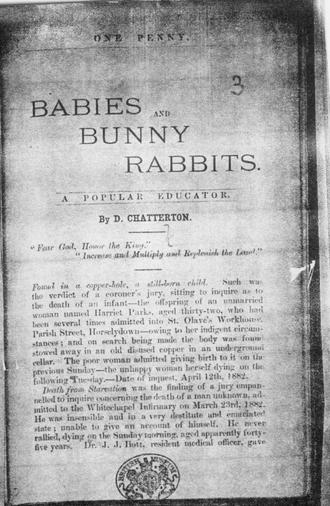
It seems that Chatterton didn't start writing and peddling political pamphlets until he was in his fifties. 'Babies and Bunny Rabbits: a popular educator' dates from 1883 - and as you can see, it was conventionally typeset and printed. It is in many ways the most remarkable of his titles, advocating contraception not simply out of Malthusian arguments about the shortage of food supply, but also so that women and men could enjoy sex without worrying about conception.
'Mothers of England, think well over this question - know that you are the framework of the evolutionary propagation of the forces of life; know that the means of restricting that propagation lies entirely in your own hands; feel that you may gratify, to your heart's desire, all the sexual pleasures of love, of life, of all desire, without have the bitter reflection that by your reckless act of reproduction of a greater number than your two selves, you have doomed all to the penalty of death by starvation.'
The tract mentioned withdrawal, the sheath and the vaginal syringe as suitable methods of contraception.
'Mothers of England, think well over this question - know that you are the framework of the evolutionary propagation of the forces of life; know that the means of restricting that propagation lies entirely in your own hands; feel that you may gratify, to your heart's desire, all the sexual pleasures of love, of life, of all desire, without have the bitter reflection that by your reckless act of reproduction of a greater number than your two selves, you have doomed all to the penalty of death by starvation.'
The tract mentioned withdrawal, the sheath and the vaginal syringe as suitable methods of contraception.
And there's a marvellous anecdote about Dan Chatterton in the papers of Charles Bradlaugh at the Bishopsgate Institute - I've only just chanced upon it (in February 2022). It's in a letter of condolence sent by Charles W. Barker from Lavender Hill to Bradlaugh's daughter on her father's death in 1891:
'My opinion of your father is not unlike that expressed to me by old Dan Chatterton in August last. I made Dan's acquaintance twelve or thirteen years ago under the St Pancras Arches, + since then have had many a free + easy conversation with him. He was looking very bad when I saw him last August: so I remarked "Dan; if you were to die who would bury you?" "That hardly concerns me" replied the old man "perhaps the parish thieves might put the old boy (himself) under the turf or he might be buried at Charlie Bradlaugh's expense". "Look here Dan" I remarked "I don't see why you should think Bradlaugh would bury you. You preach doctrines the exact reverse of those he favours. You are a regular bloodthirsty, impractical old anarchist Bradlaugh is a methodicial revolutionist". "That's right enough" said the old man "+ many a wigging - many a wigging old Charlie (your father) has given me" but - + here the old man dropped his gay + reckless tone + put not a little rough pathos into his style "but old Charlie has given the old man (Dan) other things beside a wigging. When all the -- -- thieves hadn't a crust or a good word for Old 'Chat', Charlie Bradlaugh could generally give the old man a dinner. Yes, my boy, Charlie's has fed me more than once; + I believe rather than let the parish thieves touch my carcase, he'd bury me if I were to die before him."
'The last words of the old man sound painfully now: for when I looked at him + called before my mind's eye the stalwart figure of your father, I thought within myself "Well Dan we shall doubtless see whether Charlie Bradlaugh will or will not bury you" little thinking that whilst the old irreconcilable (Chatterton) continued to throw the shadow of his bent + wasted figure on my path, Charles Bradlaugh, massive as Dan is meagre, would be resting beneath a hillock from which no shadows of the dead beneath it spread themselves across the landscape.'
'My opinion of your father is not unlike that expressed to me by old Dan Chatterton in August last. I made Dan's acquaintance twelve or thirteen years ago under the St Pancras Arches, + since then have had many a free + easy conversation with him. He was looking very bad when I saw him last August: so I remarked "Dan; if you were to die who would bury you?" "That hardly concerns me" replied the old man "perhaps the parish thieves might put the old boy (himself) under the turf or he might be buried at Charlie Bradlaugh's expense". "Look here Dan" I remarked "I don't see why you should think Bradlaugh would bury you. You preach doctrines the exact reverse of those he favours. You are a regular bloodthirsty, impractical old anarchist Bradlaugh is a methodicial revolutionist". "That's right enough" said the old man "+ many a wigging - many a wigging old Charlie (your father) has given me" but - + here the old man dropped his gay + reckless tone + put not a little rough pathos into his style "but old Charlie has given the old man (Dan) other things beside a wigging. When all the -- -- thieves hadn't a crust or a good word for Old 'Chat', Charlie Bradlaugh could generally give the old man a dinner. Yes, my boy, Charlie's has fed me more than once; + I believe rather than let the parish thieves touch my carcase, he'd bury me if I were to die before him."
'The last words of the old man sound painfully now: for when I looked at him + called before my mind's eye the stalwart figure of your father, I thought within myself "Well Dan we shall doubtless see whether Charlie Bradlaugh will or will not bury you" little thinking that whilst the old irreconcilable (Chatterton) continued to throw the shadow of his bent + wasted figure on my path, Charles Bradlaugh, massive as Dan is meagre, would be resting beneath a hillock from which no shadows of the dead beneath it spread themselves across the landscape.'
That autobiography in full
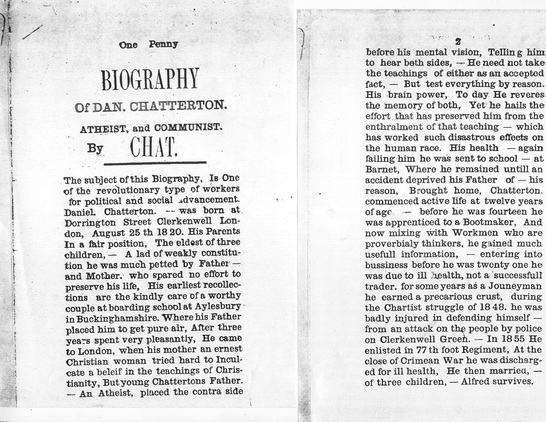
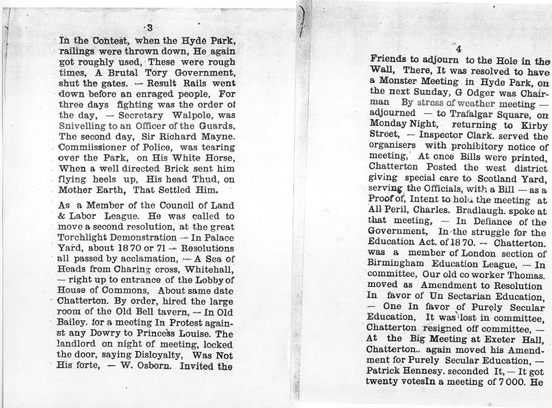
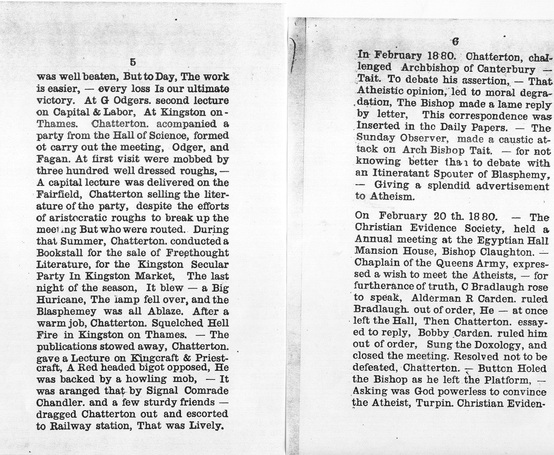
I'm posting here the text of an article I wrote many years ago about Chatterton - the reference for citation is Andrew Whitehead, ‘Dan Chatterton and his “Atheistic Communistic Scorcher”’, History Workshop Journal, 25, 1988, pp.85-99
Dan Chatterton and his 'Atheistic Communistic Scorcher'
by Andrew Whitehead
The history of the left has conventionally been written as the story of movements and organisations. Those who left no institutional legacy, who were not pioneers of party or union, whose pamphlets have not been collected by libraries, have been more-or-less neglected. There's an injustice in this - not so much a personal injustice, as an injustice to the generations that follow who are deprived of a proper sense of the complexity of the past. Those mavericks who kept aloof from organised politics and struggled alone to preach and to persuade according to their own idiosyncratic values could have quite as much importance in transmitting ideas, in however vulgarised a form, to a popular audience as the closely-printed political journals and the in-house political rallies.
Most of these independent spirits cannot be redeemed from the condescension of history simply because little or no record survives of their lives and labours. It's only possible for Dan Chatterton to be the subject of an article because he attracted, by the exuberance and outlandishness of his propaganda, the attention of journalists and novelists, and more particularly because he took the trouble to deposit a of all (or perhaps nearly all) of his pamphlets and of every issue of his entirely self-produced paper, Chatterton's Commune, the Atheistic Communistic Scorcher, with the British Museum. His 'pamphlets elaborations' were preserved among the millions of books in `this one really social institute of the world', the individualist anarchist J. H. Mackay recalled, `bound, numbered, and catalogued just as carefully as the rarest manuscript of past centuries.'[1] And there still the curious can leaf through the fragile yellow tissue pages of the Scorcher, marvelling that such a precarious venture survived for almost eleven years, and can turn the pages of Chatterton's tracts with their irregular syntax and large, ill-matched type.
Dan Chatterton was part of the underbelly of popular politics. In his writings, in his street-corner oratory, in his furious contributions from the floor at political meetings, he expressed a burning and unornamented anger at the injustices which forced him and thousands of others to live in poverty in the slums of late-Victorian London. A participant (by his account) in the Chartist movement and the Reform League, Chatterton rose to prominence in the ultra-radical organisations which flourished briefly in the early 1870s. But he was temperamentally unsuited to working in common discipline, so he went his own way, publishing and peddling his denunciatory and insurrectionary propaganda, and later tacking on to the coat-tails of the socialist revival of the 1880s and the anarchist milieus which sprang from it.
There's much about Chatterton that is unattractive. He was eccentric beyond the normal bounds of tolerance, and he could be more than a minor irritation to those chairing public meetings. The self-confidence which impelled him to articulate his grievances could also be seen as overbearing self-importance. Sometimes his rebellious rhetoric spilled over into revolutionary bloodlust:
Oh, yes! workers of to-day, there is nothing left for you to-day but to steel your nerves, dry your powder, sharpen your weapons, tighten your grasp, and drive the bright, flashing steel clean through the quivering heart of your Blood Stained Foe.[2]
These wild rallying cries have earned Chatterton the scorn of such eminent historians as E.P. Thompson and Royden Harrison.[3] Yet Chatterton stands within a distinct radical tradition, and behind his ravings there lies a consistent political outlook: denunciation of royal and clerical privilege and the inequalities and intolerances they championed; dismay at the `shams and swindles' which sought to alleviate social sufferings without addressing the root problem;determination to persuade the downtrodden to do away with everything and start again. Echoing Tom Paine and Richard Carlile, Chatterton preached against kingcraft and priestcraft, 'two rascals who have [ever] gone hand in hand to cramp the brain'.[4] he also followed Carlile in seeking to popularise methods of birth control, which he favoured not simply on Malthusian grounds but also because sex was worth enjoying without risking the misery which too many children so often brought upon poor families. When he died in 1895, there were obituaries in the anarchist and secularist press, but also in the radical London evening paper, the Star, accompanied by a drawing of `Old Chat'.[5] All paid tribute to his courage and personal integrity. Chatterton cannot simply be dismissed,as he was once by the paper of the Marxist Social Democratic Federation,as `a blatant idiot'.[6]
* * * *
Dan Chatterton was born in August 1820 into an artisan family, apparently of comfortable means, in Clerkenwell in London. This district of south Islington was, until the last years of the nineteenth century, largely given over to small workshop trades - particularly watchmaking in all its branches, but also the jewellery and precious metal trades, brass working, bookbinding and book-edge gilding, specialist printing and fancy cabinet making. This engendered a tradition of artisan radicalism in Clerkewell which endured from the late eighteenth century through to the emergence of the S. D.F. as a popular political force in the mid-1880s. Chatterton was very much a product of this tradition. His parents lived in what was Dorrington Street (now part of Mount Pleasant, squeezed between the old Times printing plant and the postal sorting office). His mother was a Christian, but Chatterton recalled that at an early age he came under the sway of his atheist father - who worked as a japanner, or furniture lacquerer - and as a child accompanied him to radical and freethought meetings at Richard Carlile's Rotunda in Blackfriars Road.[7]
Even as a young boy, Chatterton suffered from the poor health which troubled him all his life, and he was sent away for schooling to Aylesbury and later to Barnet. When he was an adolescent, an accident befell his father which marked the first step in the decline of the Chatterton family. Dan recalled rather opaquely that `an accident deprived his Father of his reason' and the trade directories record a change of occupation from japanner to what may have been the more precarious livelihood of coal merchant.[8] Dan was brought home and apprenticed to a bootmaker, and he ascribed at least some of his subsequent political development to working alongside craftsmen who were, as he put it, `proverbialy (sic) thinkers'. Dan later tried to set up in business on his own, but without much success. For much of his adult life, Chatterton gave his occupation as shoemaker, but in the 1871 census he was recorded as a 'Traveller (Bookseller)' and ten years later as a newsvendor. In his later years he relied on bill posting and paper selling for most of his meagre income, though he once declared that he had at times been a waiter in a coffee house and a baker's deliverer, and had even on one occasion cut up a corpse for a doctor.[9]
It would be difficult to find a more clear-cut example of a downwardly mobile artisan than Dan Chatterton, and his misfortunes were not restricted to the merely economic. Chatterton recalled in his autobiography, with considerable pride, that he was badly injured in one of the clashes between Chartists and police on Clerkenwell Green in 1848.[10] Chatterton's habit of harking on this incident was caricatured by the novelist Richard Whiteing in his character `Old 48' in the best-seller No.5 John Street (1899). In 1855, during the Crimean war, Chatterton enlisted in a foot regiment. The main inducement, it must be supposed, was the seven pounds bounty. It was a curious step for an ex-Chartist to take, which which he did not seek to explain in later life, in spite of his vigorous denunciations of military ventures overseas. He was not well-suited to military life, being frail of build and just over five feet four inches tall. It's hardly surprising that Chatterton seems to have spent much of his miliary career in a hospital bed in Malta.[11] He was discharged after two years in the army.
On his return to London, Chatterton married Emma Cook, the apparently illiterate daughter of a labourer. Nothing more is known of her, except that she died of pneumonia in St Pancras Workhouse in February 1865 at the age of 32. Chatterton told Max Nettlau many years later he himself had spent several spells in workhouse hospitals. [12] Chatterton married again in 1867 to Emily Scott, who at 21 was less than half her husband's age. What befell Emily isn't clear, but she certainly wasn't with Dan in his old age. The details of Chatterton's offspring are uncertain. It seems there were several children of both marriages, most of whom died young. Only one - Alfred, born in 1861 - is known to have reached adulthood. He lived with his father, being handicapped in some way and incapable of living alone.
Dan Chatterton's acute personal misfortunes do not explain why he became such an assiduous political propagandist, but his litany of troubles - an uncertain income, a wife dying in the Workhouse, a succession of short-lived children - must surely help to account for the uncompromising tone of his polemics. Chatterton said he was active in the Reform League in the late 1860s, and asserted that he `again got roughly used' in the Reform demonstration of 23 July 1866, held in defiance of the authorities, during which the crowd knocked down the railings round Hyde Park to gain access to their intended venue. However, Chatterton's role in the Reform League must have been inconspicuous, and it was only in the radical organisations which succeeded the League that Chatterton achieved some sort of prominence. In the early 1870s he was a leading figure in the Land and Labour League, the foremost of the radical groups in London which gained wind from the establishment of the Republic across the Channel in France and the brief flowering in 1871 of the Paris Commune. Chatterton was closely involved with the League's paper, the Republican, and helped to organise League demonstrations at which he also spoke. The main force within the organisation was the O'Brienites, socialists who shared with the Irish Chartist Bronterre O'Brien an emphasis on the need for land and currency reform.[14] Chatterton himself occasionally subscribed to these tenets, but he was not among the staunch O'Brienites. He did not, for example, become involved in their ambitious and briefly successful venture to establish a co-operative colony in Kansas, neither was he active in later years in the Manhood Suffrage League. Chatterton appears to have taken little active interest in the First International, where the O'Brienites mustered in some force, but he had links with what was, in a sense, a rival body, the Universal Republican League. [15]
The Paris Commune appears to have had a marked influence on Chatterton's thinking. Repeatedly in his pamphlets, he presented `the Commune' - though not specifically its Parisian manifestation - as the means of salvation, hence Chatterton's Commune as part of the title of his later paper. 'Vive la Commune' was one of his stock phrases. It is tempting to see something of Chatterton's motivation in the remarkable character of John Pether in George Gissing's first published novel, Workers in the Dawn (1880), who becomes so obsessed with the Paris Commune that he imagines, in his delirium, that London too is the scene of a popular rebellion and the rich are being massacred and their houses set alight. There is indeed a possibility, though the evidence is circumstantial, that Gissing based this character on Dan Chatterton.[16]
Chatterton was involved in a host of robustly radical organisations in the early 1870s. He attended the occasionally tempestuous debates of the Patriotic Society, which met at the 'Hole-in-the-Wall' near Hatton Garden. And when the notoriety of that society prompted the police to persuade the publican to deny hospitality to `red republicans', and the radicals raised sufficient funds to lease premises on Clerkenwell Green, Chatterton served on the committee of the newly-established Patriotic Club.[17] One well-informed contemporary, looking back on the 'Hole-in-the-Wall' days, recalled that the ordinary run of debates was decidedly disappointing:
Every tone, every aspect, every sentiment impressed upon you the fact , that this was no gathering of tribunes, but a homely meeting of ordinary British artisans, with little more than the average brain and knowledge of their order. The rant of rebellion was rarely in their mouths, which spoke rather the more sincere, if more prosaic, discontent of the toiler who finds times hard and the hearts of the rulers harder. [18]
But occasionally, the author went on, some daring discourse was indulged in:
and the Communist Chatterton was the sincere and simple type of reformer that looks from the meanness and misery about him -
And sees aloft the red right arm
Redress the eternal scales.
Chatterton served on the general committee of the Anti-Game League, which held that the existing Game Laws `by creating a legal offence which is no sin . . . form a manufactory for the product criminals'.[19] He had also, by his own account, been active in the National Education League, but found there very limited support for his stand in favour of not simply non-sectarian education but exclusively secular instruction.
It was as a pamphleteer that Chatterton became best known, even though he was in his fifties when the first title appeared. Chatterton came to the defence, in 1872, of Metropolitan Police constables who had victimised for agitating for more pay. But the pamphlet broadened out into an attack on all social and political privilege. In a style which came to be a hallmark of Chatterton's tracts, he argued that once the police and armed forces began to think for themselves, they would surely join in a popular revolution:
in fact, an entire smashing-up of kings, queens, princes, priest and policemen, land and money mongers, and rascality of all sizes and degrees - in a word, an entire re-organisation of Society, on the basis of Liberty, Equality, and Fraternity ... The only police force you might require would be a small force to arrange your street traffic. Prigs, paupers, and prostitutes, legalised and otherwise, would gradually vanish into the ranks of Labour.[20]
There followed a steady stream of pamphlets over the next twenty years, increasingly intemperate in language and wild in appearance. All were rudely atheistic, denouncing the evils occasioned by `gin and gospel,. He heaped invective on the Royal family and on politicians of all persuasions. He wanted to see Queen Victoria earning her living as a washerwoman - `let her buy a mangle, and put a sign-board over her door, Viva Regina, Washerwoman and Mangler to the Community'[21] - and foresaw a future for Gladstone as an omnibus conductor. The `day of retribution is coming', Chatterton wrote in an open letter to the Prince of Wales:
the revolution of the belly without brains, a revolution that will sweep you, Prince, and the entire gang of royal lurchers either into the ranks of labor or off the face of the earth, like vermin, as you are.[22]
He encouraged the poor to sweep away their oppressors, and was perpetually dismayed that his intended audience took no heed. The nearest he came to a political programme appeared, rather uneasily, as the second half of his pamphlet The Commune in England of 1882. 'The People's Programme Proposed' advocated that every man and woman of 20 and over should elect a Senate which would in turn draw up laws to be submitted, within a month, to a referendum. These laws would introduce secular, free and compulsory education in state schools; the nationalisation of the land and certain public utilities and natural resources, the rents from which would be the sole source of state revenue; and monetary and labour law reform, with paper notes, national stores, state banks and old age pensions. The O'Brienite influence is evident in the couching of the programme, but it has to be said that the temper of Chatterton's propaganda derives more from what he was against rather than what he was for.
Certain themes stand out from Chatterton's writings, and the accounts of his street-corner speeches and interventions at meetings. He was a proselytising freethinker, and often had to bear the barbs and worse of Christian fanatics. One leading anti-infidel, the Reverend Z.B. Woffendale, viewed Chatterton as `a harmless atheistic crank and quite as inocuous (sic) as an empty beer-barrel with a lighted candle in the bung-hole, and labelled gunpowder'. Nevertheless, he had stern words for the Scorcher:
The Infidelity which has bred such a brutal monstrosity as this yellow broad-sheet, will ever be abhorrent to all right reason, and can only be viewed with feelings of pity and laughter, and unqualified disgust.[23]
Chatterton enjoyed bible bashing. One of his pamphlets - The Fruits of a Philosophical Research (1877) - consisted of quotes from a work he described as `a cesspool of filthy and immoral language, of foul deeds, of incest, of whoredom, of theft, of murder, and every vile and unnatural crime that disgraces our humanity', viz. the Bible. Chatterton delighted in enticing clerics into debate and recalled in his autobiography how, after a brief clash at a Christian Evidence meeting, Bishop Claughton had invited Chatterton to his house in Maida Vale to continue the discussion:
There for One Hour - did the Bishop and the Bill Sticker, Plead for, and Paste God to their utmost ability. At Parting 'Chatterton, said the Bishop 'I am afraid, It Is, - As You Were, But, Give me a promise, Should God bring You, to himself, Come and Tell Me. - Oh Yes. Bishop said Chatterton. I will promise that - Aye, and give you some with advice it, Dont You Sit there untill I come Back, - Lest You get Tired.[24]
Chatterton was still prouder of his exchange of letters with the Archbishop of Canterbury which was published in The Times, and which led the Observer to chide the Archbishop on his folly in engaging in public discussion with `an itinerant spouter of blasphemy'.[25] Chatterton seems to have had only tenuous links with the main freethought organisations, though the obituary in the Star suggested that in his old age, Dan received grants from a National Secular Society benevolent fund.
Several of Chatterton's pamphlets begin with specific examples of the sufferings of the poor. Long residence in the slums around Kings Cross and in Covent Garden gave Chatterton first-hand knowledge of the severe housing problems facing the poor. In 1871 Chatterton and his wife were among four families and sixteen people living in a house in Cromer Street. The building in Cross Lane, where Chatterton and his son were living 10 years later, was even more crowded, with eleven families and a total of thirty residents. He once gave vent `in a vehement and unreportable manner to the condition of the poor, remarking that he lived in a house in which every brick was loose, and yet the rental of it was £l26 per year (shame), and not fit for a pig to live in.[26] He was damning about the official reports and inquiries into working class housing, insisting they were all `in the swim'. He submitted one of his pamphlets to the Royal Commission on the Housing of the Working Classes, and was scathing about the Commission's insistence on taking evidence from local dignitaries - `these wealthy rascals never can know anything of the inner life of the poverty stricken dwellers in our Slums' - rather than from the poor themselves.[27]
Chatterton is notable also for his championing of women's causes. He frequently referred to the thousands forced by poverty into prostitution, and consciously used the phrase `women and men'. Chatterton went out of his way to emphasise that women as well as men should work to destroy the social order and would benefit from the classless society he envisaged. His advocacy of contraception was based on the neo-Malthusian ground that smaller families would alleviate poverty, but there was also a hedonistic strand, absent in much other pioneering birth control literature, emphasising the enjoyment of sex. In 1883, a few years after the trial of Charles Bradlaugh and Annie Besant for republishing the Knowlton pamphlet on birth control, Chatterton outlined his views on family limitation in a penny pamphlet entitled Babies and Bunny Rabbits: a popular educator:
Mothers of England, think well over this question - know that you are the framework of the evolutionary propagation of the forces of life; know that the means of restricting that propagation lies entirely in your own hands; feel that you may gratify, to your heart's desire, all the sexual pleasures of love, of life, of all desire, without having the bitter reflection that by your reckless act of reproduction of a greater number than your two selves, you have doomed all to the penalty of death by starvation.
The pamphlet went on to refer to the withdrawal method, and the use of the sheath, and gave the address of a supplier of a vaginal syringe recommended by Annie Besant.[28]
Although what has been described as the 'social conservatism' of the Malthusianism League, and its reticence in addressing itself to the means of birth control rather than simply establishing the need for it, fitted uneasily with Chatterton's style and motivation, he was an active worker for the League. Chatterton described the population question as the most urgent facing the poor, and at the Malthusian League's annual meeting of 1884 explained the very personal reasons for his commitment to the cause:
He lived in one of the vilest slums of Drury Lane, and consorted with people who had nothing but a pauper's grave staring them in the face. Thousands and thousands of poor people in London had no bed to lie on. He was a Communist, and more than that a strong Neo-Malthusian. He advised the poor to marry if they pleased, but to have as few children as possible until they were better off. He himself had drunk deep of the cup of human misery, having been the father of ten children, eight of whom were dead, and having witnessed sights enough to drive him into despair. He strongly urged the claims of the League on the attention of the poor and suffering. Without small families there was no chance for them. Delicate children he held should not be allowed to live. (This statement was met with marks of vigorous dissent from the audience). The cause of war was indigence, for the ill-fed and hungry took the shilling and fought in the Soudan and other climes against poor innocent people to please a set of greedy capitalists.[29]
Babies and Bunny Rabbits was one of the last of Chatterton's publications to appear conventionally typeset and with regular syntax. From the mid-1880s, the appearance of his tracts became quite as remarkable as the contents.[30] It was at this time that he commenced Chatterton's Commune, the Atheistic Communistic Scorcher, which he himself described as 'the most Unique Production of the Nineteenth Century'. The first issue appeared in September 1884, and it came out quarterly until April 1895, just a few months before Chatterton's death. The early issues were cyclostyled, but the Scorcher soon established its regular four- or eight-page format, printed rather haphazardly in jumbled type on coarse paper, or more frequently on insubstantial yellow tissue. Chatterton was the sole contributor, the compositor, the printer and the vendor. He had no proper press, and so achieved an impression by rubbing with his fingers on a small block of wood. That necessarily restricted the print run (if that's the right term) to about 100. As Chatterton's health and eyesight declined so `Old Chat', as he styled himself, became more determined to keep the Scorcher going:
We Are Too Hot for Hell. Too Mad for Hanwell. The Scorcher not Go Broke. A Quire of Yellow Tissue, Sixpence and A halfpenny-worth of Ink. Pull that Lot. Repeat Quantum. Pull again. And untill Issue of paper is Out. To do this means Stern determination, In long hours Night after Night, Very little gain But No Loss. Expenditure Two Pounds - per Year. Income, Three Pounds. Now Isn't I A Scorcher? I am Seventy Years of Age, - Going for that other Fifty, deaf and near blind. Yet never daunted, Bring me my Compeer. But Remember What I can do, So can You (Go and Do It). Then Our World - will be A Scorcher Too.[31]
This laborious and single-minded method of production furnished material for three authors of note - Richard Whiteing, William Pett Ridge and J.H. Mackay[32] - and the Radical's description of the Scorcher as a 'literary and typographical curiosity' can't be challenged.
For most of its run, the Scorcher was priced at a penny. Its contents were strange mixture of self-advertisement - Chatterton once listed twenty papers and journals that had written about him, `some adverse, some kindly'[33] - and invective against politicians and royalty. One particularly strongly-written piece was entitled `A Grasping Queen and her Pauper Whelps':
Do you ever think MAD MURDEROUS QUEEN, in your drunken frenzied Reels at Balmoral, your Fat Legs, your whole frame is Thrilling in the excitement of the dance, that your Sister WOMAN IS yielding HER BODY, not for LOVE, but for BREAD.[34]
An occasional series on the `Shams and Swindles of the Age' took in the Social and Political Education League, the Land Restoration League and other 'misleaders of the people'. His article on `The London County Council - A Blooming Fraud' appeared more than once, advocating abstention in elections for the council. Among his pamphlets reprinted in the Scorcher was The Franchise Swindle, in which Chatterton recounted how he had qualified to vote in the 1885 general election only to discover that the contest in Holborn was between, in Chatterton's description, a Lib-Lab plunderer and a Tory who supported legalised legalised murder in Sudan. `Now here was a pretty pair of scoundrels to ask an old Communist like me to vote for.'[35] His view of the 1889 Dock Strike was typically blunt, denouncing John Burns as `an Able Trickster' and H.M. Hyndman as a`Swash-buckling Blatherer' and urging the workers to re than `a Paltry Tanner'. His article ended with a declaration in block capitals: `WORKERS; STRIKES WILL NOT AID YOU, WASTE NOT TIME, REVOLT REVOLT; HEADS OFF KILL THEM. OR THEY DO YOU.'[36]
Chatterton's reputation as a maverick was reinforced by his forceful oratory. The anarchist David Nicoll wrote evocatively of him in an obituary:
Who does not remember, in the stormy days of '87, a pale, haggard old man, who used to climb the platform at meetings of the unemployed or in the closely packed Socialist lecture halls, and pour forth wild denunciations of the robbery and injustice that flourishes in our society, mingled with fearful prophecies of the terrible revolution that was coming. He looked as he stood in the glare of the gaslight, with his ghastly face and flashing eyes, clad in an old grey overcoat and black slouched hat, a red woollen scarf knotted round his neck, like some grim spectre evolved from the misery and crime of the London slums, and middle-class men who had entered the meeting from curiosity shuddered as they murmured to themselves 'Marat'.
Yes, Marat come to life again, an English Marat.[37]
Many of his interventions were not well received. The S.D.F., the biggest socialist organisation of the day, was acutely embarrassed when in 1887 Chatterton attended a meeting organised by the Clerkenwell branch and threatened to decapitate the guest speaker, Lord Brabazon. The organiser of the meeting, H.H. Champion, was able to take a more relaxed view of the incident in later years. It was Champion who had invited Lord Brabazon:
and old Chatterton who, for all his diatribes against the aristocracy had never got a chance of giving one of its members `a bit of his mind', was naturally on hand. The noble philanthropist had just been round the world and was full of emigration as a panacea for the congested poverty of the old country. He discoursed on the subject for an hour, to the amusement of an audience of which no member could have raised the price of a railway ticket to Clacton-on-Sea, much less the fare to Canada.
Then Chatterton struggled on to the platform and poured out his indignation. Gaunt, ragged, unshaven, almost blind he stood, the embodiment of helpless, furious poverty, and shaking his palsied fist in Brabazon's face, denounced him and his efforts to plaster over social sores, winding up with a lurid imaginative account of the Uprising of the People and a procession in which the prominent feature would be the head of the noble lecturer on a pike. I shall never forget Lady Brabazon's face while this harangue was delivered.[38]
Max Nettlau, who witnessed Chatterton haranguing William Morris at the Autonomie Club in January 1890, recorded with sadness: 'the beautiful words of Morris woke in the old man nothing but the remark that hanging was nevertheless necessary for the public good'.[39]
By the late 1880s, Chatterton was becoming loosely associated with the new anarchist groups, in part because his insurrectionary propaganda fitted in well with the revolutionary optimism of many anarchists of the time, and in part, no doubt, because the anarchists were more tolerant of his outbursts and excesses. The anarchist journal Freedom had been established in October 1886, but the movement began to make a wider impact with a quick succession of events late in 1887 - desperate gatherings of the unemployed in central London, the outrage at the execution of the Chicago 'martyrs', and the police violence of `Bloody Sunday'. Anarchism soon became the dominant force within the Socialist League, and a significant minority within the S.D.F. was also sympathetic.[40] Chatterton was among those drawn into the periphery of the anarchist movement. He always chose to describe himself as `atheist and communist', but apparently termed himself an anarchist on occasion.[41] He sold anarchist journals alongside his own and other political papers. In March 1888, Chatterton gave a short speech at a meeting in Clerkenwell to celebrate the anniversary of the Paris Commune, and a few weeks later he spoke from the floor at a Freedom Group discussion meeting at which Kropotkin was the main speaker.[42]
In the closing years of his life, Chatterton lived in the notorious slums off Drury Lane. One of Charles Booth's investigators, a City Missionary, visited rooms recently vacated by Chatterton at 12 Parker Street:
On the second floor there were till lately a father and son, bill posters, of good character. The man is a notorious Atheist, one who holds forth on behalf of his creed under railway arches, saying that if there be a God he must be a monster to permit such misery as exists. This man suffers from heart disease, and the doctor tells him that some day in his excitement he will drop down dead.[43]
Chatterton lasted another six years in his new lodgings, a room in a model block on the corner of Goldsmith Street and Drury Lane. According to the death certificate, Chatterton succumbed to pneumonia and asthma on 7 July 1895, within a few weeks of his 75th birthday.
In his last pamphlet, Chatterton had written: `Oh If there be a Hell and the Atheists are damned and doubly damned, At least give Me warm quarters and respectable companions'.[44] He wanted to be cremated, and had established a Chatterton Cremation Fund, advertising photographs of himself at a shilling each, (two of which survive in the Nettlau Collection at the International Institute of Social History in Amsterdam), to boost the coffers. The fund cannot have amounted to much, or perhaps it was dissipated before his death, for Chatterton was buried in a common grave in the St Pancras cemetery in Finchley. The funeral service was conducted by the prominent secularist and radical, Robert Forder. The grave remains unmarked.
One of the points most widely commented upon in the obituaries of Chatterton was the striking contrast between his rousing rhetoric and his pacific disposition. Although violent in invective, the Freethinker reflected, he would not hurt a fly, and he was the soul of integrity.'[45] Freedom, in elegiac mood, offered its tribute of sorrow and respect to `brave old Dan Chatterton':
one who was courageous, consistent, and honest to a degree. His well-known figure will be sadly missed, for he had no enemies - not even amongst the police. His 75 years of poverty and struggle mostly in the gutters of London streets, fighting in his own way the battle against social injustice, is a piece of heroism which will carry his name down to future generations.[46]
But what did his decades of agitation achieve? Certainly no-one bothered to keep the Scorcher going or to reprint any of his pamphlets. Chatterton's reputation lingered on, it was mainly because so many marvellous anecdotes brought his name to mind. And if Chatterton's pamphlets, with their large letters and simple arguments, hawked in the street and the pub, must have reached an audience unfamiliar with other political journals. But their circulation was very small. Indeed, it would seem from passing references in the Scorcher that Chatterton sold on average each day just one copy of the Scorcher and one of his pamphlets. Chatterton's soap-box oratory may have helped to popularise notions, such as militant rationalism and anti-constitutionalism, among those not otherwise exposed to such ideas. Certainly he reflected something of the despair of those who were usually too poor, too demoralised and too inarticulate to participate in political movements. It is exactly the inarticulacy of Chatterton's audience that frustrates any assessment of what they thought of him.
Chatterton was certainly an oddball, an isolated figure who seemed almost to court adversity, but he stands within a tradition of self-centred, obsessive and perhaps slightly unhinged personalities who have contributed to the pedigree of radicalism. The most obvious comparison is with Richard Carlile - a much more commanding figure in the annals of radicalism - from whom Chatterton appears to have derived much of the substance of his polemics, the fierce secularism and the concern with birth control and the unequal status of women, as well as much of the style. The rebelliousness of Chatterton's writings, and the overblown rhetoric, echo Carlile's lampoons of half-a-century earlier.[47] It's also interesting to compare Chatterton with a later admirer and biographer of Carlile, Guy A. Aldred. He, like Chatterton, imbibed the robust radicalism of Clerkenwell's artisans. Aldred was a precocious propagandist who `travelled rapidly along a well-trodden ideological road from Christian and Liberal radicalism through secularism and socialism to atheism and anarchism.'[48] He was at various times a socialist 'impossiblist', a revolutionary syndicalist and an anti-parliamentary communist. Aldred was only eight years old when Chatterton died, and there's nothing to suggest that he was directly influenced by Chatterton's writings. But they shared similar concerns, and the same determination to publish and propagate their views.
Carlile, Chatterton and Aldred are part of a haphazard, maverick tradition often discounted by historians of radicalism. Yet by the sheer abundance of their propaganda, spoken and written, these mavericks have influenced how the left is perceived. They were inconsistent, sometimes immodest, often quixotic, but that does not mean they are unimportant.
NOTES
1 J.H. Mackay, The Anarchists, Boston (Mass.), 1891, p.52. A full list of Chatterton's pamphlets will be included in the entry on him in the forthcoming volume of the Dictionary of Labour Biography. I am very grateful to Heiner Becker, David Englander, William Fishman, David Goodway, Nigel Sinnott and Ken Weller for their kindness in sharing with me their knowledge of Dan Chatterton.
2 D. Chatterton, The Homes of the Poor and the Board of Works Swindle. [1879]. p. 8.
3 E.P. Thompson, William Morris: romantic to revolutionary, 1955. p. 679: Royden Harrison, Before the Socialists: studies in labour and politics, 1861-1881. 1965;. pp. 226-7
4 D. Chatterton, Hell, Devils and Damnation, [1875], p. 3.
5 Star, 10.7.1895.
6 Justice, 15.1.1887.
7 (D. Chatterton), Biography of Dan Chatterton, Atheist and Communist, [1891], pp. 1-2, Chatterton's Commune, the Atheistic Communistic Scorcher, no. 38, April 1894,
8 Chatterton, Biography, p. 2. In the 1841 census, Susannah Chatterton, apparently Dan's mother, was the head of household and described as a straw bonnet maker.
9 Max Nettlau, Transcribed Short-Hand Notes, f.1821, part of the Nettlau Collection at the International Institute of Social History in Amsterdam. I am indebted to Heiner Becker for his considerable kindness in not only alerting me to the references to Chatterton in Nettlau's papers, but also in sending me transcripts of the relevant passages in the original and in English translation. Heiner Becker explains about these remarkable notes: 'Nettlau used to take short-hand notes of talks with people he met around the socialist movement particularly in London from the winter of 1885-6 until the late 1890s. This he usually did either on the spot or immediately afterwards . . . He transcribed the major part of these notes in 1938-9, when he re-read most of them for the first time ... The whole has 2,332 closely written written large folio pages.'
10 Chatterton, Biography, p. 2. The clashes on Clerkenwell Green are described in avid Goodway, London Chartism, 1838-1848, 1982, pp. 116-119. David Goodway tells me that he did not come across any references to Chatterton's involvement in the Chartist movement during the course of his research.
11 Quarterly paylists of the 77th Foot Regiment, Public Record Office, W012/8290, 8291 and 8292.
12 Nettlau, f.1836.
13 For the Land and Labour League, see Harrison, Before the Socialists, pp. 210-250. Also of particular relevance is Edward Royle, Radicals, Secularists and Republicans, 1980.
14 Bronterre O'Brien's political career is discussed in Alfred Plummer, Bronterre, 1971. The later influence of the O'Brienites is considered more fully in Stan Shipley, Club Life and Socialism in mid-Victorian London, Oxford, 1971, and Watson Eugene Lincoln Jr, `Popular Radicalism And the Beginnings of the New Socialist Movement in Britain, 1870-1885', Ph.D. thesis, London, 1977.
15 National Reformer, 26.5.1872.
16 George Gissing, Workers in the Dawn, Brighton, 1985, II, pp. 199-205. Andrew Whitehead, "Against the Tyranny of Kings and Princes": radicalism in Workers in the Dawn', Gissing Newsletter, vo1.22, no. 4, 1986, pp. 13-28.
17 There is a brief account of the Patriotic Club in Andrew Rothstein, A House on Clerkenwell Green, 1972, pp. 37-57. See also Laurence Marlow, `London Working Men's Clubs: some aspects of their history, 1860-1890', M.A. thesis, Warwick, 1972, and the same author's subsequent doctoral thesis.
18 `E.D.J.' (i.e. E. Douglas Jerrold), `Red London: V -The London Patriotic Society' - Weekly Dispatch, 6.7.1879.
19 Anti-Game-Law-Circular, no. 3, 14.9.1872.
20 (D. Chatterton), The Revolution in the Police, [1872], p. 4.
21 D. Chatterton, Blood, Bullets and Bayonets, [1879], p. 7.
22 D. Chatterton, Chatterton's Letter to the Prince of Wales, [1882], p. 6.
23 Light of the World, August 1893.
24 Chatterton, Biography, p. 7.
25 The Times, 27.3.1880; Observer, 28.3.1880.
26 Malthusian, February 1884. Chatterton outlined his proposals for municipal housing to be rented at the rate of one shilling a week per room in his pamphlet The Homes of the Poor and the Board of Works Swindle, [1879], pp. 4-5.
27 D. Chatterton, The Homes of the Poor and the Royal Commission Swindle, [1887], and see also Scorcher, no. 5, [March 1885].
28 Chatterton's pioneering role as a plebeian proponent of birth control, and and his links with the Malthusian League, are discussed in Angus McLaren, Birth Control in Nineteenth Century England, 1978, pp. 174-177.
29 Malthusian, June 1884.
30 The haphazard appearance of Chatterton's later pamphlets is curious given Nettlau's remark, f.1843, that Joseph Lane told him that he had given an old press, used by Lane's Revolutionary Committee in the early 1880s, to Chatterton. Nettlau also heard direct from Chatterton, f.1825, about the problems he endured in getting the Scorcher established; Chatterton told Nettlau that he was able to produce just 12 copies of the Scorcher in an evening.
31 Scorcher, no.25 [January 1891]. Hanwell in west London was the site of a large lunatic asylum.
32 Richard Whiteing's only slightly fanciful description of Chatterton's printing methods in his novel No. 5 John Street, 1899, is quoted at length in John Quail, The Slow Burning Fuse: the lost history of the British anarchists, 1978, p. 62. There are also what appear to be brief references to Chatterton in another of Whiteing's books: Little People, pp. 197-198. W. Pett Ridge gave a detailed and convincing account of Chatterton in his reminiscences, I Like to Remember, [1925], pp. 66-71. Chatterton also appears to be the inspiration for the character of `old Leadbetter' in Pett Ridge's novel, Mrs Galer's Business, 1905. Mackay's account of Chatterton, (The Anarchists, pp. 51-55), is apparently based on their meeting at the South Place Institute in 1887. It is the fullest and most authoritative of the various descriptions of Chatterton, with his `old, sunken, wrinkled, sharply cast face,' and suggests that Chatterton was a teetotaller.
33 Scorcher, no.38, [April 1894].
34 Scorcher, no.7, [August 1885].
35 D. Chatterton, The Franchise Swindle, [1887]. This pamphlet was reprinted in the Scorcher, no. 15, [March 1889], and again in no. 30, [August 1892].
36 Scorcher, no. 19, [December 1889]. Nettlau, f.1836, suggests rather obliquely that the fervour of Chatterton's denunciation of the conduct of the Dock Strike gave rise to some suspicion that he was an `agent provocateur'.
37 Anarchist, Sheffield, vol. 2, no. 20, August 1895. The comparison with Marat had been made earlier, in the Star, 31.7.1888.
38 Book Lover, Melbourne, vol. 1, no. 4, August 1899.
39 Nettlau, ff.1821-22. Chatterton was not always so disruptive at public meetings - see F.G. Bettany, Stewart Headlam: a biography, 1926, p. 55.
40 The fullest account of the development of anarchism in Britain is Haia Shpayer, 'British Anarchism: reality and appearance', Ph.D. thesis, London, 1981.
41 Nettlau, f.1836.
42 Commonweal, 24.3.1888; Freedom, May 1888. See also Mat Kavanagh, `Some little-known Anarchists: Dan Chatterton', Freedom, February 1934.
43 Charles Booth, Life and Labour of the People in London, 1902, vol. 2, p. 65. The original notes of the investigator's visit appear not to be among the papers at the British Library of Political and Economic Science.
44 D. Chatterton, Where are you going when you die?, [1892], p. 4.
45 Freethinker, 14.7.1895.
46 Freedom, August 1895.
47 For a brief discussion of Richard Carlile, see E.P. Thompson, The Making of the Working Class, 1963, pp. 762-769.
48 Nicolas Walter, 'Guy A. Aldred (1886-1963)', The Raven: anarchist quarterly, vol. 1, no. 1, [1987], pp. 77-92. The most extensive of Aldred's many writings on Carlile is Guy A. Aldred, Richard Carlile, agitator, 1923. In this panegyric, Aldred writes of Carlile (p. 69): 'Than him, the world has never had - nor will it have - a nobler, bolder, more single-eyed prophet of liberty. Atheist and Red Republican - practical in his outlook on social ordinances - almost Communist in his recognition of the class-war existent in society - he was above all things, and because of his qualities in these respects, a man. His like will be, must be, seen again ere the Social Revolution is accomplished. But the man will never be excelled.'