Clerkenwell
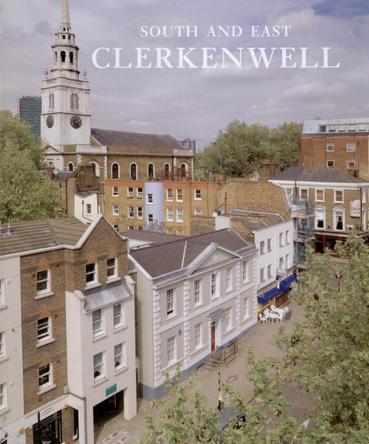
The photograph on the left is of Clerkenwell Green - and is taken from the cover of the excellent recent Survey of London volume on South and East Clerkenwell. It seems to be taken from the roof of the old Sessions House. The distinguished grey building in the foreground is the Marx Memorial Library - once a school, and then in the nineteenth century for twenty years the home of one of London's foremost radical working men's clubs, the Patriotic, and later hosted the Social Democratic Federation's press. Overshadowing it is St James, a fine eighteenth century church, and absolutely worth a visit. On the right is 'The Crown', a pub with a rich history - it was once a music hall. The Green itself - a misnomer, no grass has gown there for centuries - was in the Victorian era a venue for demonstrations, political meetings and street corner oratory.
Clerkenwell was once a bastion of artisan crafts such as watchmaking and bookbinding. There are a few, very few, remnants left of these trades. But it's still a wonderful part of London to walk round. I studied the politics of this area in the late Victorian period, when Clerkenwell was renowned for its radicalism. There's an article I wrote based on my research elsewhere on this site. I am very fond of the place.
I've posted below a review of the two Survey of London volumes covering Clerkenwell published in History Workshop Journal
Clerkenwell was once a bastion of artisan crafts such as watchmaking and bookbinding. There are a few, very few, remnants left of these trades. But it's still a wonderful part of London to walk round. I studied the politics of this area in the late Victorian period, when Clerkenwell was renowned for its radicalism. There's an article I wrote based on my research elsewhere on this site. I am very fond of the place.
I've posted below a review of the two Survey of London volumes covering Clerkenwell published in History Workshop Journal
Clerkenwell Tales
by Andrew Whitehead
Survey of London, volume 46: South and East Clerkenwell, edited by Philip Temple, Yale University Press for English Heritage, New Haven and London, 2008; xxxi + 468pp; £75 hbk; ISBN 9780300137279
Survey of London, volume 47: Northern Clerkenwell and Pentonville, edited by Philip Temple, Yale University Press for English Heritage, New Haven and London, 2008; xxi + 523pp; £75 hbk; ISBN 9780300139372
William John Pinks had been buried for five years in Highgate cemetery when his huge and ambitious History of Clerkenwell first appeared in book form. It is among the most impressive London parish histories of the Victorian era. The antiquarianism is tempered by contemporary anecdote and a keen social eye, and its 800 pages are enlivened by scores of engravings – among them one depicting the author’s grave. Pinks was himself a Clerkenwellian, apprenticed as a bookbinder, and later a full-time contributor to the ‘Clerkenwell News’, the first and most successful of London’s district papers. He died from TB at the age of thirty-one.
When J.T. Pickburn, the proprietor of the ‘Clerkenwell News’, published Pinks’s local history in 1865, it was the high water mark of prosperous, industrious Clerkenwell. A second edition, in essence unchanged, appeared in 1880 – the format of the book, reflecting Clerkenwell’s fortunes, a little more cramped and pinched in appearance. The ‘Clerkenwell News’ had by then metamorphosed into the much grander ‘Daily Chronicle’ which, as the ‘News Chronicle’, remained a leading national daily until 1960.
Clerkenwell, just north of the City, a little east of Fleet Street, Holborn and Kings Cross, but cordoned from the sink of the East End, sought to make the most of its location, but never quite achieved an enduring identity. It was joined with neighbouring St Luke’s in 1900 to form the borough of Finsbury, which was in turn merged into the London Borough of Islington in the 1960s. Its eclipse was so profound that few were sure where Clerkenwell was, and if it were not for a handful of street names the word would – as with Tyburn or Seven Dials – have become simply an echo of a distant past. The two commanding Clerkenwell novels, George Gissing’s The Nether World (1889) about the plebeian southern part of the parish and Arnold Bennett’s Riceyman Steps (1923) set amid the more aspiring but then almost as penurious northern squares, charted the decay and drift into anonymity. Two of the area’s northern-most landmarks and thoroughfares, Pentonville Road and The Angel, Islington, featured on the ‘Monopoly’ board devised in the 1930s, but at very much the cheaper end. By the 1960s, bomb damage, slum clearance, depopulation and a still more emphatic deindustrialisation, had dragged the area down to a sickly shadow of its incarnation a century earlier.
Pinks’s detail and erudition, and that displayed by an only slightly more modest parish history by Thomas Cromwell in 1828, provide some of the ballast for these two new volumes of the Survey of London. Indeed the Survey pays tribute in declaring that ‘[if] no later monographs on Clerkenwell have been as full as those of Cromwell and Pinks, that may point to the area’s declining pride’. Through the twentieth century, virtually nothing was written about Clerkenwell – certainly nothing to set alongside Pinks’s hefty volume. Then in 2001, a facsimile edition of Pinks’s history was published – and sold out. Clerkenwell reborn. Now these two Survey of London volumes are the first to outstrip Pinks in scope and ambition, and come close to matching him in their devotion to his parish. Clerkenwell resurgent!
It’s not quite so simple, of course. Which Clerkenwell, whose Clerkenwell, has come back into vogue? The talking up of the new Clerkenwell, more in the introductions and promotional material than in the body of these two fine books, may reflect a marketing strategy – given the price, just about the only non-library buyers are likely to be those enterprises which regard themselves as part of the Clerkenwell ‘renaissance’. Perhaps Clerkenwell is now a ‘prized location’, and ‘a synonym for urban regeneration and energy’ – but only a tithe of the old parish, the bounds of which define both Pinks’s and the Survey’s horizons, has partaken fully in the revival. It is ‘sometimes said there are more design firms today in Clerkenwell than anywhere else in Europe’, says the Survey. Maybe so, in the gentrified streets around Clerkenwell Green and St John’s Square. Of another corner of the parish, the Survey notes: ‘it has to be admitted that western Pentonville is hard work’. Even harder if you live there. Yet there is something rather splendid about the Survey of London’s venture into banlieus which, at first glance, are so unpromising.
If these volumes reflect a Clerkenwell revival, they also mark a new turn for a venerable historical and architectural project. ‘Because of Clerkenwell’s multiplicity of layers, these volumes’, the preface declares, ‘are probably the most complex to have been undertaken in the hundred-year span of the Survey of London’. They are fruits of a still fresh partnership with English Heritage; the first volumes to be published by Yale University Press; the first to make widespread use of colour photographs and images; indeed, the first to have photographs integrated with the text. Quite a makeover.
The result is a resounding success - meticulous scholarship, lucid writing, impressive picture research and superb presentation. The buildings of Clerkenwell are of course the focus of the study, and these are placed in a broad context – developing land use, changing patterns of transport and industry, popular and municipal politics, and even discussions or asides on topics as varied as literary representations of the area to the organised squats of the 1960s (‘an influential harbinger of gentrification’). While there is enormous detail about the more historically resonant sites, Sadlers Wells, St John’s Gate and the New River Head among them, the vernacular also attracts attention, whether the industrial dwellings and Peabody estates on Farringdon Road or the squares and circuses of Amwell.
Municipal Clerkenwell has as much to offer the architectural historian as the generous remnants from the eighteenth century or before. The Survey describes Finsbury Health Centre, designed for the borough council by Lubetkin and Tecton in the 1930s, as Clerkenwell’s most famous building. ‘Besides the hope it embodies for a brighter future, the rigour of the research expended on the project and the passion of its technics and aesthetics set the loftiest of standards for British modernism.’ It’s still there, a little hidden away to the east of Farringdon Road, adjoining a building of matching importance to the social historian, a purpose-built municipal Maternity and Child Welfare Centre from the mid-1920s. Berthold Lubetkin also built three renowned housing projects in Clerkenwell, and the volumes are diligent in describing the influence of the election of a Labour council in Finsbury in the mid-1930s, and of the power-play within its ranks which allowed left-wingers to commission building projects with vision and purpose.
The Survey of London is not intended to be a general history of the districts it describes. There are important aspects of Clerkenwell history that are glossed over: while there’s mention of the tradition of radical meetings at Clerkenwell Green and at Spafields, there’s no discussion of the area’s remarkable radical lineage from the late-eighteenth through to the mid-twentieth centuries; the artisanal basis of Victorian Clerkenwell is alluded to, but again there is no detailed account of the flourishing of highly skilled workshop crafts, watchmaking in particular, and of the impact of their sudden and almost complete collapse at the end of the nineteenth century. Yet there is space in these volumes for community. The cockneyesque enclaves of Exmouth Market and Chapel Market (the latter was, said Bert Lloyd as long ago as 1951, ‘one of the last atolls of the old-time cockney life’) get as much attention and esteem as the architectural glories of Sekforde Street or Britton Street (the latter known in Pinks’s era as Red Lion Street).
The attention given to individual buildings sometimes draws the Survey’s eye away from the collective impact. Take the view that features on the cover of the volume on south Clerkenwell. The scene from the top of the Sessions House looking over Clerkenwell Green takes in the Marx Memorial Library, the Crown Tavern, a section of Clerkenwell Close and the tower and spire of St James’s. It is an entrancing vista of the heart of an urban village, the area that Peter Ackroyd wrote about in his medieval mystery The Clerkenwell Tales (2003) set in and around the long demolished nunnery whose boundaries still define the serpentine route of Clerkenwell Close. Yet the Survey of London regards St James’s as pedestrian (‘a fairly plain Georgian preaching box’), dismisses the Marx Memorial Library as devoid of almost all its original fabric (the ‘stuccoed “Georgian” façade is a modern quasi-facsimile’), and largely ignores the Crown. The northern volume has Lloyd Square (‘one of the nicest squares in London’ according to Hugh Casson) gracing its dust jacket, part of the delightful early nineteenth century Lloyd Baker estate laid out on slopes which once led down to the Fleet river. ‘Few if any of the small estates around central London have so distinctive and memorable an architectural stamp’, the Survey declares with good reason – though it also castigates the estate’s Granville Square, harshly perhaps, for its ‘comparative banality’ and ‘dull’ house fronts.
Let’s not lose sight of the achievement of these twin volumes. The easy mix of authority and accessibility, colour photos as well as detailed floor plans, has saved the Survey of London from straying into architectural antiquarianism, and has provided a window on the social history of one of inner London’s most interesting and unduly neglected districts. It would be difficult to imagine anyone reading at length from these volumes without the desire to see for themselves – perhaps by taking the tube to Farringdon (the station dates from 1865), along the earliest stretch of what is now the underground, the excavation of which involved the demolition of some of the most notorious slums of mid-Victorian London.
The breadth of approach taken by the Survey – not simply recording today’s built environment, but retrieving earlier layers of land use and the underlying social and commercial pressures – offers a historical dynamic to the cityscape it describes. The enthusiasm with which the Survey team have taken to their task of studying the parish adds hugely to the insights and pleasure to be gained from these volumes - a sense of joy and discovery in which the reader, certainly this reader, becomes complicit.
That house on Clerkenwell Green
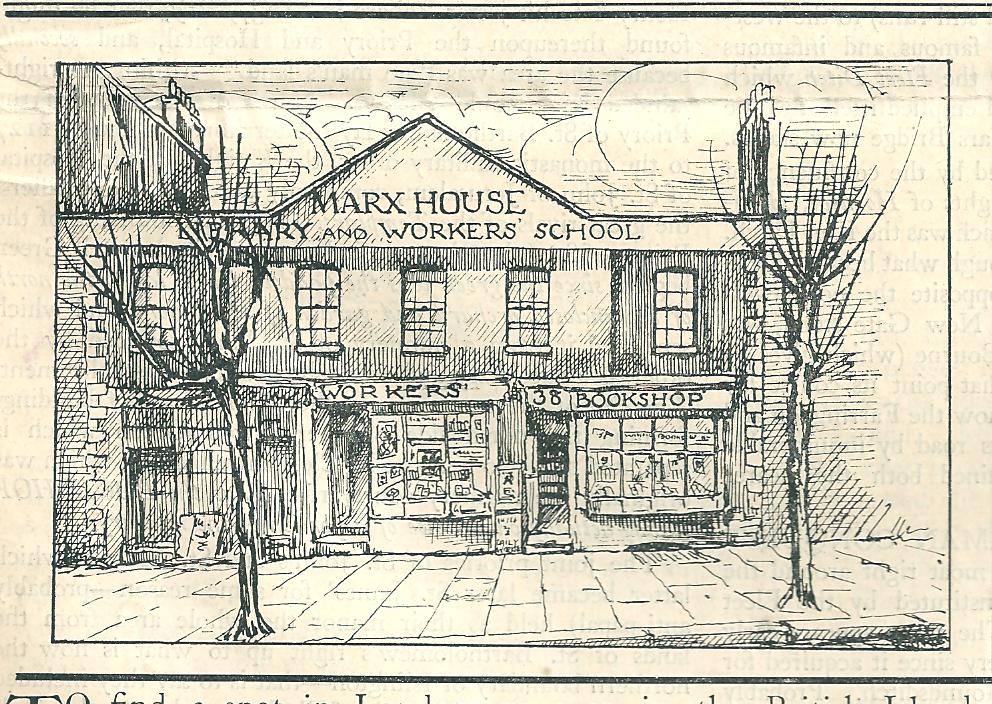
You see that demure building in a lighter shade of grey on the book cover at the top of the page - well, this is what it looked like in 1933. It was then, as it is now, Marx House - then a workers' library, educational centre and bookshop, and now the rather more forbidding Marx Memorial Library. It's a building with a richer radical pedigree than just about any in London.
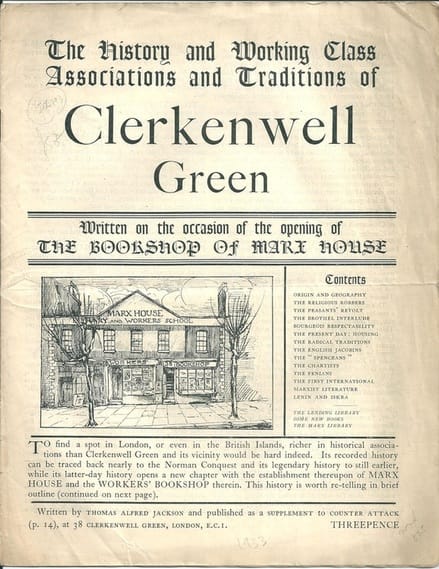
The drawing appeared on the cover of a pamphlet written by a Clerkenwellian, Tommy Jackson, reciting the radical associations of Clerkenwell Green - from the Peasants' Revolt, to the Jacobins, the Spenceans, the Chartists, Lenin's sojourn at this building and beyond.
Similar territory was covered a few years later by Andrew Rothstein, in his booklet A House on Clerkenwell Green.
This pamphlet, the author declares, 'was written by THOMAS ALFRED JACKSON, printer and writer by trade, born in Tysoe-street, CLERKENWELL, the son of Thomas Jackson, printer, born in Allen-street, Clerkenwell, the son of Alfred Jackson, watchmaker and jeweller, also born in Allen-street, Clerkenwell, the son of Henry Jackson, lock-smith and stove-maker, one-time sergeant-blacksmith in the Fifth Regiment, who was born in Suffolk.'
Similar territory was covered a few years later by Andrew Rothstein, in his booklet A House on Clerkenwell Green.
This pamphlet, the author declares, 'was written by THOMAS ALFRED JACKSON, printer and writer by trade, born in Tysoe-street, CLERKENWELL, the son of Thomas Jackson, printer, born in Allen-street, Clerkenwell, the son of Alfred Jackson, watchmaker and jeweller, also born in Allen-street, Clerkenwell, the son of Henry Jackson, lock-smith and stove-maker, one-time sergeant-blacksmith in the Fifth Regiment, who was born in Suffolk.'
Twenty years later, in 1953, Tommy Jackson explored his Clerkenwell roots, and how it moulded his politics, in his exceptionally engaging autobiography, Solo Trumpet - I remember it was the historian Raphael Samuel who first put me on to reading it. Jackson died two years later - news which made the front page of the communist 'Daily Worker'.
Clerkenwell in literature
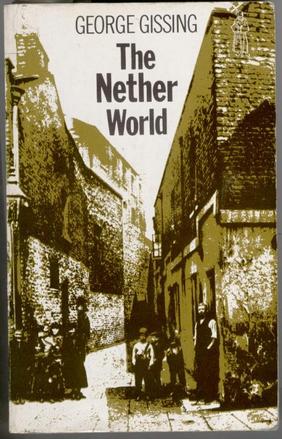
George Gissin'g The Nether World is the commanding Clerkenwell novel - I've written about it briefly on the London Fictions page of this site, and at greater length on a new London Fictions site. It's a depressing book in many ways, but acutely observed. He took the trouble to walk Clerkenwell's streets and listen it to radical meetings. It tells you hugely more about the place than a parish history ever could.
Arnold Bennett's Riceyman Steps is also set in Clerkenwell. While The Nether World is largely about the area around Clerkenwell Green, the steps Bennett had in mind - they are still there - run from just off Farringdon Road to Granville Square, one of the more humdrum squares amid the architectural magnificence of the Amwell estates. At the time Bennett was writing however - the novel was published in 1923 - the area was down-at-heel, and the story concerns a miserly bookseller, (there's a great website 'Walking Riceyman Steps' which is much recommended).This district was still distinctly tatty when B.S. Johnson wrote about in Albert Angelo, an experimental novel published in 1964
Clerkenwell also features in the writing of Charles Dickens (Oliver Twist fails in his first attempt at kerchief picking on Clerkenwell Green) and of William Hale White. It's also the setting for Peter Ackroyd's Clerkenwell Tales - a story of religious and political intrigue in the medieval period.
Arnold Bennett's Riceyman Steps is also set in Clerkenwell. While The Nether World is largely about the area around Clerkenwell Green, the steps Bennett had in mind - they are still there - run from just off Farringdon Road to Granville Square, one of the more humdrum squares amid the architectural magnificence of the Amwell estates. At the time Bennett was writing however - the novel was published in 1923 - the area was down-at-heel, and the story concerns a miserly bookseller, (there's a great website 'Walking Riceyman Steps' which is much recommended).This district was still distinctly tatty when B.S. Johnson wrote about in Albert Angelo, an experimental novel published in 1964
Clerkenwell also features in the writing of Charles Dickens (Oliver Twist fails in his first attempt at kerchief picking on Clerkenwell Green) and of William Hale White. It's also the setting for Peter Ackroyd's Clerkenwell Tales - a story of religious and political intrigue in the medieval period.
The 'real' Riceyman Steps
This is a marvellous image of the locality Arnold Bennett used as the setting of Riceyman Steps at just the time the book was published. It's dated November 1924, a year after publication, and is taken from sketches by Hanslip Fletcher, published in the Sunday Times and then as a collection of sketches, Changing London. It's remarkable that the steps had taken on their fictional name so quickly after Bennett's novel appeared - they had been called Granville Place or Steps and are now known as Gwynne Place.
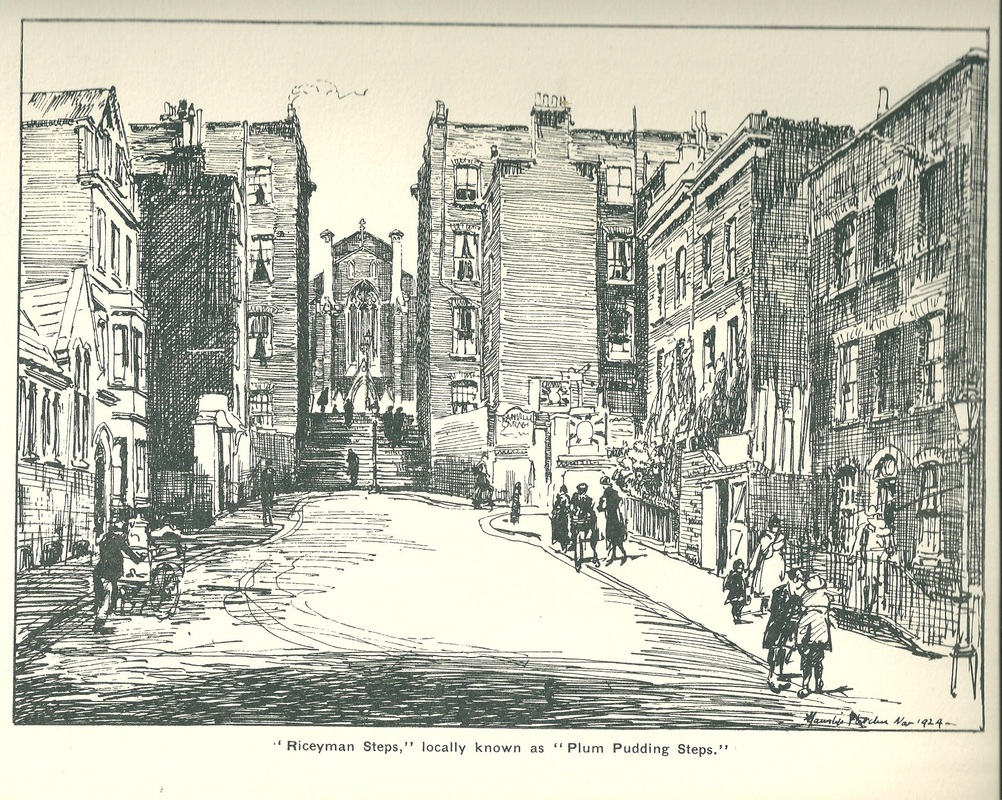
Most of the buildings shown here have been cleared. The steps survive, accessed through a non-descript modern hotel which fronts Kings Cross Road. The church you can see is St Philip's, Granville Square - it closed in 1936 and was demolished soon after.
And in post-war literature
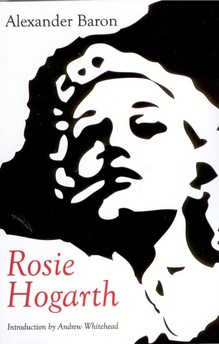
Alexander Baron is best known for his war novel From the City From the Plough, and his account of an obsessive gambler living in Dalston, The Lowlife. Rosie Hogarth (1951) deserves equal billing in his work - a strong novel and Baron's first set in London, a city which he knew intimately and loved deeply.
It's set immediately after the Second World War in the northernmost part of the old Clerkenwell parish - a respectable, working class terraced street close to Chapel Market, just north of Pentonville Road. Baron offered a powerful and evocative sense of place - and wrote a tender account of a close-knit, insular community trying to refind its feet after the dislocations of war and its aftermath.
Chapel Market remains a defiantly plebeian island amid gentrified south Islington. You can get still get a vicarious sense of the community Baron depicted. There's a more substantial account of the novel, and the manner of its account of the fictional 'Lamb Street', here. This includes a deciphered copy of the novel's original dust jacket, which at first glance looks like an abstract drawing but is in fact a detailed and very accurate map of the locality which features in the novel.
It's set immediately after the Second World War in the northernmost part of the old Clerkenwell parish - a respectable, working class terraced street close to Chapel Market, just north of Pentonville Road. Baron offered a powerful and evocative sense of place - and wrote a tender account of a close-knit, insular community trying to refind its feet after the dislocations of war and its aftermath.
Chapel Market remains a defiantly plebeian island amid gentrified south Islington. You can get still get a vicarious sense of the community Baron depicted. There's a more substantial account of the novel, and the manner of its account of the fictional 'Lamb Street', here. This includes a deciphered copy of the novel's original dust jacket, which at first glance looks like an abstract drawing but is in fact a detailed and very accurate map of the locality which features in the novel.
Though not always great literature
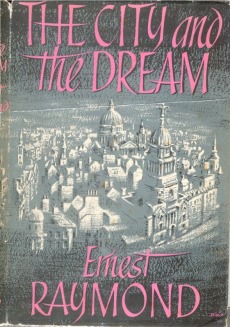
It's difficult to think of a more Clerkenwellian novel than this 1958 title, set in and around a rather grimy Red Lion Street in the 1920s. A struggling clerk, Kerry Betterkin, dreams of being an author, but his first book, a historical novel 'Green and Pleasant Clerkenwell', bombs. His next book, with more commonplace characters, is a runaway success. So he is able to marry his girlfriend at St James's.
Not a great plot, and the characterisation is no better - but amid the references to medieval Clerkenwell, there's quite a lot about the area in its lean decades. And there's certainly a lot of Clerkenwell - from first page to closing page.
This was the final title in Raymond's multi-volume 'A London Gallery', an enterprise that took him more than a quarter of a century, and is now as little remembered as, well, Betterkin's 'Green and Pleasant Clerkenwell'.
An effortless read, but hardly a match for Bennett or Gissing.
Not a great plot, and the characterisation is no better - but amid the references to medieval Clerkenwell, there's quite a lot about the area in its lean decades. And there's certainly a lot of Clerkenwell - from first page to closing page.
This was the final title in Raymond's multi-volume 'A London Gallery', an enterprise that took him more than a quarter of a century, and is now as little remembered as, well, Betterkin's 'Green and Pleasant Clerkenwell'.
An effortless read, but hardly a match for Bennett or Gissing.
And Dickens's Clerkenwell
Here's an audio walk through the Islington and Clekenwell of Charles Dickens's Oliver Twist:
http://www.guardian.co.uk/books/interactive/2011/sep/23/charles-dickens-walk-oliver-twist-interactive?CMP=twt_gu
'Follow Oliver Twist's walking route with Jon Henley and Veronica Horwell from Angel Islington to the courthouse of Mr Fang the magistrate in Clerkenwell.
This walking tour can be downloaded on to your MP3 player or mobile and used as an audio guide on location along with the map, which you can print out or use on your phone
You can also download this beautiful illustrated version of the map and print it out to take with you on your tour'
http://www.guardian.co.uk/books/interactive/2011/sep/23/charles-dickens-walk-oliver-twist-interactive?CMP=twt_gu
'Follow Oliver Twist's walking route with Jon Henley and Veronica Horwell from Angel Islington to the courthouse of Mr Fang the magistrate in Clerkenwell.
This walking tour can be downloaded on to your MP3 player or mobile and used as an audio guide on location along with the map, which you can print out or use on your phone
You can also download this beautiful illustrated version of the map and print it out to take with you on your tour'
Finsbury Health Centre
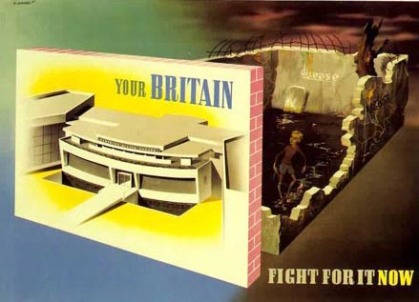
A 1943 poster by Abram Games with the frontage of the FHC
The Survey of London describes the Finsbury Health Centre just off Farringdon Road as the most famous building in Clerkenwell.
It was born out of municipal concern for the health of London's poor - an initiative of the left-leaning Finsbury Borough Council in the 1930s. And the design was the work of one of the most renowned modernist architects, Berthold Lubetkin. 'Besides the hope it embodies for a brighter future', says the Survey's recent volume on Northern Clerkenwell and Pentonville, 'the rigour of the research expended on the project and the passion of its technics and aesthetics set the loftiest of standards for British modernism.'
How sad, then, that the Pine Street building is now semi-derelict and that there's real concern about its future. There's now a 'Save Finsbury Health Centre' campaign, seeking to ensure that the centre is repaired and remains a place where the local community can access health services. The 'Guardian' - for many years based close by - recently reported on the battle over the future of the building. Given its pioneering social and architectural importance, it deserves a secure future serving the people of Clerkenwell.
It was born out of municipal concern for the health of London's poor - an initiative of the left-leaning Finsbury Borough Council in the 1930s. And the design was the work of one of the most renowned modernist architects, Berthold Lubetkin. 'Besides the hope it embodies for a brighter future', says the Survey's recent volume on Northern Clerkenwell and Pentonville, 'the rigour of the research expended on the project and the passion of its technics and aesthetics set the loftiest of standards for British modernism.'
How sad, then, that the Pine Street building is now semi-derelict and that there's real concern about its future. There's now a 'Save Finsbury Health Centre' campaign, seeking to ensure that the centre is repaired and remains a place where the local community can access health services. The 'Guardian' - for many years based close by - recently reported on the battle over the future of the building. Given its pioneering social and architectural importance, it deserves a secure future serving the people of Clerkenwell.
Pinks's 'Clerkenwell'
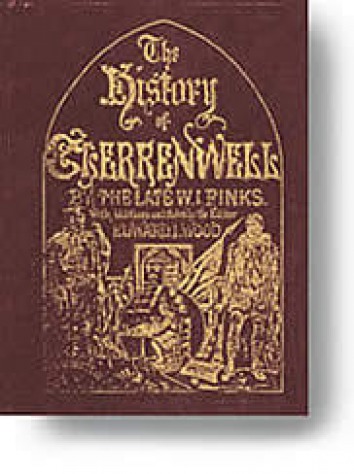
A century and a half ago, William John Pinks wrote one of the most remarkable and impressive of London parish histories. He had been buried for five years in the west side of Highgate Cemetery when his voluminous History of Clerkenwell first appeared in book form. Pinks's antiquarian approach is tempered by contemporary anecdote and keen social observation, and its 800 pages are enlivened by scores of engravings - among them one showing the author's grave.
Pinks was himself a Clerkenwellian, apprenticed as a bookbinder, and later a full-time contributor to the 'Clerkenwell News', perhaps the most successful of London's Victorian-era district papers (it became the 'Daily Chronicle'). He died from TB aged 31. When J.T. Pickburn, proprietor of the 'Clerkenwell News', published Pinks's local history in 1865, it was the high water mark of prosperous, industrious Clerkenwell. A second edition, in essence unchanged, appeared in 1880 - the format of the book, reflecting Clerkenwell's fortunes, a little more cramped and pinched in appearance.
Through the last century, virtually nothing was written about Clerkenwell. the area lost its municipal identity when it was merged with St Luke's in 1900 to form the borough of Finsbury. This was in turn merged into the London Borough of Islington in the 1960s. Slum clearance, depopulation, the decline of artisan crafts and deindustrialisation all contributed to the decline of Clerkenwell.
From the 1970s, the gentrification of Amwell and some other pockets of Georgian and early Victorian housing, and the growing the popularity of the area with architect and design companies, contributed to a modest resurgence. Clerkenwell began to mean something again. The republication in 2001 of Pinks's history in facsimile form was itself a reflection of a resurgent Clerkenwell. The Survey of London volumes about Clerkenwell published in 2008 are the first to lavish as much care and attention on the district and its built environment as Pinks, and pay proper tribute to the pre-eminent historian of the district. (These paragraphs borrow from a review I write for History Workshop Journal in 2009, posted above).
Pinks was himself a Clerkenwellian, apprenticed as a bookbinder, and later a full-time contributor to the 'Clerkenwell News', perhaps the most successful of London's Victorian-era district papers (it became the 'Daily Chronicle'). He died from TB aged 31. When J.T. Pickburn, proprietor of the 'Clerkenwell News', published Pinks's local history in 1865, it was the high water mark of prosperous, industrious Clerkenwell. A second edition, in essence unchanged, appeared in 1880 - the format of the book, reflecting Clerkenwell's fortunes, a little more cramped and pinched in appearance.
Through the last century, virtually nothing was written about Clerkenwell. the area lost its municipal identity when it was merged with St Luke's in 1900 to form the borough of Finsbury. This was in turn merged into the London Borough of Islington in the 1960s. Slum clearance, depopulation, the decline of artisan crafts and deindustrialisation all contributed to the decline of Clerkenwell.
From the 1970s, the gentrification of Amwell and some other pockets of Georgian and early Victorian housing, and the growing the popularity of the area with architect and design companies, contributed to a modest resurgence. Clerkenwell began to mean something again. The republication in 2001 of Pinks's history in facsimile form was itself a reflection of a resurgent Clerkenwell. The Survey of London volumes about Clerkenwell published in 2008 are the first to lavish as much care and attention on the district and its built environment as Pinks, and pay proper tribute to the pre-eminent historian of the district. (These paragraphs borrow from a review I write for History Workshop Journal in 2009, posted above).
The Clerks' Well
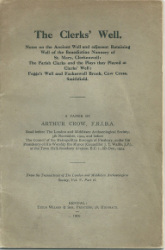
This pamphlet, illustrated with grainy black-and-white photos, was published a few months after the well from which Clerkenwell took its name was rediscovered. It's in Farringdon Lane and is open to the public by appointment - there is a none too appetising picture of the well as it is now, looking like a rather grotty latrine, on this Islington Council site.
The well was found during rebuilding work in 1924. At the time, Clerkenwell was part of the Borough of Finsbury - and this detailed account of the well and its reappearance was delivered before the council as well as at a meeting of the London and Middlesex Archaeological Society.
I bought this pamphlet from the excellent Walden book shop in Chalk Farm, which always has an excellent selection of books about London.
The well was found during rebuilding work in 1924. At the time, Clerkenwell was part of the Borough of Finsbury - and this detailed account of the well and its reappearance was delivered before the council as well as at a meeting of the London and Middlesex Archaeological Society.
I bought this pamphlet from the excellent Walden book shop in Chalk Farm, which always has an excellent selection of books about London.
Walking the Cally Road
It's not really Clerkenwell, except the southernmost end - but it's wonderful all the same. Alan Dein's audio journey and slide show down the Caledonian Road - popping in to Housmans, among other places. Give it a try!