I've now posted a full write up of the history of 'The Land Song' on the History Workshop Online site - here's the link, do please take a look, there's audio, video and images. (I've reposted the text below).
I've also posted here radio features about the song, plus a copy its original rendition back in 1910
I've also posted here radio features about the song, plus a copy its original rendition back in 1910
And almost twenty years later, here's another look at the song - prompted by the Liberal Democrats entering a coalition government and the discovery of a 78rpm disc of the song recorded in 1910:
When I was researching the song's history, and its huge popularity particularly in the double election year of 1910 when it became a key part of the Liberals' campaign, I came across newspaper references to the song blaring out from gramophones.
It took quite a search to track down the recording. But with the help of the Scarce Sounds website, I have found a 78rpm disc - released early in 1910 - with George Hardy's renditions of 'The Land Song' and on the B side, 'Land Monopoly'. The song is accompanied by quite a lively brass section and is a touch slower in pace than I had expected. I know nothing of George Hardy, whose style of delivery is best described as idiosyncratic. 'The Laaaaaand' he sings:
The Great Liberal Anthem 'The Land Song' - recorded in 1910
'The Land Song'
'The Land Song' is little known beyond the ranks of the Liberal Democrats' Glee Club - but it is one of the best political songs around. Michael Foot, among others, regarded it as his favourite political anthem.
It's sung to the tune of 'Marching through Georgia' and its origins lie in the United States in the 1880s, when Henry George developed a lively campaign in furtherance of "the single tax" on land. When a Liberal government sought to introduce a tax on land in Lloyd George's 'People's Budget' of 1909, 'The Land Song' became the anthem of Liberal radicals.
The song sheet on the left dates from this time - it's from the Centre for Political Song at Glasgow Caledonian University and is posted here with the Centre's permission.
Thc chorus of 'The Land Song' runs:
The Land, The Land, 'Twas God that made the land
The Land, The Land, the ground on which we stand
Why should we be beggars with the ballot in our hand.
God gave the land to the people!
The song was rediscovered by a new generation of radical Liberals in the 1960s, and remains the opening song of the Glee Club, an institution which still thrives at Liberal Democrat conference - indeed 'Liberator' publishes a song book specially for the occasion.
Here's where to go for my full account of the song and its history (the text is also posted below)- and this article has also been republished in the Journal of Liberal History.
It's sung to the tune of 'Marching through Georgia' and its origins lie in the United States in the 1880s, when Henry George developed a lively campaign in furtherance of "the single tax" on land. When a Liberal government sought to introduce a tax on land in Lloyd George's 'People's Budget' of 1909, 'The Land Song' became the anthem of Liberal radicals.
The song sheet on the left dates from this time - it's from the Centre for Political Song at Glasgow Caledonian University and is posted here with the Centre's permission.
Thc chorus of 'The Land Song' runs:
The Land, The Land, 'Twas God that made the land
The Land, The Land, the ground on which we stand
Why should we be beggars with the ballot in our hand.
God gave the land to the people!
The song was rediscovered by a new generation of radical Liberals in the 1960s, and remains the opening song of the Glee Club, an institution which still thrives at Liberal Democrat conference - indeed 'Liberator' publishes a song book specially for the occasion.
Here's where to go for my full account of the song and its history (the text is also posted below)- and this article has also been republished in the Journal of Liberal History.
Michael Foot on 'The Land Song'
.
I interviewed Michael Foot back in November 1990 about 'The Land Song' after he had made reference to it in a 'Guardian' book review. This is the full account of what he told me:
‘I was brought up in a Liberal household down in Cornwall and Plymouth. My father was a Liberal Member of Parliament, a radical Liberal, and he taught me the song. Way back in the 1920s, I heard the song being sung. It wasn’t only the Liberals who sang it – it was sung by many others as well. I’m not quite sure who invented it. Lloyd George adopted it when he carried out his land campaign, and his attack on the landlords in 1909, 1910, and all the associated People’s Budget. And ‘The Land Song’ was the one which really seemed to strike terror into the hearts and minds of the landlords – as it should because it was directed at them.
‘I don’t mean any insult to other songs. There have been some very good songs: ‘England Arise’, which was the socialist song, was a very good song too, and in a sense that was the one that was most popular among the growing socialist or Labour parties at the beginning of the century; the ‘Internationale’ was a song which covered the whole world, and came back to England having travelled all round the continent; and the ‘Red Flag’ too, which became more officially the Labour Party song. All of them are very good songs. But for sheer effectiveness, and for a simple democratic message, I think ‘The Land’ still retains the vibrance and rhythm I’ve mentioned. It finishes up with the chorus:
Why should we be beggars with the ballot in our hand
God gave the land to the people.
'So it’s not only a land song, and it’s much more than a Liberal song, it’s a song that summarises the democratic case – how in fact, in order to achieve what people wanted, they should use their democratic powers, they were only just getting those democratic powers, to ensure there was a proper division of the landed property in the country.
‘It wasn’t a song sung only by Liberals. I can assure you that socialists were singing that song even more rightly and justly than Liberals were doing.’
For the audio of Michael Foot talking about The Land Song, and other prominent personalities talking about their favourite political song - click here
‘I was brought up in a Liberal household down in Cornwall and Plymouth. My father was a Liberal Member of Parliament, a radical Liberal, and he taught me the song. Way back in the 1920s, I heard the song being sung. It wasn’t only the Liberals who sang it – it was sung by many others as well. I’m not quite sure who invented it. Lloyd George adopted it when he carried out his land campaign, and his attack on the landlords in 1909, 1910, and all the associated People’s Budget. And ‘The Land Song’ was the one which really seemed to strike terror into the hearts and minds of the landlords – as it should because it was directed at them.
‘I don’t mean any insult to other songs. There have been some very good songs: ‘England Arise’, which was the socialist song, was a very good song too, and in a sense that was the one that was most popular among the growing socialist or Labour parties at the beginning of the century; the ‘Internationale’ was a song which covered the whole world, and came back to England having travelled all round the continent; and the ‘Red Flag’ too, which became more officially the Labour Party song. All of them are very good songs. But for sheer effectiveness, and for a simple democratic message, I think ‘The Land’ still retains the vibrance and rhythm I’ve mentioned. It finishes up with the chorus:
Why should we be beggars with the ballot in our hand
God gave the land to the people.
'So it’s not only a land song, and it’s much more than a Liberal song, it’s a song that summarises the democratic case – how in fact, in order to achieve what people wanted, they should use their democratic powers, they were only just getting those democratic powers, to ensure there was a proper division of the landed property in the country.
‘It wasn’t a song sung only by Liberals. I can assure you that socialists were singing that song even more rightly and justly than Liberals were doing.’
For the audio of Michael Foot talking about The Land Song, and other prominent personalities talking about their favourite political song - click here
'The Land Song' as sung at the Lib Dem Glee Club in about 1990
You can sense the enthusiasm with which The Land Song was sung at the Glee Club - this rendition of a verse and a chorus is from about 1990.
'The Land Song' as sung at the 2009 Liberal Democrat conference
The YouTube rendition above was at the Lib Dem Glee Club at Bournemouth in September 2009 - a century after Lloyd George's 'People's Budget' which propelled the song to prominence in British politics. Whether the singing is any more polished than that of George Hardy a century ago - posted at the top of this page - well, make up your own mind.
'God Gave the Land to the People': the Liberal Land Song
=Andrew Whitehead=
Britain’s ‘best political song’, yet many political insiders have never heard it sung. More than a century old, ‘The Land Song’ dates back to the glory days of Lloyd George Liberalism, and was revived from the 1960s by a new generation of Liberal radicals. History Workshop Journal editor Andrew Whitehead pursues the song’s history – discovers its only commercial recording – and traces the song’s contemporary echoes to the conference hotels of Bournemouth and Liverpool:
Why should we be beggars with the ballot in our hand
God gave the land to the people!
These lines are the rousing climax to a song which many who know it maintain is Britain’s most stirring political anthem. ‘The best political song I was ever taught to sing’, declared the former leader of the Labour party, Michael Foot. He was speaking of a radical anti-landlord song which first became popular in the Edwardian era and ‘which stressed at the same time, in the same rhythmic breath, the identity of the real enemy and the means for his overthrow’ [Guardian, 18 October 1990]. Not a socialist song, however, but a liberal rallying tune. And still sung as such. Every year, more than a century after its heyday, ‘The Land Song’ is the opening number at an event with good claim to be the country’s best political sing-song, at the Liberal Democrats’ party conference.
My own familiarity with - and indeed non-partisan affection for – ‘The Land Song’ dates back twenty years or more, to my time as a lobby correspondent. For several years either side of the end of the Thatcher era, I used to spend a large part of the autumn traipsing around those seaside resorts which had managed to stave off hibernation at the end of the holiday season by attracting a party conference. Although we imagine that the dominance of the two main parties has only recently been challenged, circa 1990 the caravan of political correspondents rolled relentlessly for weeks on end: the Trades Union Congress, still a ‘must attend’ event back then; two centre party gatherings, Liberals (later Liberal Democrats) and Social Democrats; Labour; the Conservatives; and sometimes a quick jaunt north of the border to sample a resurgent Scottish National Party.
It was at this time that I first came across the Liberal Democrat Glee Club, a loud, late night and hugely well attended revue and ‘everybody join in’ evening of song: skits, lampoons, and some period pieces from the glory days of liberal radicalism. Of these, ‘The Land Song’, rendered at a gallop to the tune of ‘Marching through Georgia’, was always the first to be sung and the audience’s favourite. Although I considered myself one of the political cognoscenti, I had never come across this rousing song – nor, since my student days at the ‘Greyhound’ on Oxford’s Gloucester Green, had I encountered a lively forum for political song. I did a little light digging and feature reporting about the Liberal song tradition, but my career took me away from Westminster and party conferences and my fleeting interest in political song subsided.
In September 2009, I headed to the comfortable south coast resort of Bournemouth, once again as a journalist, to attend my first Liberal Democrat conference for almost twenty years. I wondered whether the Glee Club, hardly an event to suggest a contemporary cutting edge, might have fallen victim to a party drive towards sobriety and the political centre ground. It hadn’t. The evening was still organised by ‘Liberator’, a journal which regards itself as the disrespectful, radical ginger group within Britain’s third ranking political party. As an aide to participants, they publish a book of lyrics, underlining just how seriously liberals, architects of community politics, take their community singing. The 2009 edition was the twentieth, ran to forty-eight pages and had the words to more than seventy songs.
A little after ten o’clock at night, the Glee Club got underway with what those attending would regard without question as the liberal anthem – a song almost completely unknown outside party ranks. The words read:
Sound the call for freedom boys, and sound it far and wide,
March along to victory for God is on our side,
While the voice of nature thunders o’er the rising tide,
“God gave the land to the people!”
Chorus: The land, the land, ‘twas God who made the land,
The land, the land, the ground on which we stand,
Why should we be beggars with the ballot in our hand?
God made the land for the people.
Hark the sound is spreading from the East and from the West,
Why should we work hard and let the landlords take the best?
Make them pay their taxes on the land just like the rest,
The land was meant for the people.
Clear the way for liberty, the land must all be free,
Liberals will not falter from the fight, tho’ stern it be,
‘Til the flag we love so well will fly from sea to sea
O’er the land that is free for the people.
The army now is marching on, the battle to begin,
The standard now is raised on high to face the battle din,
We’ll never cease from fighting ‘til victory we win,
And the land is free for the people.
It’s never sung sitting down. On the chorus words ‘the land’, those assembled gently punch the air – and as they sing ‘why should we be beggars with the ballot in our hand’, everyone waves their song book as if an imaginary ballot paper. As I left the Glee Club at coming up to one o’clock in the morning, about 300 cheery conference delegates were singing ‘The Land Song’ for a second time – there’s a video of a rather bacchanalian rendition on You Tube.
Any song so loved, so carefully nurtured as an emblem of radicalism, must have quite a story. The Liberator Song Book provides, as befits such a serious minded movement, a brief historical note of all the items it contains. Those dating from the Liberals’ wilderness years need little explanation: ‘Losing Deposits’ sung to the tune of ‘Waltzing Matilda’, for instance. Others are weary recognition of the effort involved in outreach politics, such as ‘Climb Every Staircase’ to the music of ‘Climb Every Mountain’.
The swathe that date from the convulsions and excitements of the rise of the SDP in the 1980s, in alliance with the Liberals, sometimes need a little more context: ‘If you were the only Shirl in the world, and I were the only Woy’, for example, refers to two of the “gang of four” prominent Labour defectors who founded the SDP, and later were prominent in the Liberal Democrats. The Glee Club crowd tended to regard the Social Democrats as ‘soggies’, that is insufficiently radical and too concerned about their political careers. The alliance and subsequent merger prompted, a little like grit in the oyster, some pearls of the modern satirical political song.
Of ‘The Land Song’, the Liberator Song Book briefly records that its origins lay in the American land tax movement. ‘Liberals adopted the song in the two general elections of 1910, following the rejection by the House of Lords of Lloyd George’s 1909 People’s Budget, which proposed a tax on land.’ That made the Bournemouth sing-song a centenary rendition. Revitalised by the occasion, I sought to discover the song’s inception, the extent of its popularity among Lloyd George-era Liberal land campaigners, and the reasons for its restitution by Liberal radicals two generations later in part as a statement of political lineage. In the course of this quest, I have come across the only commercial recording of ‘The Land Song’ – a 78 rpm disc from 1910 – which is posted as part of this article. What I have failed to understand is why such a resonant anthem, which evokes strong identification and loyalty among those who still sing it, has such an inconspicuous place in the winder pantheon of political song.
FROM CHICAGO TO TRAFALGAR SQUARE
The words of ‘The Land Song’ appeared in a single tax publication in Chicago in 1887. No author was cited [Foner, pp261-2]. It was to be sung to the tune of ‘Marching through Georgia’, the stirring march composed a generation earlier at the end of the American Civil War which quickly became popular among veterans of the northern Union army. The lyrics have changed barely at all since that early published version.
The campaign for a single tax on the unimproved value of land was indelibly associated with Henry George, whose 1879 book Progress and Poverty was immensely influential on both sides of the Atlantic. There was a crusading air to the Georgite movement. The campaign for a land tax was not simply a fiscal measure, but was intended to challenge the large landowners and their influence and so promote the social and economic interests and political empowerment of the working class. There was also an arcadian aspect to the movement, seeking to break up land ownership and so encouraging homesteads and a return to the land. Some socialists argued that taxing rather than nationalising land was inadequate, and that an emphasis on land rather than industrial ownership was out-of-date, but George was a charismatic figure and a substantial political economist and he became a beacon around whom American and British radicals gathered. His unsuccessful campaign in 1886 as the United Labour Party candidate for mayor of New York – on a democratic platform which extended far beyond the land issue – attracted huge attention. One of the issues arising from that contest was the demand for uniform printed ballot papers, a theme reflected in ‘The Land Song’.
Henry George visited Britain five times in the course of the 1880s to campaign on land issues. There was a long British tradition of emphasis on land reform, both within mainstream politics and, on the radical fringes, from Thomas Spence to the Chartist Land Plan and the small but influential group of followers of Bronterre O’Brien. Henry George’s ideas and activities attracted the attention of several of those who were to become leading members of the most important of the socialist organisations of the 1880s, the Social Democratic Federation. Indeed, his influence has been recognised as one of the factors behind the British socialist revival of the last two decades of the century [Pelling, pp10, 18-25]. Henry Hyde Champion, an army officer who became a key figure within the SDF and at the founding of the Independent Labour Party, was one of several activists impressed both by George and the arguments he presented in Progress and Poverty. ‘For many thoughtful people in the early eighties’, Champion’s biographer has argued, ‘George’s writings were the catalyst which changed their whole conception of what might be done to end the poverty and injustice which was being exposed.’ [Barnes, pp20-23] Yet while George helped to attract young radicals towards socialism, many quickly moved away from his single-minded focus on a land tax.
There is nothing to indicate that Henry George and his followers brought ‘The Land Song’ to Britain during his lifetime, or that it found any echo among British socialists of that era. The song achieved a resonance as part of a different political tradition, Liberalism, which proved a more congenial home to land taxers. Henry George and his work attracted some determined partisans among Liberal radical activists. His ideas ‘appealed to their dissenting natures and brilliantly touched on all the big issues that were close to their hearts. With an analysis of poverty and deprivation that was simple, it identified an obvious enemy and offered a clear solution. George believed in the underlying goodness of human nature, disliked bureaucracy and saw feudal, rather than capitalist, oppression as the source of all evil. He provided a faith, not simply a political belief.’ [Mulvey, ‘Radicalism’s Last Gasp?’]
1905-06 LIBERAL LANDSLIDE
One of the most enthusiastic devotees was Josiah Wedgwood, a member of the pottery dynasty, who entered Parliament as a Liberal representing Newcastle-under-Lyme in the general election at the close of 1905. He had by then, according to his memoirs, already been won over to the single tax. ‘Henry George’, he wrote, ‘gave me those sure convictions on free trade and the taxation of land values which have been at once my anchorage and my object in politics. Even before I reached Parliament I had become a pamphleteer, a propagandist and a missionary. … Ever since 1905 I have known “that there was a man from God, and his name was Henry George”. I had no need henceforth for any other faith.’ [Wedgwood, p60]
The Liberal landslide in that general election offered an opportunity for implementing a land tax. Josiah Wedgwood took upon himself a role as a Parliamentary leader of the ‘single taxers’. He did so with energy and a fair measure of success. The Parliamentary Land Values Group claimed 280 members, though most supported a land valuation to allow a modest tax on land rather than the full rigour of a ‘single tax’. In November 1908, Wedgwood presented to the Prime Minister a petition in favour of the taxation of land values signed by 241 Liberal and Labour MPs. The land tax campaign was pursued vigorously at local and national levels, and won the support of several of the main Liberal newspapers.
LLOYD GEORGE AND THE “PEOPLE’S BUDGET”
The breakthrough came in January 1909 when the chancellor, David Lloyd George, promised that the taxation of land values would be implemented in his next budget. He favoured a one penny in the pound tax on all land and a national land valuation to make that possible. By the time the budget was delivered, the scope of the tax had been watered down, and agricultural land was specifically exempted from the proposed capital value tax, but the principle of land taxation had been established and the national valuation made it feasible.
To the delight of the single tax lobby, in July 1909 Lloyd George followed up his budget with a vitriolic speech at Limehouse denouncing large landowners. Two weeks later, a Great Land Reform Demonstration provided a powerful display of support for the taxation of land. According to Josiah Wedgwood, one of the sponsors and principal speakers, 100,000 demonstrators marched from the Embankment to be addressed from twenty speaking platforms in Hyde Park. ‘It was on a river trip to celebrate this demonstration’, Wedgwood recalled in his Memoirs, ‘that the “Land Song” was born to the tune of “Marching through Georgia”.’ [Wedgwood, p.68] Josiah Wedgwood and his wife were certainly guests on a steam launch which embarked from Richmond on the Sunday after the demonstration to mark its success, though the account of the trip in the land taxers’ journal makes no reference to any song [Land Values, Aug 1909]. How exactly it was devised Wedgwood does not explain – though as an enthusiast for the Northern side in the American Civil War, he would have been familiar with the tune. It was clearly an adoption of the American Georgite song rather than a new birth, and Wedgwood’s account appears to have some basis for from late 1909, references start to appear to the singing of ‘The Land Song’ at political meetings.
The 1909 budget prompted one of the most profound constitutional crises of the century. The House of Lords defied convention by rejecting the budget, largely because of the measures to tax land. In November, Parliament Square became a gathering point for protestors. On the last day of the month, a crowd again gathered in spite of a ban on demonstrations there. ‘It was not till after 9 o’clock that the partisanship of a section became apparent by cheering and “booing”. The “Land Song” was started but was soon stopped by police, and mounted officers were used to clear away one or two groups of men who attempted to stand their ground in the Square.’ [Times, 1 Dec 1909] A few days later, demonstrators gathered in Trafalgar Square, passing time by ‘singing popular political songs, the chief being “The Land Song”, with its constant refrain “God save the land for the people” [sic].’ [Times, 6 Dec 1909] In the excited political atmosphere, the song became enormously popular as a rallying call for supporters of the Lloyd George budget and the radical agenda it represented.
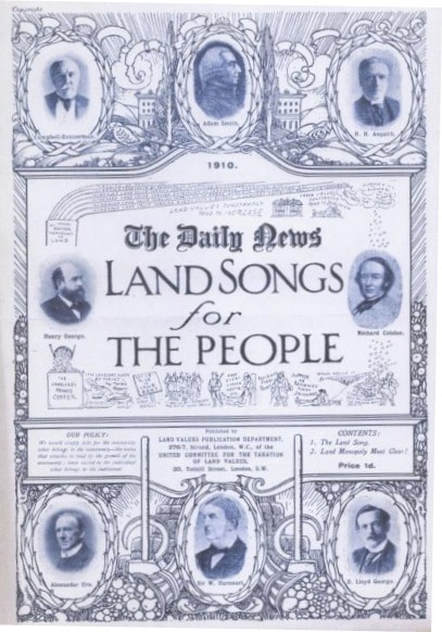
In January 1910, at the start of a year which saw two keenly contested general elections, the journal ‘Land Values’ reported the publication by the main single tax lobby group, the United Committee for the Taxation of Land Values, of Land Songs for the People. This was issued as a leaflet with just the lyrics or as four pages of sheet music with the melody.
Produced in collaboration with the ‘Daily News’, the cover of the sheet music was graced with portraits of liberal heroes (Adam Smith, Richard Cobden and, of course, Henry George) and of leading figures in party and government, Asquith, Lloyd George, Campbell-Bannerman, Sir William Harcourt and the single taxer Alexander Ure.
Pride of place was given to ‘The Land Song’. A second song was also included, ‘Land Monopoly Must Clear!’ – again an adaptation of an American Civil War song – with lyrics which certainly made the message evident:
Tramp, tramp, tramp, the boys are marching
All along the line we’ll make them clear
On this principle we stand,
That the values of the land
Shall be paid into the Treasury ev’ry year
On the rear cover, the publishers took pains to assert that a land tax would penalise ‘speculators and monopolists’ rather than farmers. The taxation of land values, it was argued, would place the tax burden not on agricultural districts, but ‘on towns and cities, where bare land rises to a value of tens of thousands of pounds per acre’.
Of the two general elections in 1910, the first was dominated by the land tax proposals and the second by the constitutional “peers versus people” issue. ‘The Land Song’ became the Liberal campaign tune. ‘At the general election of January 1910’, recalled Christopher Addison, later a Labour cabinet minister, ‘we went round singing “God gave the Land for the People”! We called ourselves Radicals in those days, and I am not sure that we had not more of the real democratic stuff in us that some who call themselves Socialists these days.’ [Addison, p5] This enthusiasm did not always translate into votes, as Percy Harris discovered when he contested Harrow as a Liberal:
I never had before or since such splendid meetings as I had at that election. Every night outside my committee rooms in Willesden hundreds of young men would await my return signing and cheering. … At every meeting my supporters would sing with gusto the land song. …
… Alas, young men who cheered me did not put in any spade work, and most of them had not even votes under the law as it then was. When it came to the count … I could hear them all singing the land song and cheering my name as the piles of Mallaby-Deeley’s ballot papers mounted up, out-numbering mine by thousands. [Harris, pp44-5]
Josiah Wedgwood, however, was re-elected. Long before the polls opened, he recalled, there were processions ‘of elderly respectable Nonconformists’ through the towns and villages of his constituency singing the ‘eternal refrain’ of ‘The Land Song’. There wasn’t a single meeting which he attended between 1909 and 1914, he wrote, which ended without the song. Indeed, Wedgwood often insisted on it being sung:
When he is at the country home … it is his custom to invite his poorer constituents in batches, to come and spend the afternoon … they are regaled with a sumptuous tea, followed by a conversational speech’ and music, in which the Land Song is always included … These meetings do more than many pamphlets to popularise the cause. [Profile of Josiah Wedgwood in ‘The Standard: a journal to advocate the rights of people in the land’, 15 Jan 1914. I owe this reference to Dr. Paul Mulvey.]
Wedgwood told an anecdote about his likeminded wife, who closed a political meeting she had chaired with the words: “We will now conclude with the usual song”. A solitary voice began: “God save …”, prompting a burst of irreverent laughter [Wedgwood, p68].
The conventional wisdom among those who sing ‘The Land Song’ today is that the anthem has never been commercially recorded. But it was. The issue of ‘Land Values’ for April 1910 reported that ‘the Edisonic Works’ had, by arrangement with the land campaigners, issued a ‘discaphone’ of ‘The Land Song’ and ‘Land Monopoly Must Clear!’. It reported that the ‘rendering of the songs by Mr. George Hardy gives an exceptionally good record’ You can judge for yourself. Even by the standards of 78 rpm discs of a century ago, George Hardy’s rendition of ‘The Land Song’ is difficult to track down – but with the help of a specialist collector in Australia, both songs have been located, a little breezier in style than the manner in which the song is now sung and worth a listen.
While the land taxers were keen to state that the Liberal government was re-elected in January 1910 to the strains of ‘The Land Song’, the true story was more complex. Asquith’s administration emerged much diminished from the two elections of that year, and reliant on Irish nationalists for a majority in Parliament. In the first contest, the Liberals lost more than half their rural seats, which put something of a brake on the party’s enthusiasm for a land tax. The single taxers remained active and were buoyed by the success of their candidates in two high profile by-elections in 1912, one in rural Norfolk and the other at Hanley in the Potteries district. Josiah Wedgwood campaigned enthusiastically at Hanley, with the help of George Hardy’s disc. ‘It was a hot summer. All day and all night we declaimed in the [Hanley market] square to the accompaniment of the ‘Land Song’ on my gramophone’ [J. Wedgwood, pp83-4].
At around this time, the UCLTV republished the lyrics of ‘The Land Song’ as a leaflet – a reflection of its importance to the single tax campaign [Short, p17]. But when in the following year Lloyd George launched his land campaign and pledged to tackle the land monopoly, the centre piece was an agricultural minimum wage rather than a land tax. The single tax lobby managed to persuade the government to move towards site value rating, a form of taxation of the land, but implementation was derailed by the declaration of war.
THE LAND TAXERS LOSE OUT
The rump of land tax MPs were keenly aware of the irony when in 1920 a Conservative-dominated national government headed by Lloyd George rescinded the measures towards a land tax he had introduced as chancellor. The remnants of the single tax lobby went down to defeat to the tune they had made their own. ‘While the division was being taken’, The Times reported, ‘supporters of the amendment in the division lobby were heard singing “The Land Song”. Gradually the refrain of the song drew nearer the House and Mr Hogge [Liberal M.P. for Edinburgh East] and others entered the Chamber singing “The Land, the Land, ‘twas God who made the land”. The incident was greeted with some laughter and cries of “Order”.’ [Times, 15 July 1920; Amery, p342]
The land taxers could only summon up the support of about seventy Members of Parliament, of whom Colonel Josiah Wedgwood was one of the most outspoken. The song survived into the 1920s, and was sung at demonstrations and public meetings.
Michael Foot heard it sung then. He was taught the song by his father, a radical Liberal Member of Parliament in south-west England. Many decades later, he still regarded ‘The Land Song’ – for its vibrancy and rhythm as well as for its simple democratic message – as a more effective political anthem than such socialist stalwarts as ‘England Arise’, ‘The Internationale’, and ‘The Red Flag’.
‘The Land Song’ was the one which really seemed to strike terror into the hearts and minds of the landlords – as it should, because it was directed at them. … It’s not only a land song, and it’s much more than a Liberal song, it’s a song that summarizes the democratic case – how in fact, in order to achieve what people wanted, they should use their democratic powers, they were only just getting those democratic powers, to ensure there was a proper division of the landed property in the country. … It wasn’t a song sung only by Liberals. I can assure you that socialists were singing that song even more rightly and justly than Liberals were doing.'
While there may be some special pleading here from a socialist politician of radical Liberal pedigree, it is hardly surprising that when so many of the leading land taxers and their supporters – among them Josiah Wedgwood – eventually moved over to the Labour party, so too did the song. In the 1920s and 1930s, Labour sought to take over the Liberal mantle of rural radicalism. ‘The Land Song’ featured in a Daily Herald song sheet published around 1927, where it was ‘re-dedicated to Labour’s Agricultural Campaign’. In the following decade it was customized to serve Labour’s purpose in a Welsh rural by-election campaign. [Griffiths, p69] But there was little sustained interest in a land tax. ‘In spite of Labour conference resolutions calling for the taxation of land values, the Land-Taxers had little real influence in the trade union-dominated party, where land values taxation was either poorly understood of written off as an irrelevancy in a world of socialist class struggle, and by the late 1920s they were reduced to a small minority voice within the party.’ [Mulvey, ‘Radicalism’s Last Gasp?’]
In 1931, however, a Labour Chancellor of the Exchequer, Philip Snowden, proposed a penny in the pound tax on land values. Lloyd George, no longer in harness with the Conservatives, made a fiery Commons speech in support of the measure. ‘The land, the value of which has been created by communal enterprise and expenditure, should make its contribution to taxation on the basis of its real value. That is the principle.’ He spoke with pride of the land tax measures of 1909-10, and mentioned Henry George by name. The measure was passed and the strains of ‘The Land Song’ were once more heard in the division lobbies, but the government fell before the measure was implemented. [Hansand HoC, 3 July 1931; Times, 4 July 1931] That was the last occasion on which a government put before Parliament a measure to tax land values.
If memory of ‘The Land Song’ lingered, it was as an emblem of the high water mark of Liberal radicalism in the years before the First World War. For as long as Lloyd George’s “people’s budget” was part of living memory, so too was the song. In his 1946 budget, Labour’s Hugh Dalton announced a national land fund and wove into his speech a taunt to the Conservative leader, Winston Churchill, who in 1909-10 had been a senior cabinet minister in the Liberal government.
Mr Dalton: Finally, I have a word to say about the land, and about the special fund to which I have already referred. In 1909, 37 years ago, David Lloyd George introduced a famous Budget. Liberals in those days sang the “Land Song” – “God gave the land to the people.” I think that the right hon. Member for Woodford used to sing that song.
Mr Churchill: I shall sing it again.
Mr Dalton: Then I hope for the right hon. Gentleman’s full support in the proposals I am about to make. The strains of that song have long since died away. But much land has passed, since then, from private into public ownership and ‘t is the declared policy of the Labour Party that much more should so pass [Hansard HoC, 9 April 1946]
Twenty years later, a new generation of Labour leaders still on occasion harked back to ‘The Land Song’ to make a partisan point. Harold Wilson, addressing the 1965 Labour Party conference as Prime Minister, proposed a Land Commission ‘to deal once and for all with racketeering in the price of land’, which he said would make a reality of ‘a basic theme of socialist belief, that profits arising through the action of the community should accrue to the community.’ Wilson contrasted that with the more cautious Liberal Party policy on land which, he argued, ‘places its present leadership some years behind the Liberals of some 60 years ago. In 1909 and 1910, they filled the land with song – “God gave the land to the people”. … While [Liberals] would not intend to throw doubt on the Almighty’s intention in this respect, their researches suggest he did not intend this declaration to be taken too literally.” (Laughter).’ [Times, 29 Sept 1965]
‘The Land Song’ was cited several times in the Parliamentary debate on the setting up of the Land Commission – and has been quoted in the chamber in more recent years, notably by Labour MPs (an online search of Hansard shows that the words of the song have been cited in the Commons by Austen Mitchell in 1981 and 1985, by Greville Janner in 1992 and by Tony Benn in 1996). In 1974, Dingle Foot – who had served as both a Liberal and a Labour MP and was Michael Foot’s older brother – devoted a substantial article in The Times to advocacy of land nationalization. He referred approvingly to Henry George and to the Lloyd George budget of 1909 and cited at length the words of ‘The Land Song’ before concluding: ‘We should sing the Land Song again.’ [Times, 14 Sept 1974]
THE REVIVAL
By the time Dingle Foot invoked ‘The Land Song’, some were indeed singing the anthem once more. It’s not clear whether the song was sung continuously at Liberal Party events from the Lloyd George era into the 1960s – if so, it was a frail and tenuous tradition. The Young Liberals who blew new life into the anthem were resurrecting ‘The Land Song’ rather than reviving it. From the mid-1960s, the Young Liberals became the radical conscience of the party – advocating direct action (most notably in opposition to apartheid-era South African sporting tours of Britain), taking left-wing positions on social and foreign policy issues, and championing community politics.
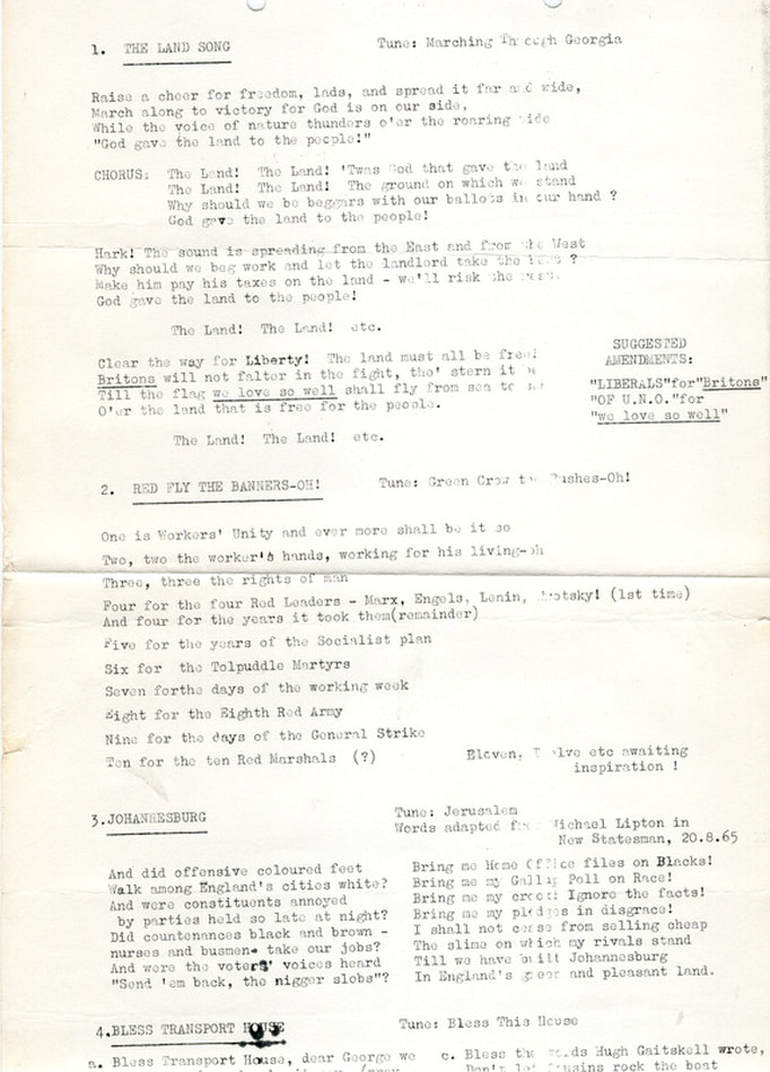
The psephologist Michael Steed was a student Liberal at Cambridge from 1959 and then at Oxford into the mid-1960s. There was a tradition of Liberal and other political songs at Oxford, he recalls, but he has no clear recollection of ‘The Land Song’ from that time. He was active in the Young Liberals and became their national vice-chairman. In 1965 or the following year, he and Mary Green put together what they believe to be the first Young Liberal song sheet. It was a duplicated foolscap sheet bearing the words of four songs, among them ‘Red Fly the Banners-Oh’ to the tune of ‘Green Grow the Rushes-Oh’ with distinctly hard left sentiments (‘One is Workers’ Unity and ever more shall be it so’). Pride of place, however, was given to ‘The Land Song’ – a truncated three verse version. Neither Michael Steed nor Mary Green can recall how they come across the song or the lyrics.
At around this time or perhaps a little later, groups such as the Young Liberals and the Welsh Liberals began to hold informal singing evenings. Several of those who have burnished the tradition of Liberal song recall a Liberal Assembly at Scarborough as a landmark in the restoration of ‘The Land Song’ as the pre-eminent Liberal radical song. Viv Bingham, a one-time president of the Liberal party, recalled that he first attended the party annual conference in 1973, and it was a little later ‘in 1975 when I first heard the Land Song at Scarborough. That year there were two impromptu sing songs in the conference hotel – one a very select band of about a dozen of us in the ballroom with Liz R[orison] playing the piano; one on the staircase and the hall with Michael Steed leading. Both, to my memory, sang “The Land”’. He sees the song’s ‘reincarnation’ in part as a morale-boosting reminder to a party with a handful of M.P.s of the period when it led a great reforming government, and also to a revived interest in site value rating and reform of property taxation.
From these late night singing sessions, the Glee Club developed, and was from almost its inception aligned to the ‘Liberator’ group. The annual song book followed. Over the years, the Glee Club has been transformed from an event on the fringes of the party conference to one of the highlights, convened in the biggest banquet room of the main conference hotel. As a result, ‘The Land Song’ is often sung in venues which don’t entirely chime with its radical lyrics, with the party leader often in attendance. Although the organizers would be horrified by the thought, the Glee Club, and the rendition of ‘The Land Song’, have become so hallowed that they are part of the party establishment. There are even signs that the younger elements within the party are becoming disenchanted. At the 2009 autumn conference, Liberal Youth, the latest incarnation of the Young Liberals, staged a rival event at a Bournemouth night club. ‘Have you sung “The Land” far too many times?’, their flyer asked. ‘Then THE GLEE CLUB ALTERNATIVE is for you!’
THE LAND SONG REVISITED
A year later, and coincidence took me back to the Liberal Democrats autumn conference, again out of professional duty rather than political loyalty. Liverpool was the venue, and the occasion was the party’s first big conference in government (wartime coalitions excluded) since the Lloyd George era. ‘Liberator’ had produced its ‘biggest ever’ songbook, and in the perhaps unlikely venue of the Liverpool Hilton some 500 Liberal Democrats – among them a former leader, Paddy Ashdown, and the deputy leader, Simon Hughes – sang themselves hoarse. The mood was decidedly upbeat, as if entering a Conservative-led coalition had given the radical wing of the party an issue around which to rally, or at least to rail and make jibes. ‘The Land Song’ was sung again by a party of government, demonstrating its staying power and providing a tenuous link between the radicalism of the last Liberal majority government and the ambitions of those who stand today in the same political tradition.
ANDREW WHITEHEAD is a news journalist and an editor of History Workshop Journal. He is keen to hear from anyone with recollections or information about ‘The Land Song’ – awkashmir@gmail.com or use the comment button on this page– and will update this article accordingly. This version was posted in May 2011.
This article has been written with the help and encouragement of the historians Kenneth Morgan, Paul Mulvey and Ian Packer; of John Powles at what was the Centre for Political Song at Glasgow Caledonian University; and of the political activists and singers Viv Bingham, Gwynoro Jones, Michael Meadowcroft, Mary Pendlebury, Stewart Rayment, Liz Rorison, Michael Steed and Simon Titley.
REFERENCES AND BIBLIOGRAPHY
Lord [Christopher] Addison, A Policy for British Agriculture, London, 1939
Leo Amery, My Political Life, [1953]
John Barnes, Socialist Champion: portrait of the gentleman as crusader, Melbourne, 2006
Roy Douglas, Land, People and Politics: a history of the land question in the United Kingdom, 1878-1952, London, 1976
Philip S. Foner, American Labor Song of the Nineteenth Century, Univ. of Illinois Press, 1975
Clare V.J. Griffiths, Labour and the Countryside: the politics of rural Britain, 1918-1939, Oxford, 2007
Percy Harris, Forty Years in and out of Parliament, London, [1947]
Peter d’A. Jones, Henry George and British Socialism, London, 1991
Elwood P. Lawrence, Henry George in the British Isles, East Lansing, 1957
Liberator Song Book, Liberator Publications, London, 2009
Graham Lippiatt, ‘Red Guard versus Old Guard? The influence of the Young Liberal movement on the Liberal Party in the 1960s and 1970s’, Journal of Liberal History, 2010, 68, pp.37-40
Paul Mulvey, ‘The Single-Taxers and the Future of Liberalism, 1906-14’, Journal of Liberal Democrat History, 2002, 34/35, pp.11-15
Paul Mulvey, ‘Radicalism’s Last Gasp?: the British Liberal Party and the taxation of land values, 1906-1914’, a research paper available on the internet
Ian Packer, Lloyd George, Liberalism and the Land: the land issue and party politics in England, 1906-1914, Woodbridge. 2001
Henry Pelling, Origins of the Labour Party, 1880-1900, Oxford, 1965
Brian Short, Land and Society in Edwardian Britain, Cambridge, 1997
C.V. Wedgwood, The Last of the Radicals: Josiah Wedgwood, M.P., London, 1951
Josiah C. Wedgwood, Memoirs of a Fighting Life, London, 1941
[1.0 – 5/11]
Part of a mid-1960s song sheet, courtesy of Michael Steed
In the spring of 2017, Steve Williams very kindly sent this item in response to the above which I am posting here with his consent:
Andrew Whitehead’s fascinating account of ‘The Land Song’ reminded me of another ‘Land Song’ I came across when reading through the journal Our Land for 1910. The issue for June of that year carried Dollie Radford’s ‘Land Song’:
‘The seed that is sown for the harvest day,
Shall be straight and strong in growing,
The snow and the rain sweep its meadow in vain,
Through the night when the cold wind is blowing:
For surely planned is the bountiful seed,
That is laid for a people’s need, -
And over the earth there shall spring form its birth
All the grain, of summer’s showing.
The cry of our hearts for the land to-day
Is the cry our need has made us,
Its sound shall endure till its answer issure
Till the share of our birthright is paid us:
And wide and free is our portion to be
As our right in the soil and sea, -
The fruit of the earth that shall come to their birth
Shall be sweet when no hungry upbraid us.
The land is the land for the people’s need
Not a land for selfish pleasure,
Our crying shall cease when our need is at peace
When we gather our part in its treasure;
And sure and soon shall our harvest draw nigh
For the seed of our hope grows high,-
The fruits of the earth shall come to their birth
And be blessed when work claims its measure.’
By 1910 Radford was an established poet, novelist and children’s writer. Born Caroline Maitland in Worcestershire in 1858 into a middle class if insecure family, she was by the late 1870s living in lodgings in London with her father, Robert and sister, Clara. The family had experienced tragedy with the death of Caroline’s mother, Ann in 1868 and four younger siblings. Although not well-off, Caroline – who was commonly known as Dollie - had a small annuity which allowed her to concentrate her efforts on writing and expanding her reading at the British Museum where she met and became close friends with Eleanor Marx. Through EleanorDollie became a regular visitor to the Marx household and it was at one of the Marx family social and dramatic events that she met Ernest Radford, a barrister who wanted to give up the law for a life in the arts. Dollie married Ernest in October 1883, by which time a number of her poems had been published inthe secular magazine, Progress.
Converted to socialism towards the end of 1884 when listening to William Morris’s lecture on ‘How we live and how we might live’, Dollie wrote in her diary that she had become convinced of ‘the seriousness and beauty of the socialist movement.’ In the following year, the couple moved to Hammersmith Terrace to be near Morris and to join his branch of the Socialist League. Both appear in the famous group photograph of League members in the garden of Morris’s Kelmscott House taken in the summer of 1888; Dollie sits on the left side of the front row wearing a dark jacket, between May and Jenny Morris. Following the withdrawal of the Hammersmith branch from the Socialist League in 1890, Dollie and Ernest continued to be active in the Hammersmith Socialist Society.
The Land Club League banner designer by Eric and Ethel Gill - reproduced by kind permission of the British Library
Our Land commenced its monthly publication in March 1908 with the aim to represent ‘the interests of agriculture and land in England. It will endeavour to draw together all those agencies which have for their object the greater success of home farming and the happier circumstances of country life.’ The progressive credentials of the magazine were clear from the outset with early issues giving prominence to the efficacy of cooperative agricultural practices and the urgency of rural sanitary reform.
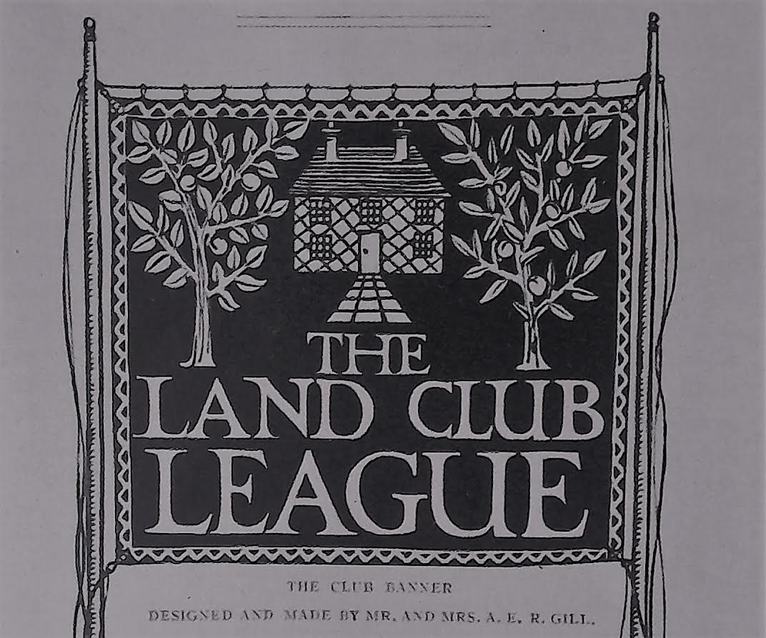
By January 1910 Our Land had declared its support for the recently established Land Club League which sought to encourage small holdings, allotments, model farms and revive traditional life to the countryside. Linking the League to Morris and the arts and crafts movement was Eric Gill who, with his wife Ethel, designed and made the League’s banner. From his Ditchling home Eric Gill was secretary of the Keymer and District Land Club which was active in campaigns to improve access to small holdings. When in 1909 East Sussex County Councillors lost their nerve when challenged by a landowner over compulsory purchase of his land for small holdings Gill commented: ‘There is no getting away from the facts. The majority of Councillors, being landowners themselves, do not want to get into hot water with their friends. Shall Satan cast out Satan? No. And neither is it to be expected that landowners shall offend landowners, much less cast them out. It is quite obvious that until the interests of labour are more directly represented on the county councils there is little hope for the revival of British agriculture.’