Political Ephemera
Political ephemera - handbills, postcards, pottery and the like - are wonderfully evocative. This pages feature a few of the items I have accumulated. I hope you enjoy browsing.
Luddites on the Scaffold
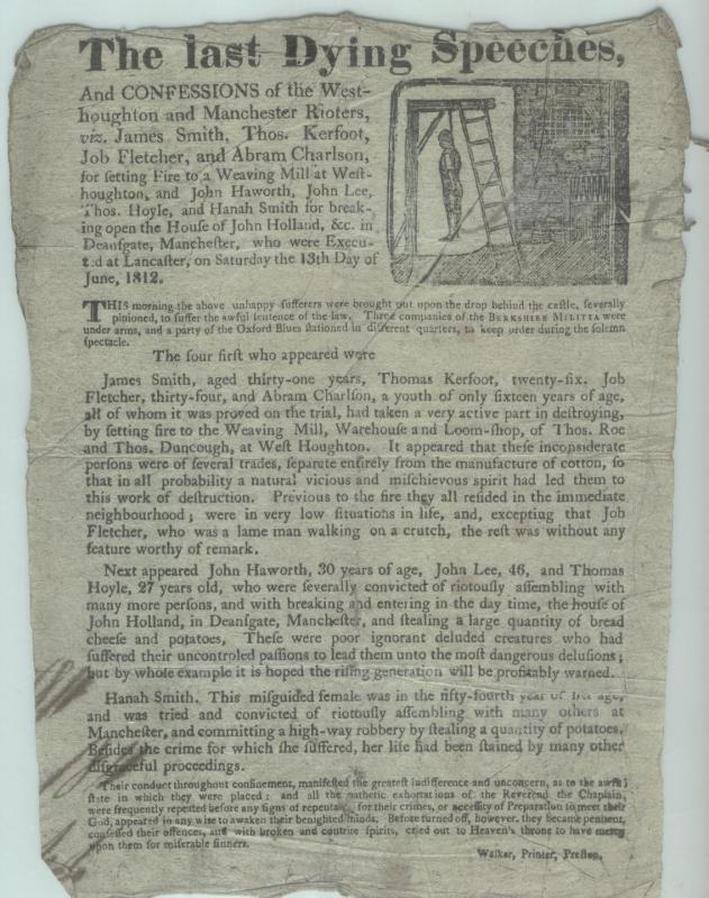
This is a fantastic broadside dating from 1812 marking the hanging of Luddite rioters.
It opens: 'The last Dying Speeches, And CONFESSIONS of the Westhoughton and Manchester Rioters ... for setting Fire to a Weaving Mill at Westhoughton, and ... for breaking open the House of John Holland ... in Deansgate, Manchester'. Those convicted, seven men and one woman, were executed at Lancaster on 13th June 1812.
The woodcut is a very simple gallows scene. the bulk of the text refers to those convicted and the crimes for which they were sentenced to death.
Two short paragraphs in smaller print, probably last minute interpolations, give some sense of the scene at the execution: 'This morning the above unhappy sufferers were brought out upon the drop behind the castle, severally pinioned, to suffer the awful sentence of the law. ...'
It opens: 'The last Dying Speeches, And CONFESSIONS of the Westhoughton and Manchester Rioters ... for setting Fire to a Weaving Mill at Westhoughton, and ... for breaking open the House of John Holland ... in Deansgate, Manchester'. Those convicted, seven men and one woman, were executed at Lancaster on 13th June 1812.
The woodcut is a very simple gallows scene. the bulk of the text refers to those convicted and the crimes for which they were sentenced to death.
Two short paragraphs in smaller print, probably last minute interpolations, give some sense of the scene at the execution: 'This morning the above unhappy sufferers were brought out upon the drop behind the castle, severally pinioned, to suffer the awful sentence of the law. ...'
Heading to Civil War
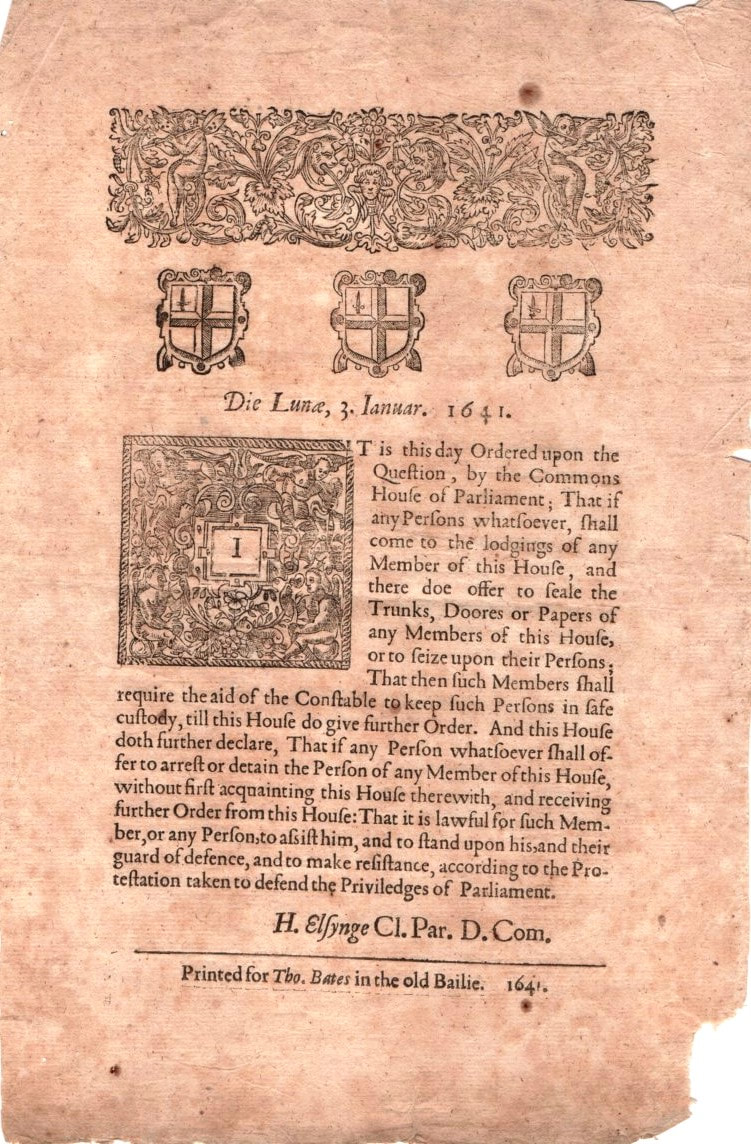
My oldest piece of political ephemera by quite some way - from the early 1640s, when tension was rising between King Charles 1 and Parliament.
This broadside dates from 3 January 1642 (yes, I know it says 1641 but at this time England used 'Lady Day' dating when the date moved forward from one year to the next on Lady Day, that's 25th March). Although it cites a resolution of the House of Commons and was published over the name of Henry Elsynge, the clerk to the House, it's not an offiicial Parliamentary publication but the work of a small publisher/bookseller in the Old Bailey district of London.
The content of the broadside is a bold assertion that MPs have the right to resist arrest unless that detention is authorised by Parliament itself.
'And this House doth further declare, That if any person whatsoever shall offer to arrest or detain the Person of any Member of this House, without first acquainting this House therewith, and receiving further Order from this House: That it is lawful for such Member, or any Person, to assist him, and to stand upon his, and their guard of defence, and to make resistance, according to the Protestation taken to defend the Priviledges of Parliament.'
At this time, Parliament was concerned about the King's determination to raise funds for the developing war in Scotland and his reluctance to call Parliament. The king reckoned that some outspoken Puritan MPs were in league with his enemies in Scotland and were intent on a prosecution of the Queen.
The day after the broadside, the king - accompanied by about eighty armed soldiers - violated Parliamentary privilege and entered the chamber of the House of Commons. He was seeking the arrest of five MPs he regarded as particularly troublesome, including John Pym and John Hampden. They had all been tipped off by the French ambassador and had hopped on a barge and travelled downriver to the City. As word of the king's action spread, some Londoners came onto the streets bearing arms to resist the king and his troops if, as rumoured, he headed to the City in pursuit of his Parliamentary quarry.
When Charles asked Speaker Lenthall about the whereabouts of the five members, the Speaker replied in one of the bravest - and most renowned - remarks ever uttered in Parliament : "May it please your majesty, I have neither eyes to see nor tongue to speak in this place but as this House is pleased to direct me whose servant I am here; and I humbly beg your majesty's pardon that I cannot give any other answer than this to what your majesty is pleased to demand of me."
The king failed to arrest any of the five MPs - and they returned in triumph to Westminster the following day. Within a week or so, the king withdrew from London to Hampton Court and later to Oxford. He had lost his capital. Charles only returned to London seven years later, having lost the war with the army of Parliament, for his trial and execution.
So this broadside is from the moment that the row between monarch and Parliament started veering towards civil war.
This broadside dates from 3 January 1642 (yes, I know it says 1641 but at this time England used 'Lady Day' dating when the date moved forward from one year to the next on Lady Day, that's 25th March). Although it cites a resolution of the House of Commons and was published over the name of Henry Elsynge, the clerk to the House, it's not an offiicial Parliamentary publication but the work of a small publisher/bookseller in the Old Bailey district of London.
The content of the broadside is a bold assertion that MPs have the right to resist arrest unless that detention is authorised by Parliament itself.
'And this House doth further declare, That if any person whatsoever shall offer to arrest or detain the Person of any Member of this House, without first acquainting this House therewith, and receiving further Order from this House: That it is lawful for such Member, or any Person, to assist him, and to stand upon his, and their guard of defence, and to make resistance, according to the Protestation taken to defend the Priviledges of Parliament.'
At this time, Parliament was concerned about the King's determination to raise funds for the developing war in Scotland and his reluctance to call Parliament. The king reckoned that some outspoken Puritan MPs were in league with his enemies in Scotland and were intent on a prosecution of the Queen.
The day after the broadside, the king - accompanied by about eighty armed soldiers - violated Parliamentary privilege and entered the chamber of the House of Commons. He was seeking the arrest of five MPs he regarded as particularly troublesome, including John Pym and John Hampden. They had all been tipped off by the French ambassador and had hopped on a barge and travelled downriver to the City. As word of the king's action spread, some Londoners came onto the streets bearing arms to resist the king and his troops if, as rumoured, he headed to the City in pursuit of his Parliamentary quarry.
When Charles asked Speaker Lenthall about the whereabouts of the five members, the Speaker replied in one of the bravest - and most renowned - remarks ever uttered in Parliament : "May it please your majesty, I have neither eyes to see nor tongue to speak in this place but as this House is pleased to direct me whose servant I am here; and I humbly beg your majesty's pardon that I cannot give any other answer than this to what your majesty is pleased to demand of me."
The king failed to arrest any of the five MPs - and they returned in triumph to Westminster the following day. Within a week or so, the king withdrew from London to Hampton Court and later to Oxford. He had lost his capital. Charles only returned to London seven years later, having lost the war with the army of Parliament, for his trial and execution.
So this broadside is from the moment that the row between monarch and Parliament started veering towards civil war.
The Zinoviev Letter
|
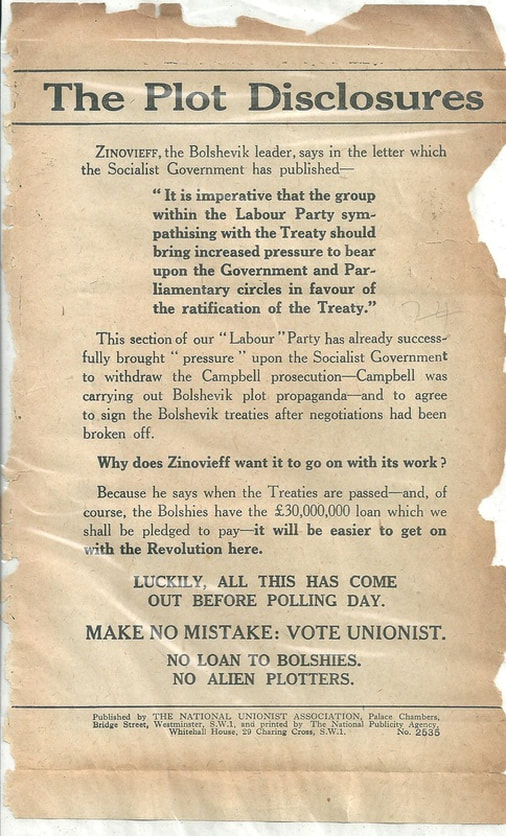
This scurrilous leaflet - printed cheaply, and a fragile survival from the 1920s - played its part in ending Britain's first, minority, Labour government.
A general election in December 1923 saw a sharp swing against Stanley Baldwin's Conservatives. They remained the largest party, though well short of an overall majority. Ramsay MacDonald became the first Labour prime minister, reliant on Liberal support. His government lasted just ten months - another election was held in October 1924. Just days before polling in 1924, the Daily Mail published a letter from a Soviet official - a directive from the Communist International in Moscow to the Communist Party of Great Britain. It said the resumption of diplomatic relations with Moscow (by a Labour government) would hasten the radicalization of the British working class. The letter seemed authentic at the time but historians now believe it was a forgery. |
|
This Conservative leaflet issued in October 1924 sought, on the basis of this forged letter, to portray the Labour government as 'Bolshies', whose actions were hastening a British Revolution. And just to add a xenophobic twist, the leaflet added the slogan: 'No Alien Plotters'.
The letter appears to have had little impact on the Labour vote—which held up in 1924. However, it aided the Conservative party in hastening the collapse of the Liberal party. The Conservatives won a landslide victory, with 47% of the vote and more than 400 MPs. Asquith's Liberals slumped to just 40 seats. And of course Britain's first Labour government, which relied on Liberal support, was out.
The letter appears to have had little impact on the Labour vote—which held up in 1924. However, it aided the Conservative party in hastening the collapse of the Liberal party. The Conservatives won a landslide victory, with 47% of the vote and more than 400 MPs. Asquith's Liberals slumped to just 40 seats. And of course Britain's first Labour government, which relied on Liberal support, was out.
'Mourning' the end of a political career
|
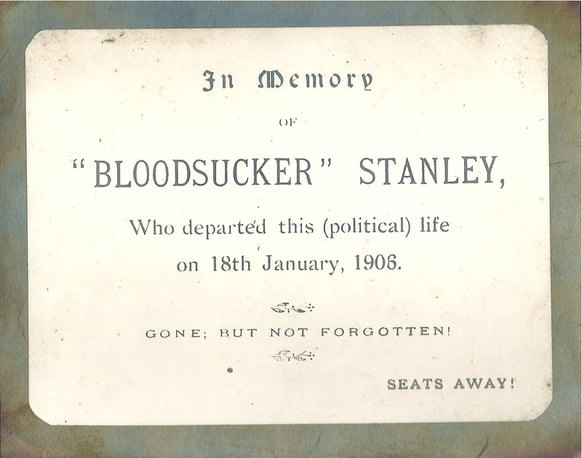
Here's a wonderful piece of political ephemera - a spoof mourning card marking the defeat in the Lancashire constituency of Westhoughton of the sitting Conservative MP, Edward Stanley, in the 1906 'Liberal landslide'.
Stanley had been the Postmaster General in the outgoing Conservative government and had notoriously castigated postal workers wanting a pay rise as parasites and bloodsuckers. Not surprisingly, that insult rankled - and with this denunciation of "Bloodsucker" Stanley, the postal workers got their revenge. |
The seat was won by the Labour candidate, W.T. Wilson, who ascribed his victory to Stanley's contemptuous attitude towards trades unions and working people. As the result was announced, a crowd sang:
Good-bye Stanley dear, good-bye
Good-bye Stanley dear, don't cry
You're a bloodsucker so true
And we've had enough of you
Good-bye Stanley dear, good-bye
'Bloodsucker' Stanley hadn't 'departed this political life' however. In 1908 he inherited the title of Earl of Derby and in later years served twice as Secretary of State for War and was also Britain's ambassador to France.
Good-bye Stanley dear, good-bye
Good-bye Stanley dear, don't cry
You're a bloodsucker so true
And we've had enough of you
Good-bye Stanley dear, good-bye
'Bloodsucker' Stanley hadn't 'departed this political life' however. In 1908 he inherited the title of Earl of Derby and in later years served twice as Secretary of State for War and was also Britain's ambassador to France.
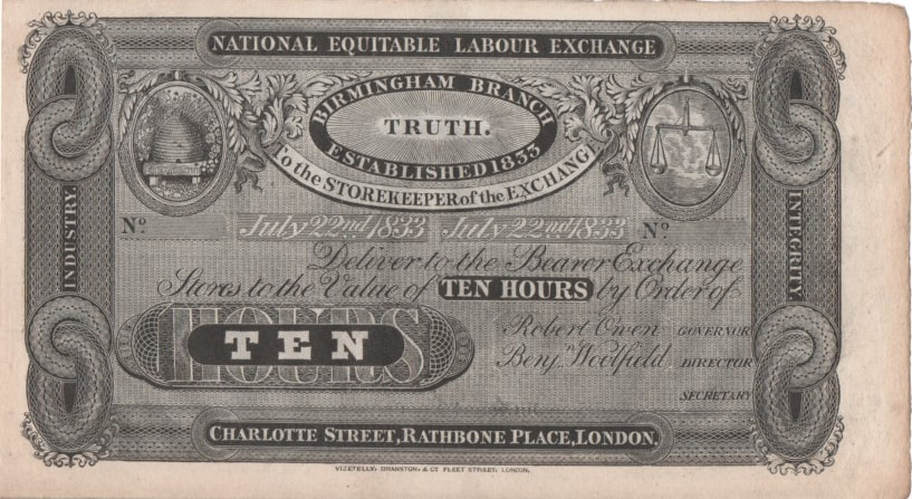
Robert Owen's 'labour notes' - "to the value of ten hours"
This is a gem - a 'labour note' issued in 1833 by Robert Owen's National Equitable Labour Exchange. Owen sought to use the hours spent in handicraft as the basis for value, and for two years the scheme did tolerably well - with offices in London and Birmingham. It didn't work, not least because of inconsistencies in the scheme. But it was in a sense a practical expression of the labour theory of value - though the idea that all labour (in Owen's case, artisanal labour only) was of equal value was not widely accepted.
London's printers and Reform
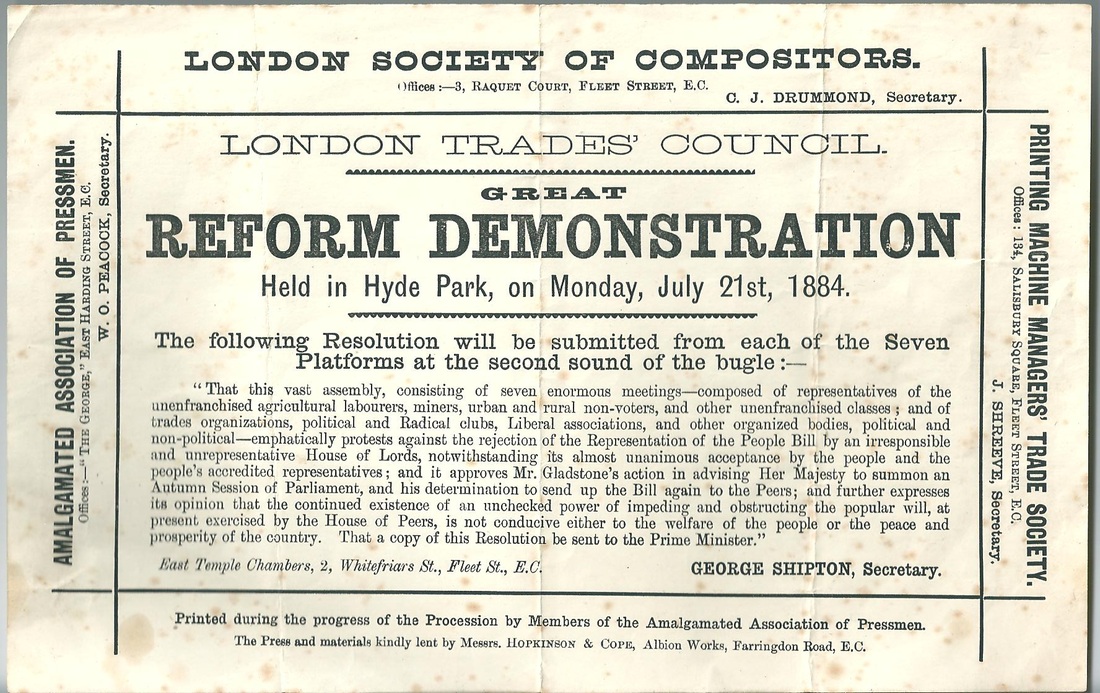
What a wonderful handbill - from the Reform movement which, towards the end of 1884, delivered the Third Reform Act, and a big extension of the (still male-only) Parliamentary franchise in the countryside. It's a long time since resolutions were submitted 'at the second sound of the bugle'. The most remarkable aspect of the handbill is that little bit at the bottom - 'Printed during the progress of the Procession by Members of the Amalgamated Association of Pressmen', clearly using the press of a sympathetic employer.
An election message on a disc
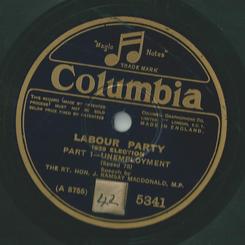
Ramsay Macdonald - after a brief spell as Prime Minister in the mid-1920s - led Labour into the 1929 election. It resulted in a minority Labour government, and a second period for Macdonald in Number 10.
This disc dates from the 1929 election campaign - bought for £2 from Noel Lynch's (now closed) treasure of a bric-a-brac shop, The Green Room, on Archway Road. On one side, Macdonald speaks on unemployment, and on the other on world peace.
It was so cheap because although this 78rpm disc is in one piece, it's so scratched and cracked as to be unplayable. Still, if you want to hear him, then click here. And there's a bit more about Macdonald's oratory, and this record in particular, here.
This disc dates from the 1929 election campaign - bought for £2 from Noel Lynch's (now closed) treasure of a bric-a-brac shop, The Green Room, on Archway Road. On one side, Macdonald speaks on unemployment, and on the other on world peace.
It was so cheap because although this 78rpm disc is in one piece, it's so scratched and cracked as to be unplayable. Still, if you want to hear him, then click here. And there's a bit more about Macdonald's oratory, and this record in particular, here.
An election slate on a card
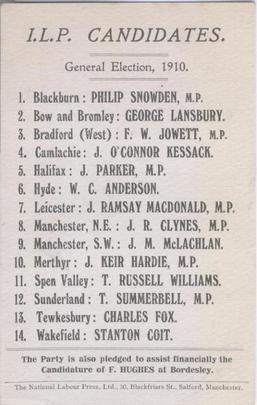
A marvellous piece of political ephemera from a century ago. 1910 was a year of two general elections - the Liberals emerged on top in both, the last elections when they were returned as the largest party of Parliament,. But a key theme of the early decades of the last century was the political rise of Labour.
This postcard lists the 14 ILP candidates in one of the 1910 elections - I haven't yet worked out which one, but imagine from the wording that it's the earlier one, in January. It includes a future Prime Minister, J. Ramsay Macdonald, and several future cabinet ministers and a coming party leader, George Lansbury. Also on the list is the iconic pioneer of Labour parliamentarism, Keir Hardie.
Not all Labour candidates were members of the ILP. These candidates were the nerve centre of the emerging Labour party. In all, 40 Labour MPs were elected in January 1910 and 42 in the year's second general election in December.
This postcard lists the 14 ILP candidates in one of the 1910 elections - I haven't yet worked out which one, but imagine from the wording that it's the earlier one, in January. It includes a future Prime Minister, J. Ramsay Macdonald, and several future cabinet ministers and a coming party leader, George Lansbury. Also on the list is the iconic pioneer of Labour parliamentarism, Keir Hardie.
Not all Labour candidates were members of the ILP. These candidates were the nerve centre of the emerging Labour party. In all, 40 Labour MPs were elected in January 1910 and 42 in the year's second general election in December.
An early trade society
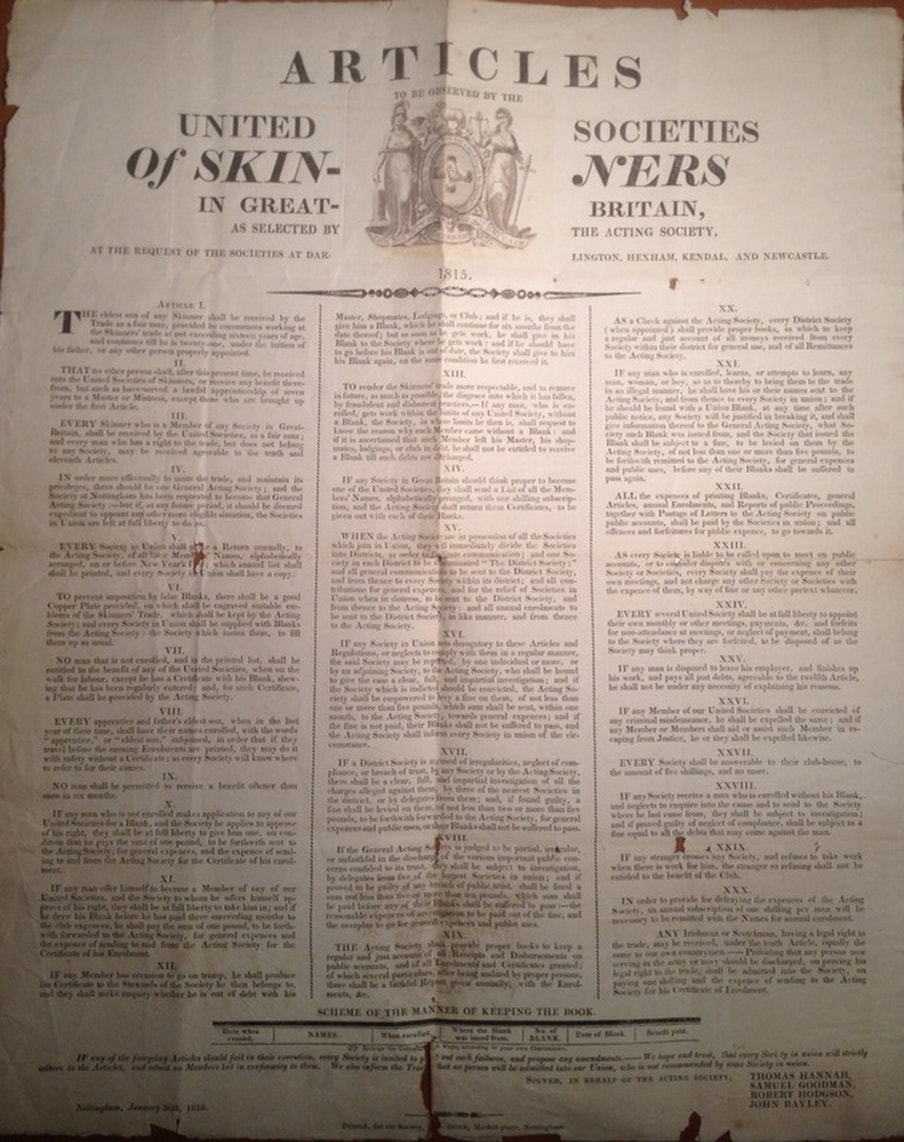
The articles of the United Societies of Skinners - agreed in 1815 and printed in Nottingham the following year. It establishes the criteria for entry into the trade (eldest sons of skinners and those with a full apprenticeship can be considered 'a fair man'), and sets down how the various local societies operate. This is a broadsheet, a little larger than A3 size - a remarkable survival from two centuries ago.
Supporting Sir Francis Burdett
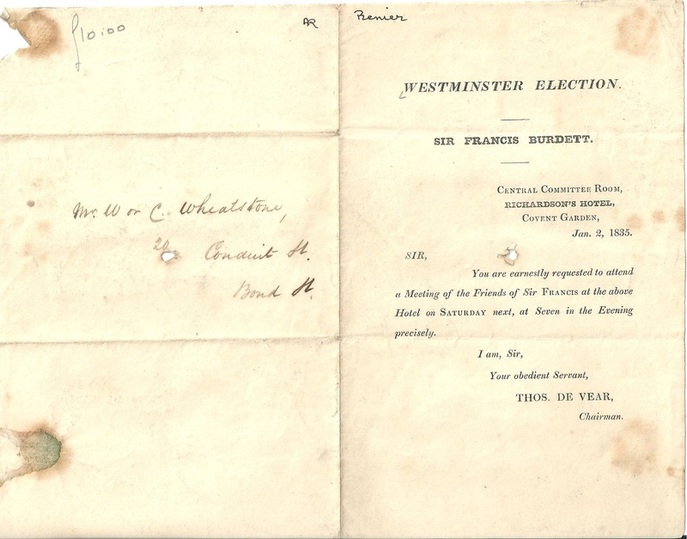
An item touching on the career of one of England's earliest and most high profile Parliamentary reformers. Eton-educated Sir Francis Burdett was an MP from 1796 until his death in 1844, and for thirty of those years he represented Westminster, where there was a broad franchise even before the 1832 Reform Act. Burdett's advocacy of universal male franchise, annual parliaments, vote by ballot and equal electoral districts pre-dated the Chartist movement, but reflected their main demands. By 1835, his political career - and appetite for reform - was waning. Mr Wheatstone seems to have spiked this invitation to a meeting of the friends of Sir Francis - but the flyer survived, and indeed found its way into the Renier collection.
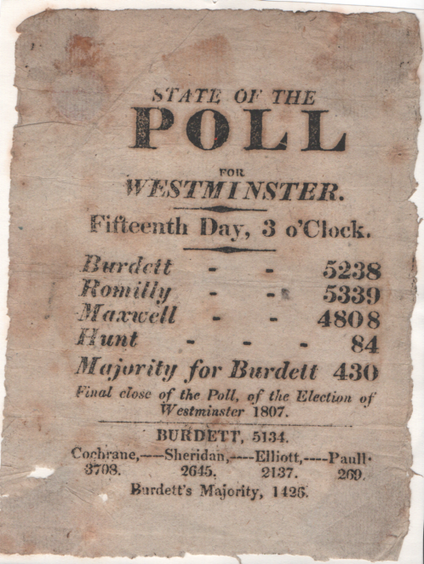
This is another piece of Burdett-related ephemera from 1818. Here's the story -
In 1807, Sir Francis Burdett stood for election - somewhat reluctantly - in the Westminster constituency. He topped the poll - very comfortable so. It was a triumph for political radicalism. The story in outline is told here. He stood again in 1818. Polling was in those days a protracted, and public (no secret ballot), process. This slip reflects the final result - Burdett was elected again, but as you will see he didn't do quite as well as a decade earlier, and failed to top the poll. Nevertheless in the excited political times after the Napoleonic Wars, his re-election was a reaffirmation of popular support for political reform.
In some ways, Burdett was a precursor of the Chartist movement which sprang up in the late 1830s. But by then, the Great Reform Act of 1832 had at least begun the process of Parliamentary and political reform.
In 1807, Sir Francis Burdett stood for election - somewhat reluctantly - in the Westminster constituency. He topped the poll - very comfortable so. It was a triumph for political radicalism. The story in outline is told here. He stood again in 1818. Polling was in those days a protracted, and public (no secret ballot), process. This slip reflects the final result - Burdett was elected again, but as you will see he didn't do quite as well as a decade earlier, and failed to top the poll. Nevertheless in the excited political times after the Napoleonic Wars, his re-election was a reaffirmation of popular support for political reform.
In some ways, Burdett was a precursor of the Chartist movement which sprang up in the late 1830s. But by then, the Great Reform Act of 1832 had at least begun the process of Parliamentary and political reform.
A touch of the Keir Hardie's
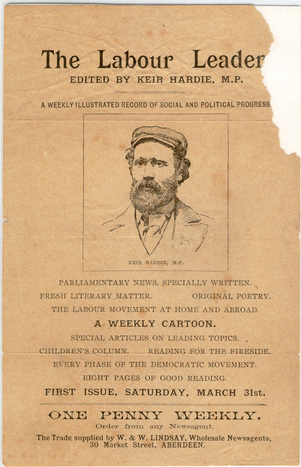
Of all my political ephemera, this is perhaps my favourite. And unlike just about everything else on this page, it wasn't bought as a choice piece - I found it as a bookmark in a rather tawdry book in an old second-hand shop (Miles's in Leeds, which - as I recall - was just behind the Town Hall).
At first, I hugely regretted that someone, at some stage in this handbill's precarious existence, had torn a corner off as a pipelight or for some other trivial reason. But it's now, in my eyes, part of the item - bestowing personality and, as you would expect from something so ephemeral, indicating just how remarkable it is that something so fleeting has survived at all.
Keir Hardie, blessed with a memorable name, was perhaps the key figure in Labour's decision to seek a separate Parliamentary group. His election to Parliament in 1892 is regarded as the beginning of an independent Labour presence at Westminster. The 'Labour Leader' was a key early Labour journal which Keir Hardie edited from 1888 right through to 1904, when he sold it to the Independent Labour Party. I suspect this handbill dates from 1894 when the 'Labour Leader' moved from monthly to weekly publication.
At first, I hugely regretted that someone, at some stage in this handbill's precarious existence, had torn a corner off as a pipelight or for some other trivial reason. But it's now, in my eyes, part of the item - bestowing personality and, as you would expect from something so ephemeral, indicating just how remarkable it is that something so fleeting has survived at all.
Keir Hardie, blessed with a memorable name, was perhaps the key figure in Labour's decision to seek a separate Parliamentary group. His election to Parliament in 1892 is regarded as the beginning of an independent Labour presence at Westminster. The 'Labour Leader' was a key early Labour journal which Keir Hardie edited from 1888 right through to 1904, when he sold it to the Independent Labour Party. I suspect this handbill dates from 1894 when the 'Labour Leader' moved from monthly to weekly publication.
An ILP grammar lesson
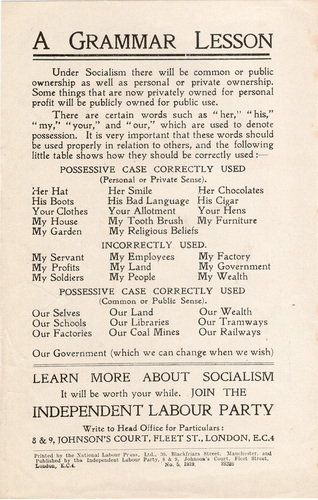
This wonderful handbill was produced by the Independent Labour Party in 1919 - a very clever and effective way of getting over the message about what 'common ownership' meant - and what it didn't mean. So 'Our Coal Mines' but 'My Garden'. 'Our Factories' but 'His Cigar'. 'Our Land' but 'Your Hens'. And, pointedly: 'Our Government (which we can change when we wish).' For remember - universal suffrage had not been fully achieved in 1919, though women had by then been given the vote.
Declared ungrammatical are such terms as 'My Servant' or 'My Profits' or 'My People'.
The early ILP had a gift for simple propaganda - a tradition which dated back to Robert Blatchford and the 'Clarion' movement - which many later political organisations never managed to emulate.
It is wonderful that such a modest handbill has managed to survive. I picked it up at a bookstall ninety or so years after it was published for an incredibly modest £6. And it's in pristine condition.
Declared ungrammatical are such terms as 'My Servant' or 'My Profits' or 'My People'.
The early ILP had a gift for simple propaganda - a tradition which dated back to Robert Blatchford and the 'Clarion' movement - which many later political organisations never managed to emulate.
It is wonderful that such a modest handbill has managed to survive. I picked it up at a bookstall ninety or so years after it was published for an incredibly modest £6. And it's in pristine condition.
Two early socialist meeting handbills
 |
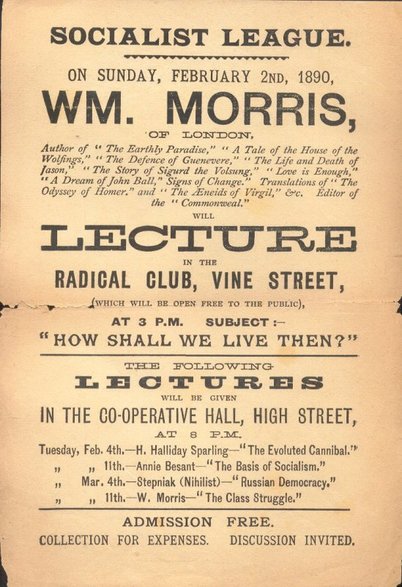 |
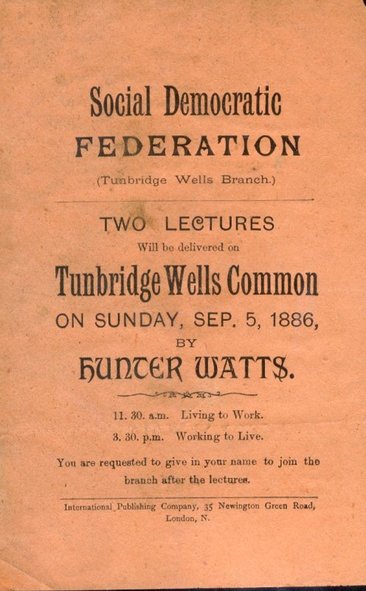
Two hugely resonant handbills. On the left, from the year the Social Democratic Federation first came to public attention, an outdoor meeting in the perhaps unlikely setting of Tunbridge Well addressed by one of the most prominent of the early SDFers, Hunter Watts. On the right, the Socialist League's William Morris talking on "How Shall We Live Then" at the Vine Street Radical Club in central London.
Democracy comes to South Africa
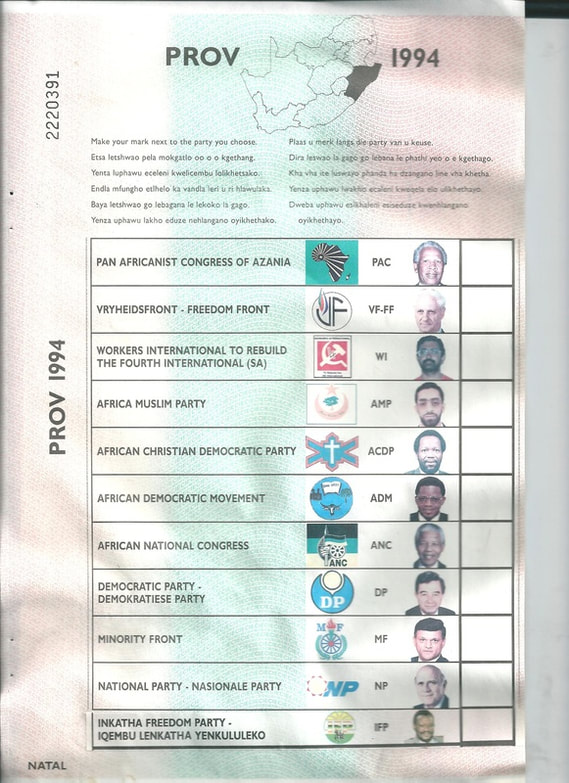
You don't come across many ballot papers, for obvious reasons. But this one has a real claim to the world's attention - part of the 1994 elections which marked the end of apartheid and the achievement of democracy in South Africa.
I got this from Noel Lynch's magnificently chaotic The Green Room on Archway Road. Noel says a friend was involved in managing the elections in Natal, and kept a few of the ballot papers - of which this is one. He tells me that Chief Buthelezi's Inkatha Freedom Party only decided at the last moment to contest the elections. The ballot papers were already printed.
So millions of slips were pasted on the ballot papers - and indeed you can tell that the Inkatha details are a last minute add-on.
Nelson Mandela's ANC won more than 60% of the national vote, but lost in Natal to Inkatha. You can find all the results here.
I got this from Noel Lynch's magnificently chaotic The Green Room on Archway Road. Noel says a friend was involved in managing the elections in Natal, and kept a few of the ballot papers - of which this is one. He tells me that Chief Buthelezi's Inkatha Freedom Party only decided at the last moment to contest the elections. The ballot papers were already printed.
So millions of slips were pasted on the ballot papers - and indeed you can tell that the Inkatha details are a last minute add-on.
Nelson Mandela's ANC won more than 60% of the national vote, but lost in Natal to Inkatha. You can find all the results here.
The Nottinghamshire Miners' Coal Queen
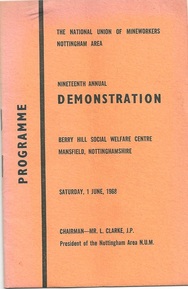
The programme of Nottingham NUM's annual demonstration in 1968 - when Nottingham had 36 NUM branches (some were workshops, but there would have been up to 30 mines). Mines were opening in the Nottingham coal field into the 1960s, though by 1968 the first signs of contraction were evident. The demonstration resolution stated: 'we view with great concern the run-down of the coal-mining industry in this Area'.
Today Nottinghamshire has just one colliery left - Thoresby. Another, Welbeck, closed last year (2010) - Welbeck's headstocks and winding gear, once so common in the coalfields, were demolished as recently as March 2011.
Back in 1968 the coalfield's annual demonstration was a big number - thirteen colliery bands, tableaux, show stands including caged bird and rabbits, and football, boxing and wrestling. An ATV announcer, Sheila Kennedy, added a little glamour to the guest list.
Today Nottinghamshire has just one colliery left - Thoresby. Another, Welbeck, closed last year (2010) - Welbeck's headstocks and winding gear, once so common in the coalfields, were demolished as recently as March 2011.
Back in 1968 the coalfield's annual demonstration was a big number - thirteen colliery bands, tableaux, show stands including caged bird and rabbits, and football, boxing and wrestling. An ATV announcer, Sheila Kennedy, added a little glamour to the guest list.
.
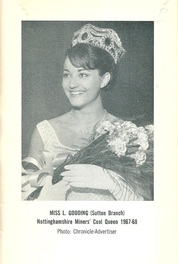
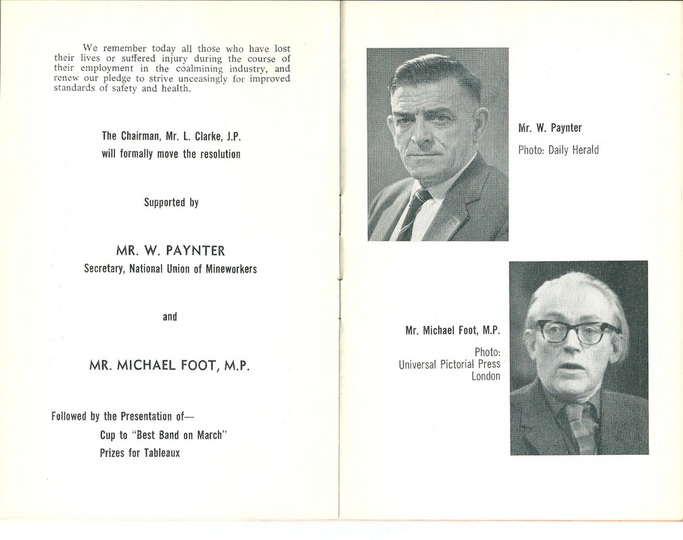
Inside the front cover of the programme is this charming, and very much of its time, photo of the Nottinghamshire Miners' Coal Queen 1967-68. She had a prominent place in the procession through Mansfield. And one of the highlights of the day was the selection of the following year's Coal Queen. But this was a political event - and the key speakers were the NUM's Will Paynter and Labour's Michael Foot. This copy of the programme, which I bought from a second hand bookshop for £1, was almost certainly Michael Foot's.
Nottinghamshire was not the most radical of coal fields. The programme contained the words of two songs - the Labour anthem 'The Red Flag', and the hymn 'The Lord is My Shepherd', both being led on the day by the Thoresby Colliery Welfare Band (yes, the same pit that is now the lone survivor of a once flourishing local industry).
Nottinghamshire was not the most radical of coal fields. The programme contained the words of two songs - the Labour anthem 'The Red Flag', and the hymn 'The Lord is My Shepherd', both being led on the day by the Thoresby Colliery Welfare Band (yes, the same pit that is now the lone survivor of a once flourishing local industry).
Commonw Wealth in 1945
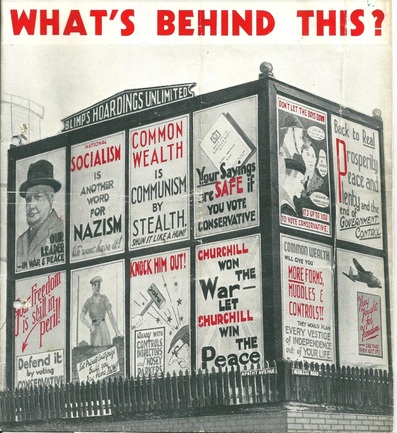
A Common Wealth party election pamphlet from 1945 - a radical left party which briefly had a presence in Parliament.
It was, in essence, a libertarian socialist pressure group, founded in the early 1940s by a Liberal MP, Sir Richard Acland, with support from the novelist J.B. Priestley and a former communist, Tom Wintringham.
Acland gave the party a presence in Parliament and during the war, CW won three Parliamentary by-elections against candidates from the Churchill-led coalition.
In 1945, Labour hoovered up most of the Common Wealth votes. It retained just one seat, Chelmsford, and this lone CW MP crossed the floor a year later to join the Labour party. It never again had a presence in Parliament, but didn't dissolve as a political party until the 1990s.
This election literature has a fake hoarding of Conservative anti-Common Wealth posters, 'What's Behind This?', the fold-out asks. That's answered by a Zec cartoon from the Daily Mirror on the reverse - it's big business and state control that's behind it.
Anti-statism was very evident in Common Wealth policies and propaganda, though it saw itself as a radical, progressive and indeed socialist movement.
It was, in essence, a libertarian socialist pressure group, founded in the early 1940s by a Liberal MP, Sir Richard Acland, with support from the novelist J.B. Priestley and a former communist, Tom Wintringham.
Acland gave the party a presence in Parliament and during the war, CW won three Parliamentary by-elections against candidates from the Churchill-led coalition.
In 1945, Labour hoovered up most of the Common Wealth votes. It retained just one seat, Chelmsford, and this lone CW MP crossed the floor a year later to join the Labour party. It never again had a presence in Parliament, but didn't dissolve as a political party until the 1990s.
This election literature has a fake hoarding of Conservative anti-Common Wealth posters, 'What's Behind This?', the fold-out asks. That's answered by a Zec cartoon from the Daily Mirror on the reverse - it's big business and state control that's behind it.
Anti-statism was very evident in Common Wealth policies and propaganda, though it saw itself as a radical, progressive and indeed socialist movement.
Funding the wartime Daily Worker
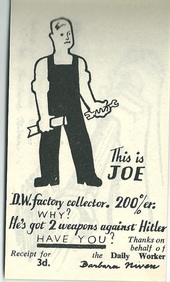
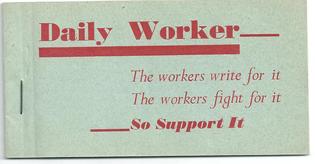
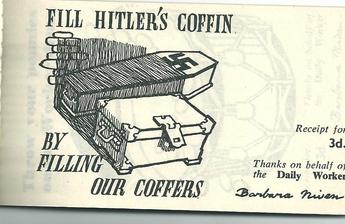
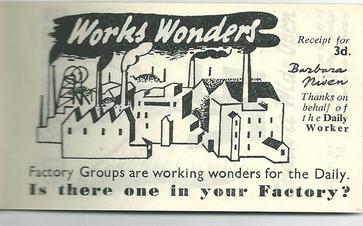
A choice piece of political ephemera - a receipt boom for donations (each for threepence that's just over one penny of today's money) to the communist Daily Worker. Each of the receipts consist of a different cartoon, and a note of thanks on behalf of the paper from its fundraiser, Barbara Niven. The newspaper always relied on funding by supporters as much as on sales and farily modest advertising revenue
The receipt book dates from 1943, when the Communist Party of Great Britain - following Hitler's attack on Stalin's Russia - was strongly in support of the allied war effort. Earlier in the war, the party had denounced the confliict as an 'imperialist war' and the Daily Worker had, briefly, been banned. Most of the cartoons are much more pro-war effort and anti-Hitler than they are in any customary sense communist. The paper always had good cartoonists.
The receipt book dates from 1943, when the Communist Party of Great Britain - following Hitler's attack on Stalin's Russia - was strongly in support of the allied war effort. Earlier in the war, the party had denounced the confliict as an 'imperialist war' and the Daily Worker had, briefly, been banned. Most of the cartoons are much more pro-war effort and anti-Hitler than they are in any customary sense communist. The paper always had good cartoonists.
.
The Communist Party ended the war with about 50,000 members and had two candidates elected to Parliament in the 1945 general election. In terms of popular support, this was the party's high watermark. The Daily Worker changed its name to the Morning Star in 1966. The Communist Party of Great Britain voted to dissolve - or more accurately to become a pressure group called Democratic Left - in 1992.
 |
 |
Red Stepney
|
|
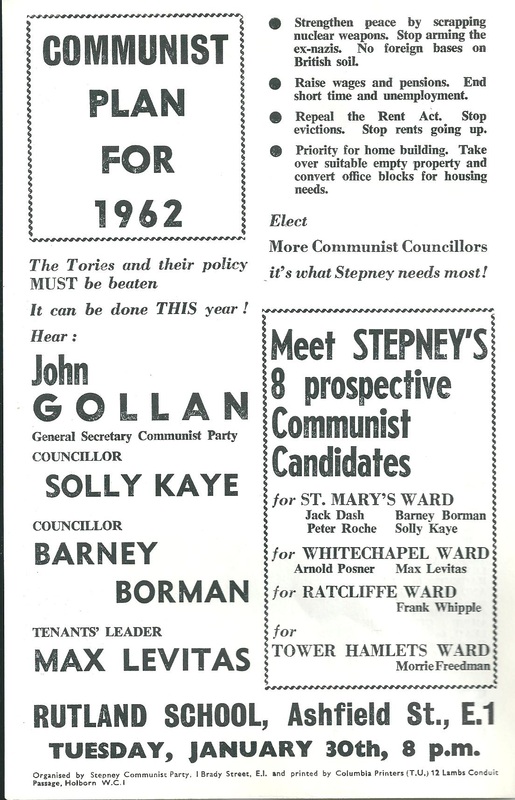
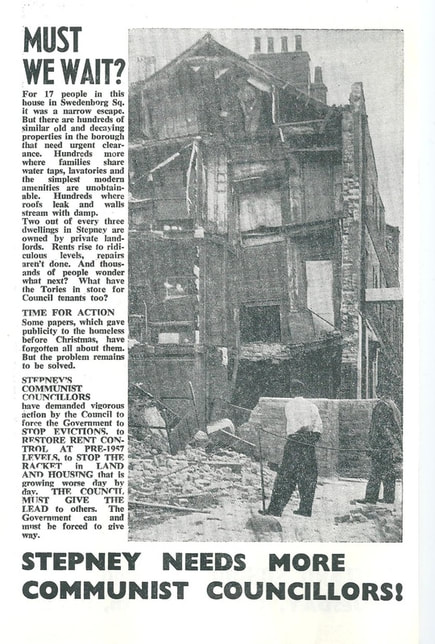
The Communist tide in Stepney reached its high water mark in the 1945 general election, when Phil Piratin was elected as the local MP. But there was a Communist presence in local government from the 1930s into the 1960s, as this CP election leaflet from 1962 demonstrates. I haven't found out whether any of their candidates were successful - I suspect not. Max Levitas, by the way, was still going strong almost fifty years later at the celebrations of the 75th anniversary of the Battle of Cable Street.
Trade union membership cards
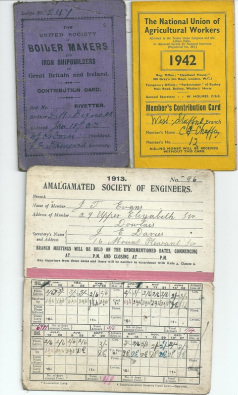
Trade union membership cards are personal and very resonant forms of political ephemera. You can buy them for very modest sums at flea markets - the ones featured were bought, for the most part, at the Monday flea market at Covent Garden.
The Boiler Makers and Shipbuilders card dates from 1903 - the oldest of those shown. These were, as the Amalgamated Society of Engineers card from 1913 demonstrates, contributions cards, a record of the dues paid and proof that the member was 'paid up' and so eligible for benefits. The provision of sick and unemployment benefits was one of the prime functions of trade unions, especially before the creation of the welfare state.
Cards from the nineteenth century are much harder to come by. So too are travelling benefits cards, as used by tramping artisans - skilled workers paid by their unions to take to the road in search of work, so avoiding the temptation of undercutting the trade union rates.
Party cards are also difficult to find - though I have over the years collected a few.
The Boiler Makers and Shipbuilders card dates from 1903 - the oldest of those shown. These were, as the Amalgamated Society of Engineers card from 1913 demonstrates, contributions cards, a record of the dues paid and proof that the member was 'paid up' and so eligible for benefits. The provision of sick and unemployment benefits was one of the prime functions of trade unions, especially before the creation of the welfare state.
Cards from the nineteenth century are much harder to come by. So too are travelling benefits cards, as used by tramping artisans - skilled workers paid by their unions to take to the road in search of work, so avoiding the temptation of undercutting the trade union rates.
Party cards are also difficult to find - though I have over the years collected a few.
A Socialist League celebration of the Paris Commune
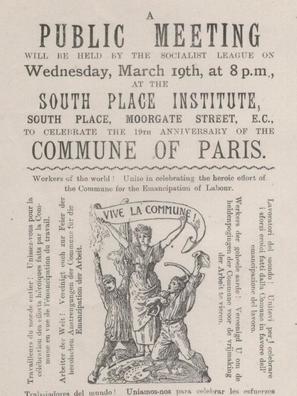
Political ephemera - handbills, membership cards and similar - rarely survives. But it's often more resonant of the moment than the more manicured publications.
The handbill on the left was issued to promote a Socialist League meeting in March 1890 in celebration of the Paris Commune nineteen years earlier. The imagery is so evocative. I don't know the provenance of the image of the Communards - it looks to be in the style of Walter Crane. It's rare in its internationalism - slogans in several languages.
The Socialist League was an organisation closely associated with William Morris - socialist, somewhat utopian in tone, and increasingly libertarian. Socialists of the 1880s looked back to the Paris Commune of 1871 as one of the high water marks of the radical left, and every year held meetings to commemorate that popular uprising.
The handbill on the left was issued to promote a Socialist League meeting in March 1890 in celebration of the Paris Commune nineteen years earlier. The imagery is so evocative. I don't know the provenance of the image of the Communards - it looks to be in the style of Walter Crane. It's rare in its internationalism - slogans in several languages.
The Socialist League was an organisation closely associated with William Morris - socialist, somewhat utopian in tone, and increasingly libertarian. Socialists of the 1880s looked back to the Paris Commune of 1871 as one of the high water marks of the radical left, and every year held meetings to commemorate that popular uprising.
Socialist Songs
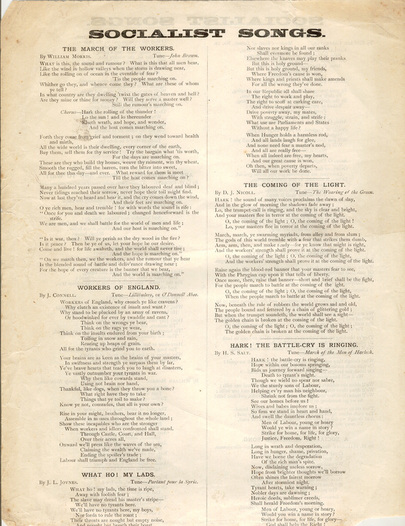
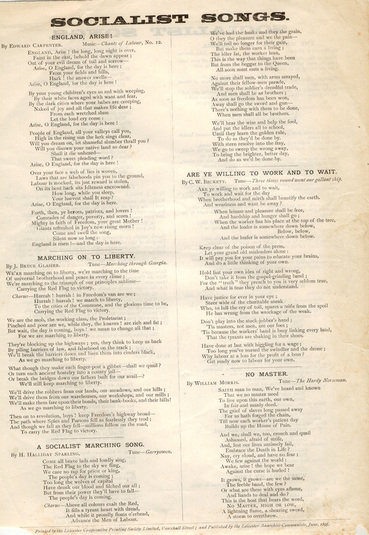
A socialist song sheet from 1895, published by the Leicester Anarchist-Communists. There are a couple of William Morris songs, 'The March of the Workers' and 'No Master'. The anarchist David Nicoll contributes 'The Coming of the Light', to the Irish nationalist tune 'The Wearing of the Green', which rehearses all the themes of battle, struggle and opposition to tyranny which are common to many of the lyrics. There's also Edward Carpenter's anthemic 'England. Arise!':
England Arise! the long, long night is over,
Faint in the east, behold the dawn appear;
Out of your evil dream of toil and sorrow -
Arise, O England, for the day is here
Wonderful that such a transient thing as a song sheet should survive!
England Arise! the long, long night is over,
Faint in the east, behold the dawn appear;
Out of your evil dream of toil and sorrow -
Arise, O England, for the day is here
Wonderful that such a transient thing as a song sheet should survive!
 |
 |
A Liberal song sheet
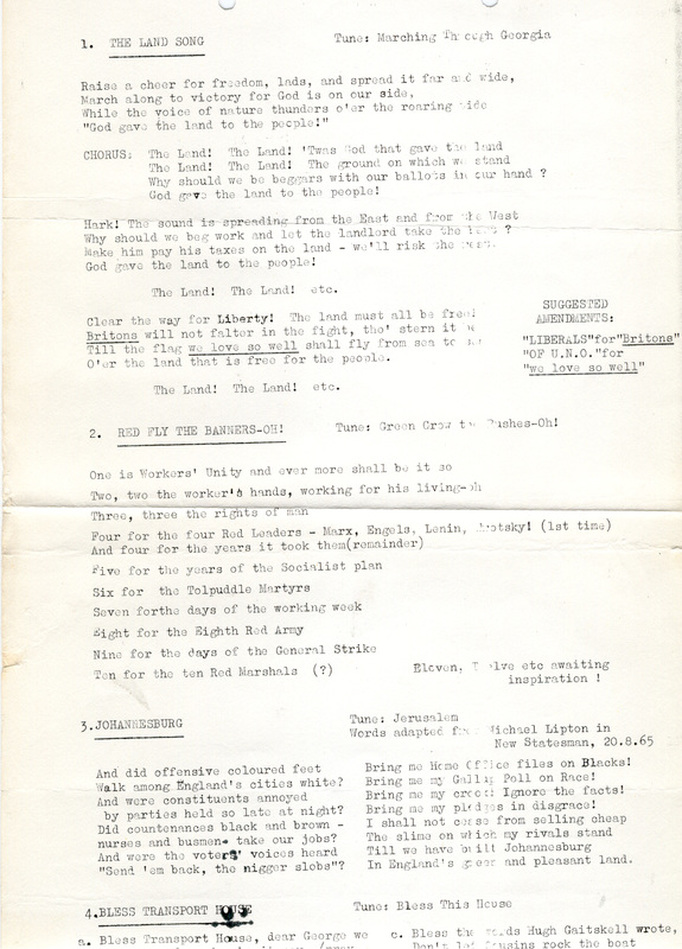
The socialists didn't have all the best songs! This is a liberal song sheet, given to me by Michael Steed. 'The more I look at this', he says in an accompanying note, 'the more I think it was probably put together by Mary Green with my assistance in 1965-6, and was the first circulated YL [Young Liberal] song sheet.'
That means that the Liberator song book, which published its 21st edition in 2010, is in direct apostolic succession from this duplicated and untitled sheet - foolscap in size, which means it's a little too big for my scanner to capture all of it.
The first title is the Liberal anthem 'The Land Song', harking back to Lloyd George's People's Budget of 1909 and the keenly contested elections of the following year. 'Red Fly the Banners-Oh' is much more of a socialist song, which Tariq Ali remembers singing in the 1960s.
That means that the Liberator song book, which published its 21st edition in 2010, is in direct apostolic succession from this duplicated and untitled sheet - foolscap in size, which means it's a little too big for my scanner to capture all of it.
The first title is the Liberal anthem 'The Land Song', harking back to Lloyd George's People's Budget of 1909 and the keenly contested elections of the following year. 'Red Fly the Banners-Oh' is much more of a socialist song, which Tariq Ali remembers singing in the 1960s.
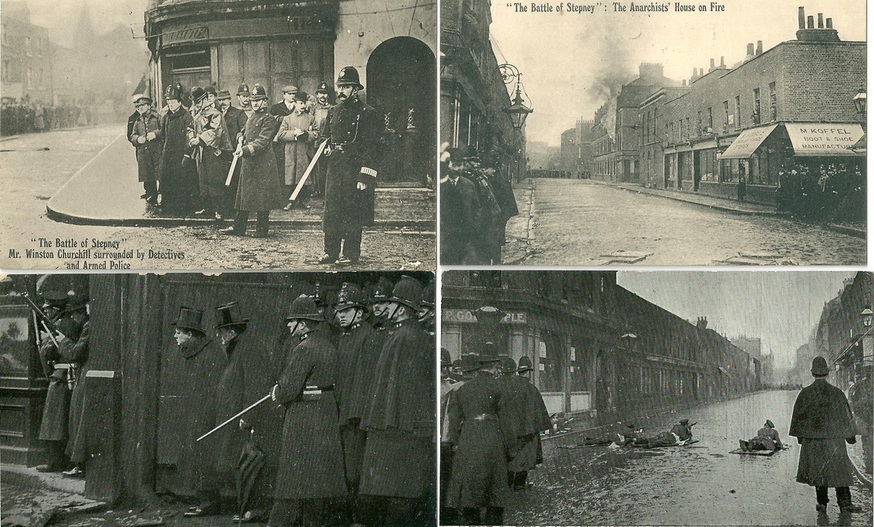
The Siege of Sidney Street - 3rd January 1911: in postcards
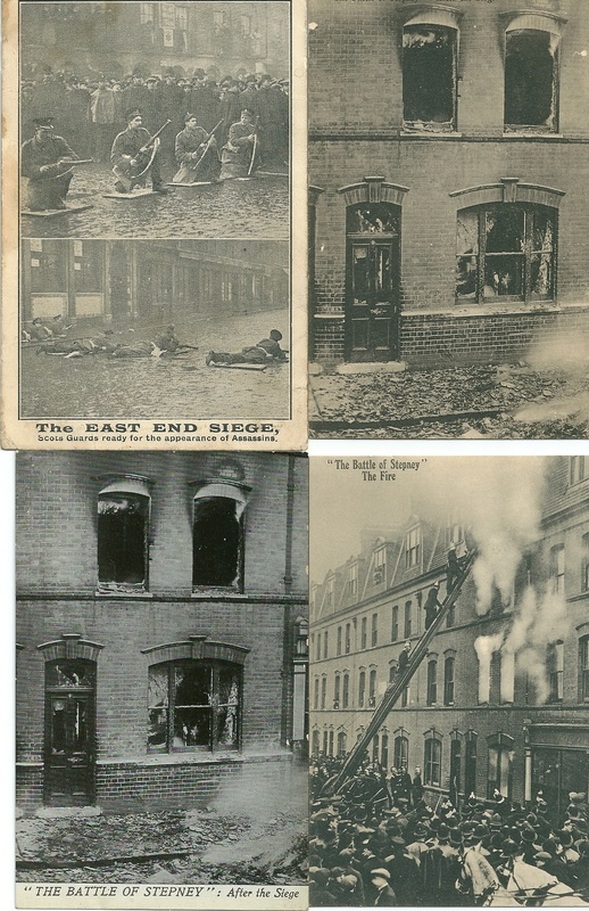
On 3rd January 1911, Winston Churchill deployed scores of armed police and soldiers to flush out a group of armed robbers holed up in a house in Sidney Street in Stepney. Churchill, then home secretary in a Liberal government, went along himself - wearing a splendid top hat - to see the action. The house at 100 Sidney Street eventually caught fire. The bodies of two Latvian revolutionaries ('anarchists' in the parlance of the popular press and the postcard publishers) were found in the burn-out remnants of the building. A third man, 'Peter the Painter', disappeared - his real identity has been the subject of excited speculation and conspiracy theories ever since.
The 'anarchists' had, the previous month, killed three policemen while trying to rob a jeweller's shop in Houndsditch. The incident created great alarm about alien extremists bringing gun crime to the heart of London.
The first two decades of last century were the great era of political postcards - Joe Chamberlain and David Lloyd George, two great populist politicians, were the most widely featured. But incidents such as the Sidney Street siege were also hugely popular with the postcard makers. To judge by the numbers surviving, tens of thousands - perhaps more - of these cards must have been sold.
In case you think this bizarre, I remember visiting New York in the aftermath of 9/11 and being astonished a by the nunber of postcards on sale on the streets harking back to the tragedy. Of course, I bought a good selection.
The 'anarchists' had, the previous month, killed three policemen while trying to rob a jeweller's shop in Houndsditch. The incident created great alarm about alien extremists bringing gun crime to the heart of London.
The first two decades of last century were the great era of political postcards - Joe Chamberlain and David Lloyd George, two great populist politicians, were the most widely featured. But incidents such as the Sidney Street siege were also hugely popular with the postcard makers. To judge by the numbers surviving, tens of thousands - perhaps more - of these cards must have been sold.
In case you think this bizarre, I remember visiting New York in the aftermath of 9/11 and being astonished a by the nunber of postcards on sale on the streets harking back to the tragedy. Of course, I bought a good selection.
The 'beer and sandwiches' PM - on a beer mat
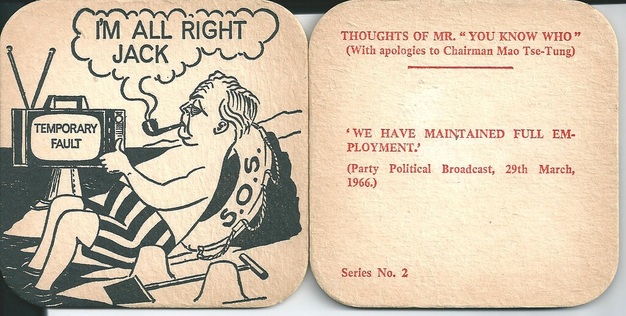
Harold Wilson being lampooned - I don't know whether Private Eye was responsible for this series of beer mats, or his Conservative opponents, but it's a great period piece. Wilson of course never said: "I'm All Right Jack". That entered the language as the title of a hugely successful 1959 movie, featuring Peter Sellers as the communist shop steward Fred Kite.
The Thoughts of Chairman Mao, the Little Red Book, achieved international attention particularly in 1966-67, though the less than flattering drawing of an ageing Wilson may suggest a slightly later date - he was Prime Minister from 1964-70 and again 1974-76.
The Thoughts of Chairman Mao, the Little Red Book, achieved international attention particularly in 1966-67, though the less than flattering drawing of an ageing Wilson may suggest a slightly later date - he was Prime Minister from 1964-70 and again 1974-76.
A Labour Movement Mystery
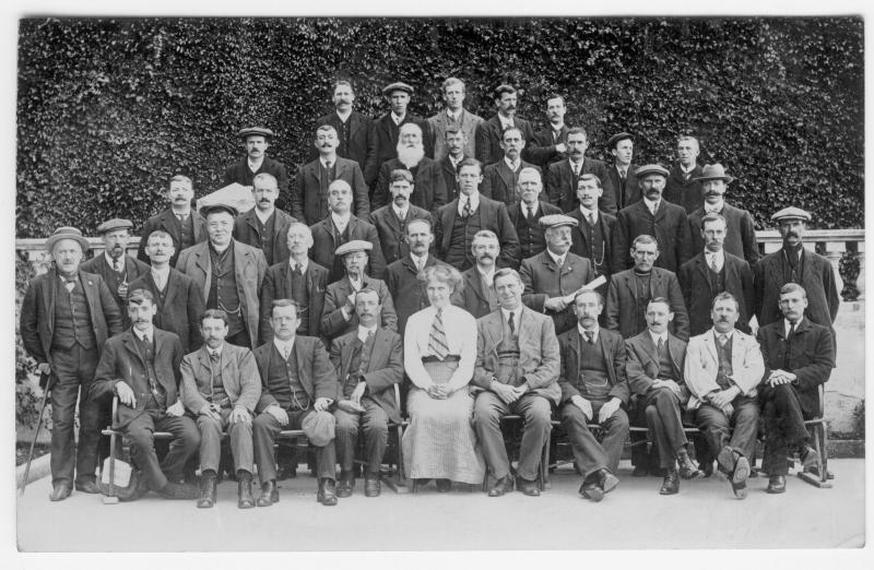
I bought the postcard above for 50 pence. The reverse is blank - nothing at all to indicate provenance or date. My instinct tells me that this is a labour movement group - perhaps at a conference, or trade union meeting. I have at various times imagined that Tom Mann and Will Thorne are among those featured - but in truth I am not too confident about the identification. Do let me know if you can identify those in the photograph or have some idea about the event. awkashmir@gmail.com
An Anti-Suffrage Handbill
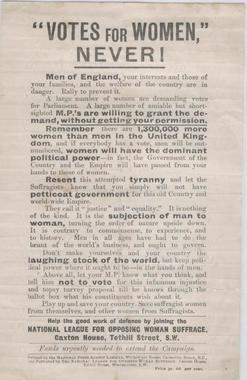
An appeal to the men of England to resist the 'tyranny' of 'petticoat government'. This anti-suffragette handbill was issued by the National League for Opposing Woman Suffrage. It probably dates from just before the First World War.
'Don't make yourselves and your country the laughing stock of the world', it warns, 'but keep political power where it ought to be - in the hands of men.'
There are few more obvious examples of an unsuccessful political campaign. But the anti-suffragist movement was nationwide in scope, and consisted of much more than a few fusty crackpots. 'Play up and save your country', the leaflet exhorted. 'Save Suffragist women from themselves, and other women from Suffragists.'
'"VOTES FOR WOMEN", NEVER!'
'Don't make yourselves and your country the laughing stock of the world', it warns, 'but keep political power where it ought to be - in the hands of men.'
There are few more obvious examples of an unsuccessful political campaign. But the anti-suffragist movement was nationwide in scope, and consisted of much more than a few fusty crackpots. 'Play up and save your country', the leaflet exhorted. 'Save Suffragist women from themselves, and other women from Suffragists.'
'"VOTES FOR WOMEN", NEVER!'
Saddam's Pack of Cards
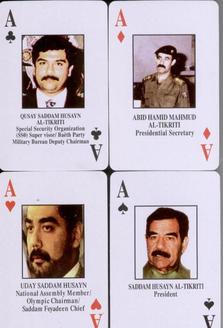
Do you remember how during and immediately after the Gulf War, American troops were issued with a pack of cards to help them identify the most wanted members of the defeated Ba'athist regime?
Well, these are the four aces from the pack. Saddam was the ace of spades. His sons were the ace of clubs and the ace of hearts. The ace of diamonds was Saddam's secretary.
I bought this pack of cards from a stall in New York - it's not a Pentagon original I'm sure, but a copy hastily assembled to sell to tourists. There were any number of copycat packs of cards, addressing everything from Presidential elections to campaigns to restrict state spending. I am sure someone, somewhere is collecting them.
Well, these are the four aces from the pack. Saddam was the ace of spades. His sons were the ace of clubs and the ace of hearts. The ace of diamonds was Saddam's secretary.
I bought this pack of cards from a stall in New York - it's not a Pentagon original I'm sure, but a copy hastily assembled to sell to tourists. There were any number of copycat packs of cards, addressing everything from Presidential elections to campaigns to restrict state spending. I am sure someone, somewhere is collecting them.
A Coalition Mug ... or Two
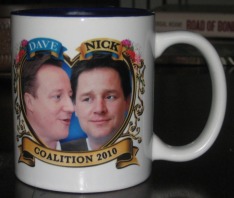
Am I a mug ... for getting this mug?
Well, I quite like the tacky instant memorabilia. And this prize item is not for my morning cuppa, but put away behind glass as a collectors' piece of the future.
Don't be surprised that Nick is looking alarmed. You would if the Prime Minister was sticking his nose in your ear.
Well, I quite like the tacky instant memorabilia. And this prize item is not for my morning cuppa, but put away behind glass as a collectors' piece of the future.
Don't be surprised that Nick is looking alarmed. You would if the Prime Minister was sticking his nose in your ear.
Fred Bakunin
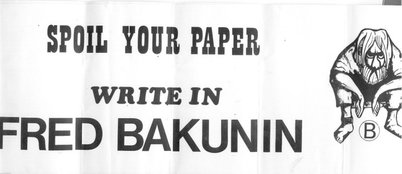
A blast from the past - Fred Bakunin was, fleetingly in the mid-1970s, a popular rallying cry in Oxford student politics.
I seem to remember that he did tolerably well in one Students' Union election - politics as carnival! It hardly changed the world but it was quite fun.
I seem to remember that he did tolerably well in one Students' Union election - politics as carnival! It hardly changed the world but it was quite fun.