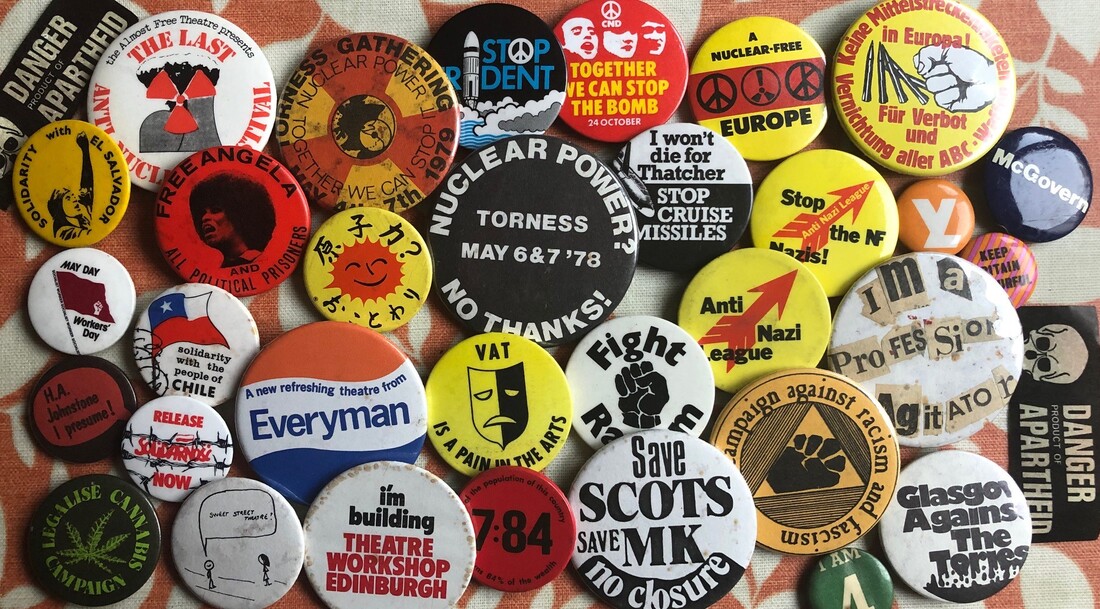
 Here's a wonderful cache of political badges that I have been sent by Mike Sharples - thanks Mike! These are mainly from the late 1970s and include some of the most iconic badges of that time, including the Anti Nazi League red arrow, the 'Fight Racism' black fist and the anti-nuclear power Smiley Sun. And then there's this one ... 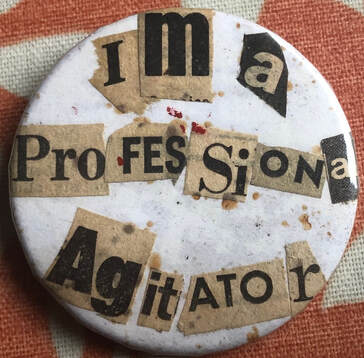 Good to be reminded that lefties really did have a sense of humour! Mike Sharples tells me: 'I was involved in various political and community arts campaigns in Scotland during the 1970s, including a stint as Press Officer of the Scottish League of Young Liberals (Peter Hain was my counterpart in England at the time), as a community drama worker in Edinburgh, as a coordinator of the SCRAM campaign against the Torness nuclear power station in Edinburgh, and as an editor of various community magazines. 'I collected the badges as souvenirs then put them up in the attic along with other memorabilia such as alternative magazines and posters from the 1970s. We have recently moved house, so it’s high time for a clear out.' 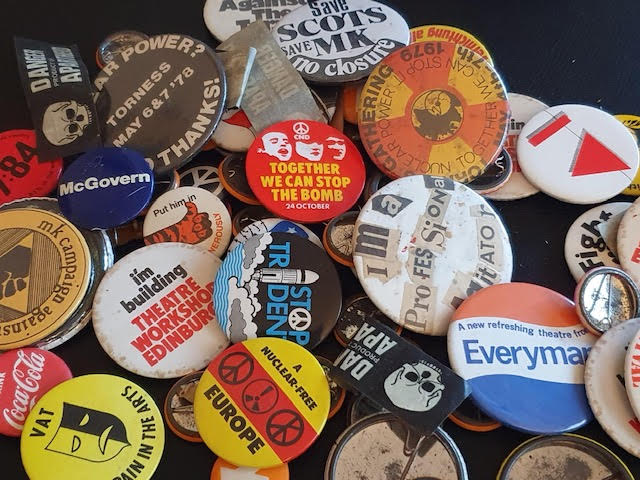
0 Comments
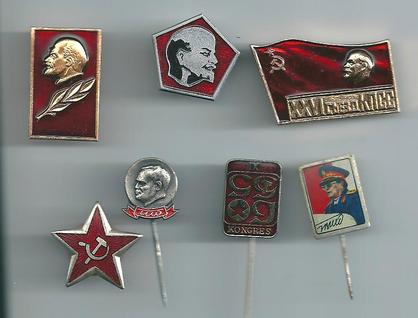
A handful of badges from my holiday - bought in the flea market at Pula, the onetime capital of Istria in Croatia. Lenin in the top row (and these Soviet badges were just a few pence each), Tito down below (only a shade more pricy). The one moderately costly badge was the hammer and sickle in a red star, which I think is an army cap badge.
I am not sure why the Soviet bloc, and Yugoslavia, were so abundant in their issuing of (usually fairly cheap and tacky) badges. I suppose it was about the Communist love of iconography, and probably disguised a profound sense of insecurity. Anyway, these will look just mighty fine on my pinboard. 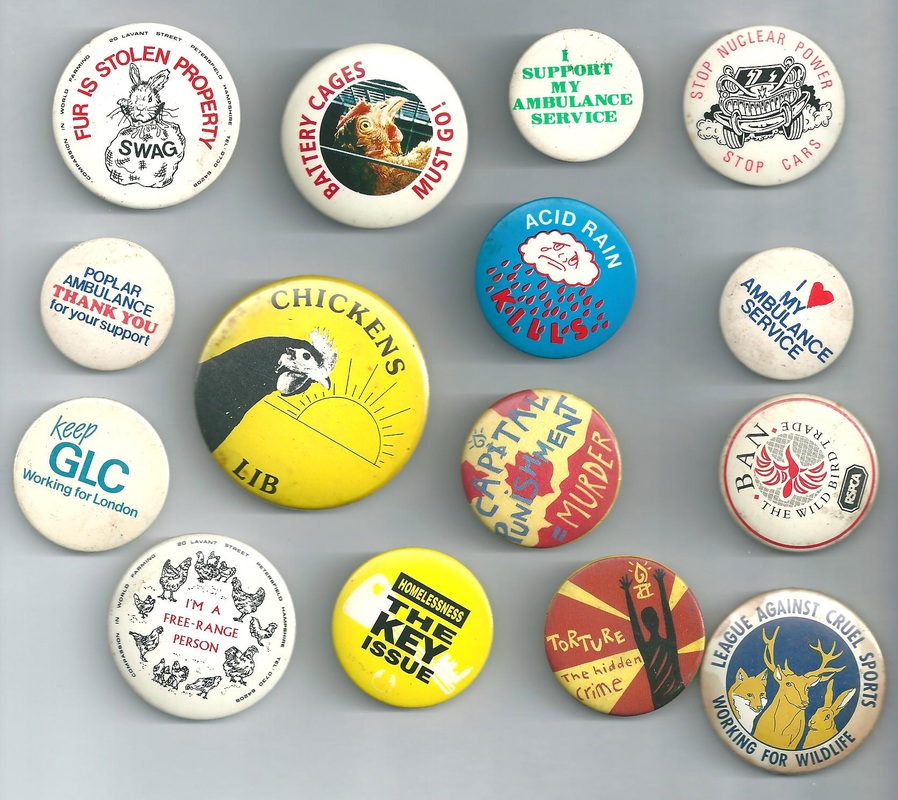 A wonderful array of badges - mainly about the health service and animal rights, and dating (I'd guess) from the 1980s. All from a generous benefactor who had come across this website. I particularly like the 'Acid Rain' and Amnesty International 'torture: the hidden crime' designs. A really big thank you, Julia!
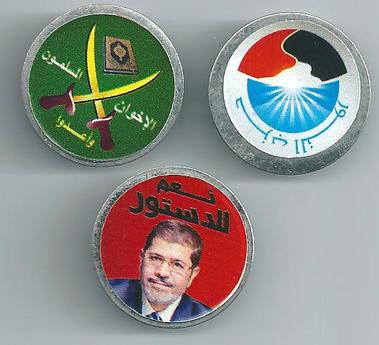
A really nice Christmas present - a trio of badges from Cairo, all supporting (or from groups supporting) the successful 'yes' side in the recent constitutional referendum. "An Islamist deluxe collection", in the words of an Egyptian friend.
The green badge displays the Muslim Brotherhood's emblem of two swords, and a short verse from the Qu'ran which translates as: "be prepared". On the top right is a badge of the Salafi 'Nour' party. And the one with President Morsi's image reads: "yes to the constitution". Nice to know that the very American device of the political campaign button is flourishing in Muslim Brotherhood-run Egypt. A big thank you to Brian for the badges, and to Shaimaa for the context and translation. 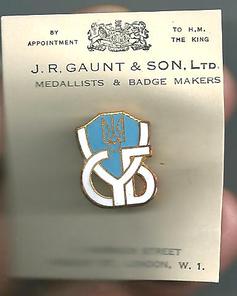 I spent yesterday evening at the Notting Hill headquarters of the Association of Ukrainians in Great Britain - and came away with this marvellous gift (thanks Vlod!), the association's badge still mounted in card, as supplied from the makers. And the makers were the very illustrious J.R. Gaunt & Son, medallists and badge makers to H.M. the King - which means that the badge must be more than sixty years old. J.R. Gaunt seems to have specialised in making military badges and buttons - and is still in business, no longer off Regent Street, but in Birmingham. The occasion yesterday was a public viewing of the work of a distinguished Ukrainian artist, Dmytro Dobrovolsky. And particularly, a display of his 'Cycling to Bush House' - a wonderful icon of what is now is starting to feel a distant era in the BBC's history. The BBC handed back the keys to Bush House on the last day of last month. Over! 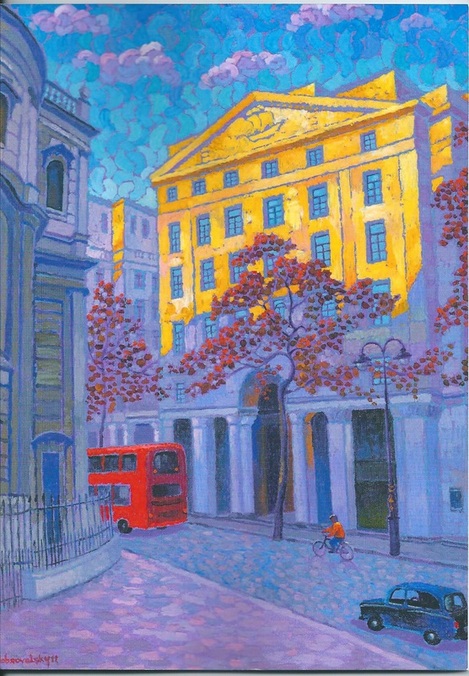
Dmytro Dobrovolsky, 'Cycling to Bush House'
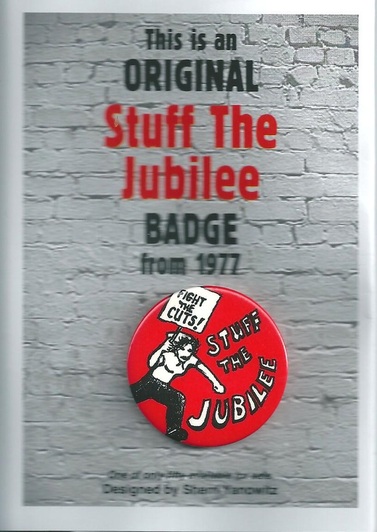 In the year of Jubilee, a classic - if controversial - badge from an earlier Jubilee is back on the market.
And this isn't a reissue. A cache of fifty of these 1977 badges, one of the most celebrated of political badges, has been unearthed and put on sale - at a fiver a time. A bargain - given that one of the originals was sold recently on eBay for a staggering £44.63! The designer was Sherrl Yanowitz. Her first badge design - and in the end they shifted more than 40,000. 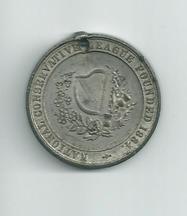 A political curiososity - bought from The Green Room, a great place for Irish political ephemera (and lots more besides) on Archway Road. Graced with the Irish harp, this is a medal issued by the National Conservative League, founded in 1884. As the proprietor (himself Irish) remarked when making the sale, Irish Conservatives were an endangered species even in the 1880s. Sufficiently so, it seems, to embrace socialist-style slogans: 'Unity is Strength' and 'We Hold Together' 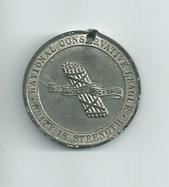 So what exactly was the National Conservative League? There's not much to go on on the 'net. I wondered whether it was a Northern Unionist organisation - but then it would be displaying the Ulster palmed hand rather than the harp.
My guess is that it was a response to the rise of Irish Home Rulers, followers of Parnell, who became such a powerful political force in Ireland from the mid-1880s. Anyone out there with any further info? 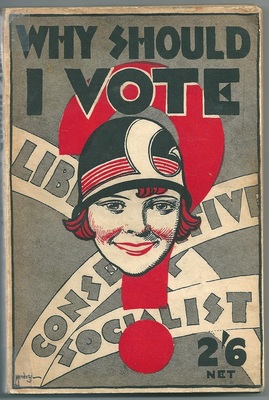 Every so often, I spend a weekend afternoon trawling round second-hand bookshops and what you might call vintage shops in search of, well, anything that attracts my interest. Today was my winter wander - around Highgate and Archway, taking in two good charity shops, Oxfam and Mind, the excellent Ripping Yarns near Highgate tube, and the always intriguing Green Room down Archway Road. This is my favourite purchase - bought entirely because of the wonderful, and gloriously dated, cover. It came out in 1929, don't you know. It's sub-titled 'a handbook for electors', and was clearly aimed at the new women's vote (women only got the vote on the same terms as men, I believe, in 1928). The principal author was Amabel Williams-Ellis - whose father, John Strachey, was editor of the 'Spectator' and similarly named brother dallied variously with communism, socialism and Oswald Mosley. 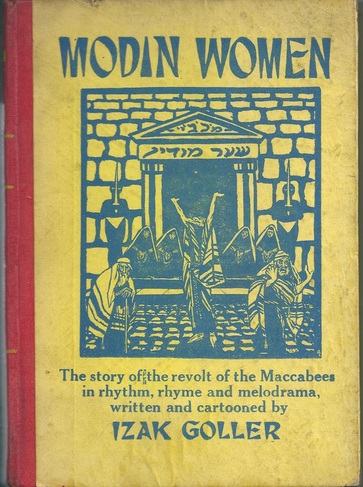 This too I bought largely because of the remarkable cover. The book is by a Zionist writer, Izak Goller - 'stark, undiluted melodrama', in his words - and was published by the Ghetto Press in London in 1931. Goller co-founded the press 'to provide both the Jewish and non-Jewish English reading public with modern Anglo-Jewish literature.' It is, to me at least, a bibliographic curiosity - in great condition, and hardly expensive at a tenner. If anyone knows anything more about the author or indeed the symbolical importance of the revolt of the Maccabees, do let me know. 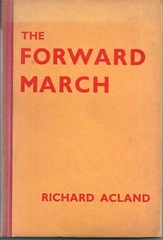 Richard Acland's Forward March - published in 1941, with a remarkably dull cover - was a key step in the foundation that year of Common Wealth, a radical (slightly libertarian) party which went on to win a series of wartime Parliamentary by-elections. Acland was a Liberal MP and a Christian progressive who allied with the author J.B. Priestley and a former communist Tom Wintringham to set up Common Wealth. It was a remarkable phenomenon but collapsed very quickly with the return to peacetime politics. The last vestiges of the party survived into the 1990s. 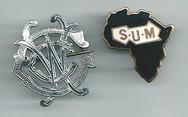 All the books came from Ripping Yarns. At the Green Room, I bought some intriguing bagdes. The 'silver' badge I got - for a very modest amount - because I though it was a Common Wealth badge or tie pin. Their emblem was a 'W' inside a 'C'. I'm now not so sure.
I had no idea what the S.U.M. was - though the badge is very striking. I suspect after sleuthing round the interent that it stands for the Sudan United Mission - bringing the gospel to the 'dark' continent, and all that. Anyway, that's what I did during my afternoon wander. I hope you approve. 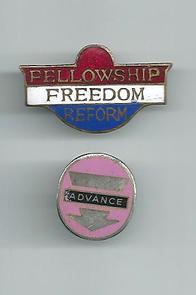 Two badges bought today from the wonderful Monday flea market in Covent Garden . I bought them 'blind' - I collect political badges, and these looked sort of political but I wasn't sure.
It turns out the top one is from an inter-war temperance organisation, the Fellowship of Freedom and Reform. I should have guessed that a badge in red, white and blue was using 'reform' in a measured manner. Reform of the licensing laws in this case. There's more about the Fellowship and its splendid badge here. The bottom one is hallmarked silver, and so was more expensive. It could well be commercial, but if I remember right the Labour League of Youth had at one time a paper called 'Advance' and I wonder whether this was their badge. Anyone know? |
Andrew Whitehead's blogWelcome - read - comment - throw stones - pick up threads - and tell me how to do this better! Archives
April 2024
Categories
All
|
 RSS Feed