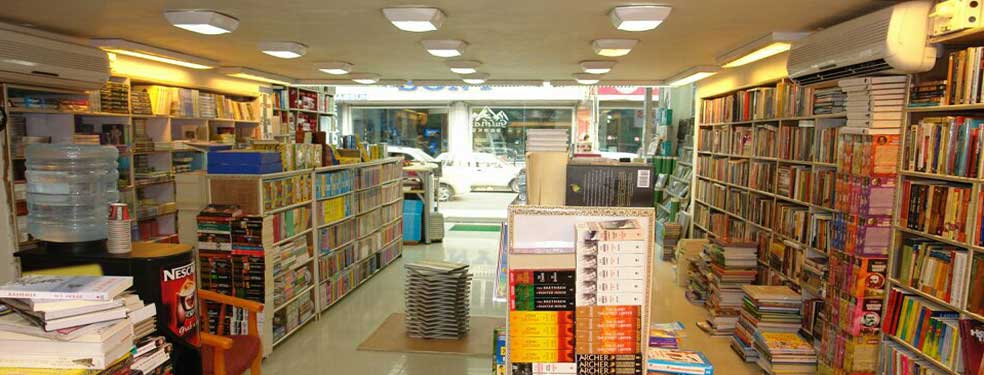
This is a photo of one of the best bookshops I know - Gulshan Books, on Residency Road in Srinagar. They are publishers too. They have a wide stock - comprehensive about Kashmir but extending much more widely. And their publishing house has brought back into print many key titles about Kashmir's past, as well as supporting new research. OK, so that's the shop as it was a few weeks ago - this is the shop as it is now ... 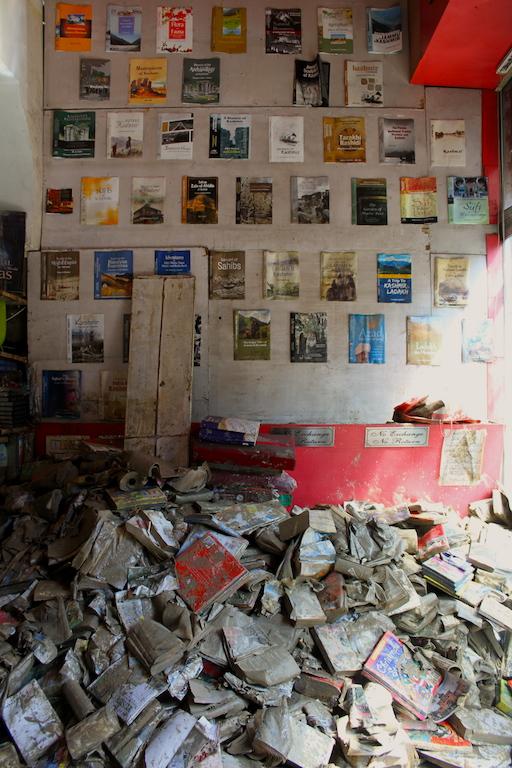
It's a gut wrenching sight. A business built up with such attention and care swept away by flood waters, and as much by the absence of any flood warning. The Rising Kashmir reports that as many as 40,000 books - some of them rare - have been lost.
This is perhaps almost trivial compared to the human suffering inflict by the floods - hundreds dead, hundreds of thousands displaced, communities ruptured. But this too is a grave loss to Kashmir, to its sense of itself - and this too is damage that needs to be made good.
1 Comment
A few weeks ago, I spent some time in Kashmir - my first visit there in several years. The BBC radio programme From Our Own Correspondent today broadcast my piece reflecting on that visit, and how Kashmir has changed over the past twenty years - and I am posting my script here with the programme's blessing.
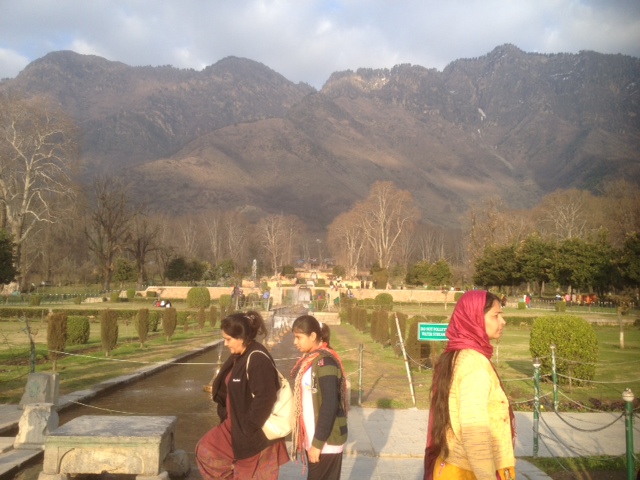
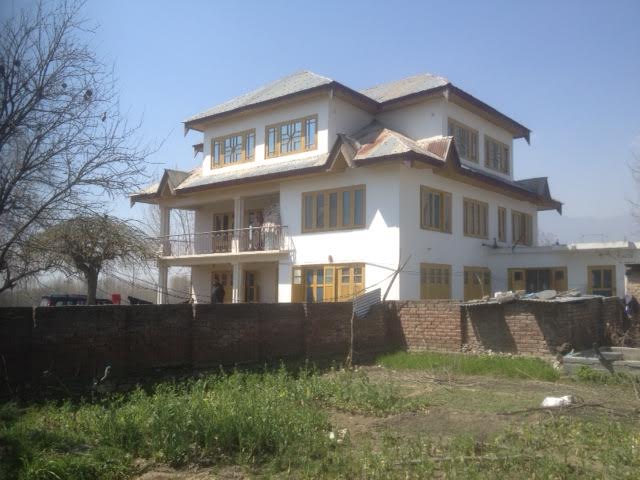
INTRODUCTION: Indian-administered Kashmir, a mainly Muslim corner of a Hindu majority nation, was in the grip of a violent separatist insurgency when Andrew Whitehead first reported from there for the BBC in the 1990s. He’s gone back regularly, but his latest visit was his first for several years, and prompted him to reflect on what’s changed, and what hasn’t, over the period he’s known the Kashmir valley: The flight into Kashmir was full – of Indian tourists. Every seat taken, and an air of holiday excitement. What a change from twenty years ago. Then, amid the separatist insurgency and equally brutal Indian army response, no one took the plane to Srinagar for pleasure. This time I came across scores of holiday makers strolling along Dal Lake and visiting the beauty spots. At a shop on Polo View, I queued behind a family from Delhi who spent seven-thousand rupees, a hundred dollars, on Kashmiri walnuts and almonds to take home with them. The number of Indian tourists, there are far fewer foreigners, has been edging up year-by-year as the violence has eased – so much so, I heard tell there’s been an appeal for Kashmiris to offer home stays, because of a shortage of rooms in hotels and on houseboats. In the nineties, even if there had been any Indian holiday makers, they would never have felt at ease in a Kashmiri home. On my drive in from the airport, I spotted another sign of Kashmir’s bounce back – huge mansions being built on the outskirts of Srinagar. The place has always had more of an air of prosperity than many north Indian cities, and – while there’s certainly poverty and deprivation – some Kashmiris are now doing very well indeed. And not just in the city. At a saffron growing village just outside Srinagar, every house was lavishly appointed – sprawling, two or three storeys, not the sort of opulence I’d expected in rural Kashmir. And security? Well, what was once one of the most militarised spots on earth is now much more lightly guarded. There are bunkers and checkpoints, but many fewer than in the 90s – in Srinagar at least. I walked round the city at close of day with a colleague who has spent many years in Pakistan – we browsed at the paper stalls, said hello to the women selling fish on one of the bridges, and chatted to a teenager as we walked along the banks of the Jhelum river. He was astonished – Srinagar today, he said, felt safer than Islamabad or any other Pakistani city. But it would be wrong to imagine that Kashmir has found peace. The numbers killed in the troubles amount to perhaps one-in-fifty of the valley’s adult population – a huge proportion when set aside, say, Northern Ireland or Sri Lanka. It’s still a society in trauma. A Kashmiri who was a teenager when the armed separatism erupted said that in some areas, perhaps half the young men came to be embroiled in some manner in the militancy. A younger, upper class Kashmiri told me how his parents had sent him out of the valley to a boarding school, because it was safer. “The other kids there, Punjabis mainly, nicknamed me AK-47”, he said with a thin, resentful smile. He supports continued Indian rule. He’s in a minority. One Kashmiri intellectual whose opinion I respect ventured that for every Kashmiri who backs India there are three who favour Pakistan – and that both these camps are outnumbered by supporters of Kashmir’s independence. Young Kashmiris may not be taking up guns, but the killing of scores of stone throwing but otherwise unarmed anti-India demonstrators by the security forces in the summer of 2010 reforged a burning sense of resentment. At a new university, the Islamic University of Science and Technology – both faculty and students told me there was nothing Islamic about it beyond the name – young men and women explained, in calm and considered tones, why the ebbing of the militancy doesn’t mean that Kashmiris feel any more Indian, why they remain unreconciled to Indian rule. On my initial visits to Kashmir all those years ago, I used to see quite a bit of a bookish young man called Umar Farooq. He was then in his early twenties, and had recently assumed the role – on his father’s assassination - of Srinagar’s Muslim chief priest. He was a leading separatist. He still is. I called again at his home near Nageen lake. The years have been kind to him, more kind than they have been to the cause he champions. The reduced level of violence was no bad thing, he said. But if the armed militancy hadn’t worked, neither had India’s military presence. The young were even more alienated today, and the mood of resistance was still very strong. So much has changed in Kashmir. So much remains the same.
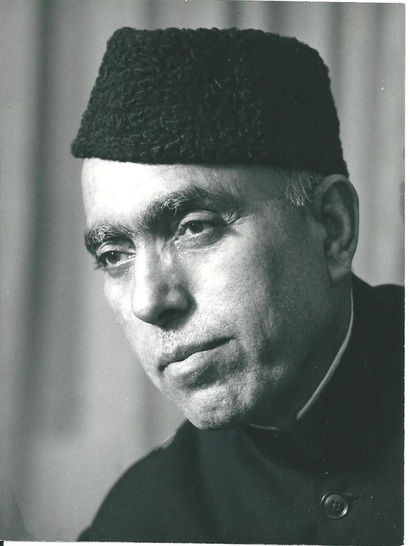 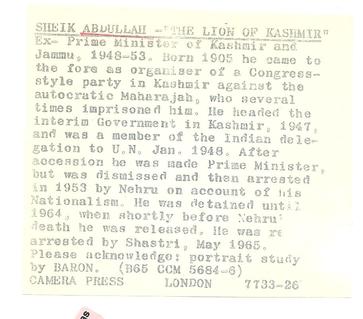 Just bought on eBay - a photo of Sheikh Abdullah which bears the date on the back of 24th September 1965. He was then 59, and - as the press note on the back of the photo confirms - at that time in detention. I'm not clear whether the photographer was able to take this picture while Abdullah was under arrest or whether it's a re-release of an earlier portrait photo. LATER: And the photographer? Well, there was a very famous camera man by the name of 'Baron' who worked for Camera Press ... 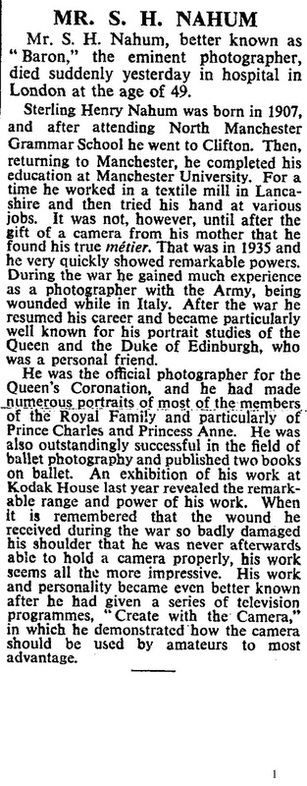 Sterling Henry Nahum died in 1956 - this is his obituary in 'The Times' - but it seems that he took this portrait shot of Sheikh Abdullah, and then it was recirculated by the Camera Press agency in 1965.
It's also possible that this photo was indeed taken in or around 1965 by Baron Studios, which continued in operation until 1974. Of this, the National Portrait Gallery says: Founded by the dance, film and celebrity photographer Baron (born Sterling Henry Nahum) , 1906-56, the studios operated between 1954 and 1974 from London studios on Brick Street, Park Lane and Mayfair. They employed a number of operators including Count Zichy and principally Rex Coleman. Though primarily consisting of over 10,000 studio portraits of businessmen, many of the more interesting subjects, including those in colour or on location, portray writers, musicians, foreign dignitaries, artists, broadcasters and fashion designers. Godfrey Argent purchased Baron Studios in 1974 and the collection was generously donated to the National Portrait Gallery in 1999. 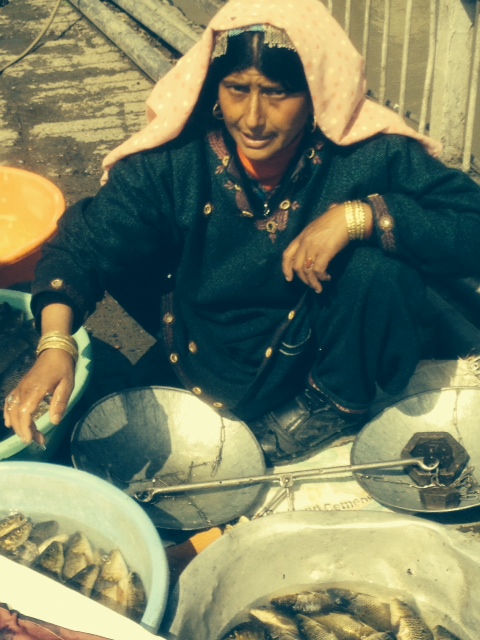
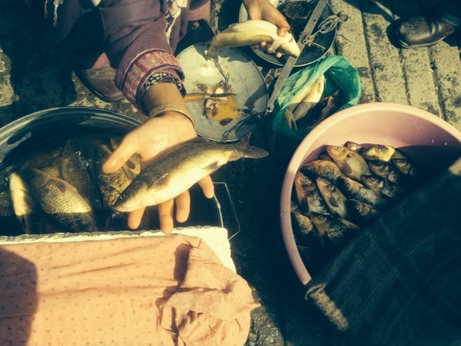
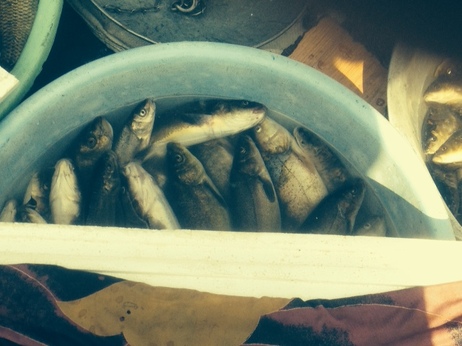
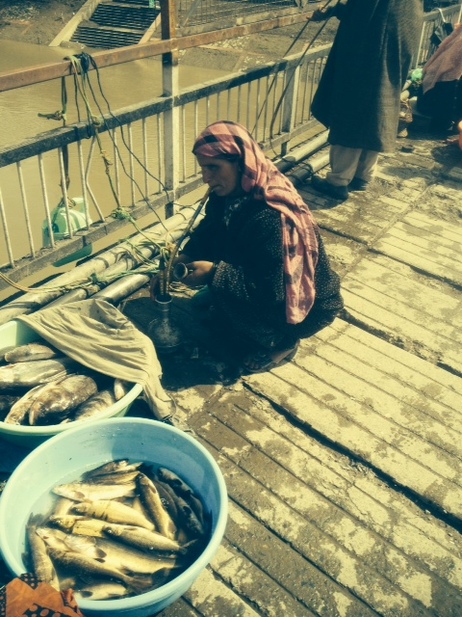
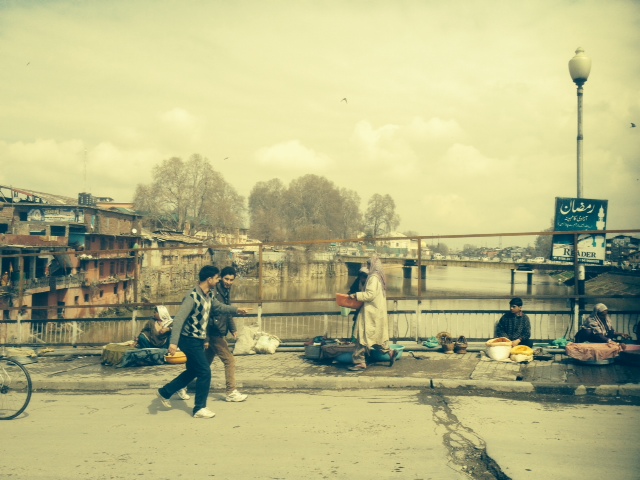
Over the years, I've walked round Srinagar many times - but I'd never before noticed the fish market on Amira Kadal, one of the most prominent bridges across the Jhelum. The bridge - there's more about it here - dates from the 1770s and the period of fairly brutal Afghan rule over the valley - through the current construction is as recent as the 1980s. It's just a couple of minutes walk from Lal Chowk. The fish sellers, all women, are all on the right side of the bridge as you walk over from Lal Chowk - all the other traders, of which there are plenty, stick to the other walkway. There is something about 'fish wives' around the world - sassy, confident, outgoing. It's certainly true of the sellers on Amira Kadal. A friendly, welcoming bunch who were happy for me to take photographs, and were clearly doing good business. 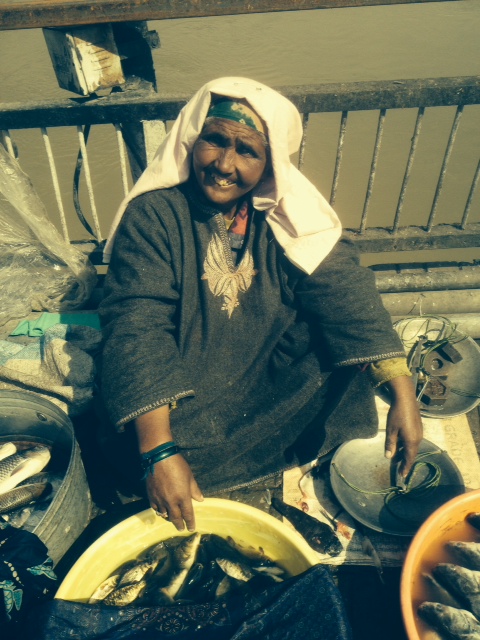
The fish in the plastic basins - covered both to stop them jumping out and to discourage the cheel overhead - were clearly that morning's catch. Still very much alive. The women were gutting some of the catch as they sold it - I hadn't realised that they simply disembowelled living fish. There were three main types of fish - a small one which I can't name, a medium size which looked to me to be the famed Kashmiri trout though the women clearly didn't recognise that name, and a much larger fish which they called 'golden fish'. It all leaves me to wonder why fish dishes don't feature more prominently in Kashmiri wazwan. I ate in a few local restaurants, and there certainly wasn't a lot of fish on offer. I once managed to eat pan-fried trout in Kashmir, served with lightly fried Kashmiri almonds - but that was at the Grand Palace on the sole occasion I've dined there. 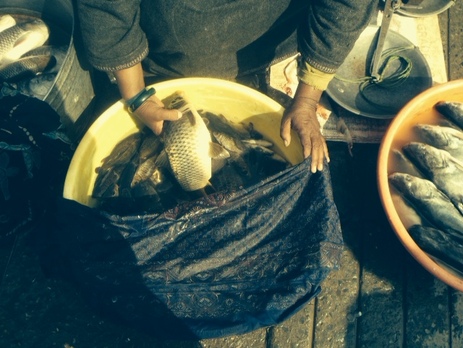
Who catches the fish? Is it the women's menfolk, or are they buying catches wholesale? And where is the fishing? On the Jhelum and Dal Lake or further afield? If you know, let me know. And if you are wondering how to cook fish Kashmiri style, there's a film on YouTube which might help you. 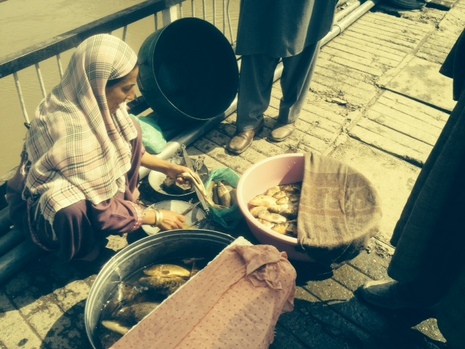
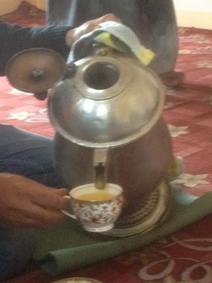
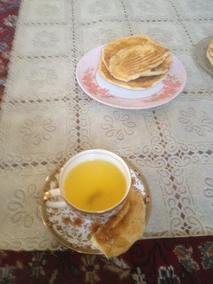
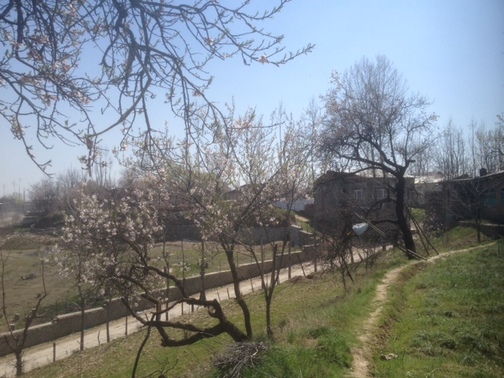 The saffron fields on the outskirts of Srinagar. The crocuses whose stigmas constitute saffron (kesar in Hindi) flower in October and November. At the moment, there are just unexceptional little plants which from a distance look like tufts of grass - overshadowed by the almond trees in blossom. But saffron is one of the world's most valuable crops - about $2,500 a kilo (in case you are wondering, a kilo of gold costs $42,000). Kashmiri saffron is, so the growers say, the world's best - much superior to the saffron from Iran and Spain. Indeed, it's said that some unscrupulous Kashmiri traders bulk up their saffron with cheaper, coarser Iranian stigma. The culinary value of saffron comes not so much from the taste - which is not at all pronounced - as the golden hue it imparts to cooking, and the wonderful fragrance. While in the saffron belt, we had some kahwa, traditional Kashmiri tea, containing saffron - and the colour really does stand out.
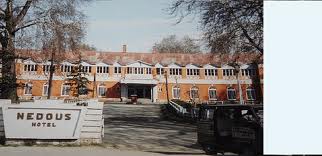
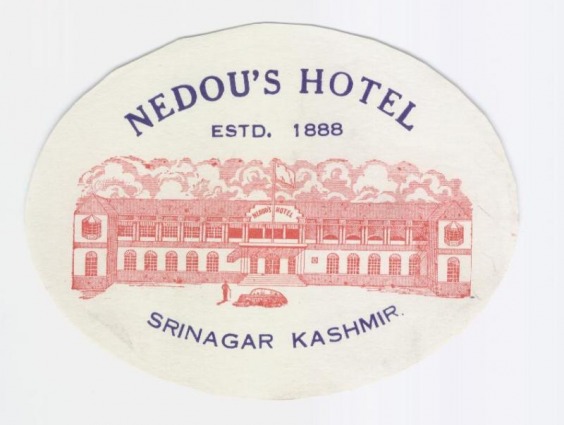
What stands out even more is the wealth of the saffron-growing community - the houses are immense, not just one or two houses, but all of them. I've never seen a village anywhere which, in terms of the size of the houses, appeared to be quite this prosperous. OK, so these are each home to an extended familiy and people here would much rather invest in property than save in a bank. Even so, these are big, big properties. 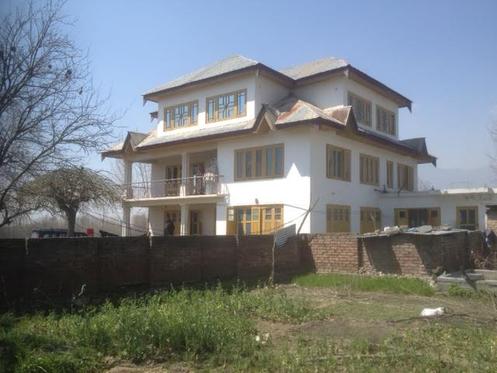 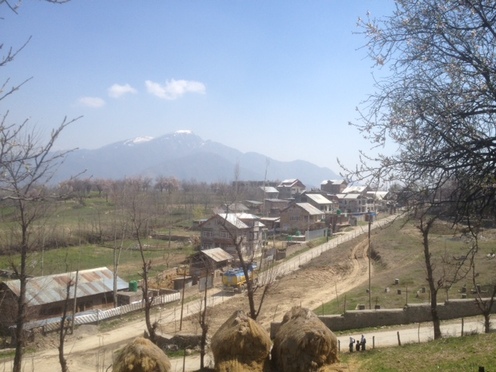 It wasn't immediately clear to me why saffron was grown in just a small area on the southern fringes of Srinagar. I was told that the land was good, slightly sloping to aid drainage, and that tradition - reinforced by religious myth - dictated that this was the realm of saffron. There are plenty of Kashmiri villages that are much, much poorer - especially those on the edges of the valley, where the mountains start to climb. But it was astonishing to see such opulence. Another sign of this increasing wealth - where once the crocus stamen would have been picked and sorted by Kashmiris, now Bihari workers from hundreds of miles away travel to Kashmir to take on this delicate and repetitive task. Saffron has certainly brought a golden touch to Kashmir. 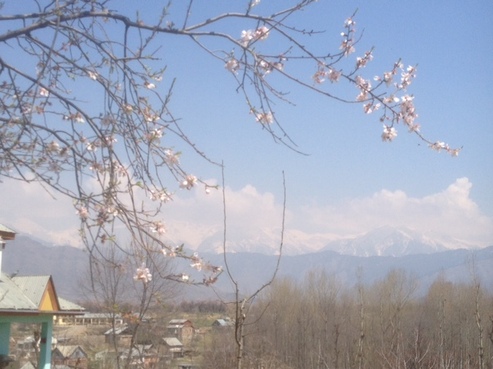 (... and read to the end for the story of Khruschev's chandelier ...) 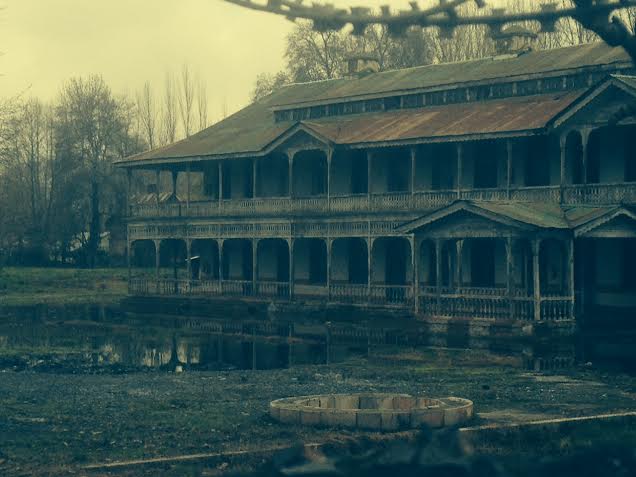 In the first half of the last century, there was one commanding hotel in Srinagar - Nedou's. It's still there. At least, the building is. But it hasn't had guests for many decades. Indian security forces were billeted there, but they have now gone. The site, on M.A. Road (photographed as best I could through gaps in the fencing and barbed wire) is a mess. But word around town is that Nedou's is to be reborn, with the old facade retained. What a heartening prospect! 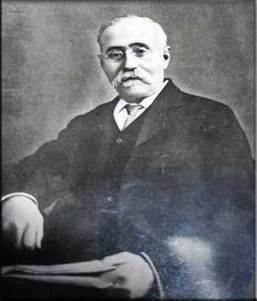 The Nedou family story is fascinating. Michael Adam Nedou - I think that's him on the right, photo courtesy of the Nedou's Gulmarg website - came to India from Dubrovnik (then also known as Ragusa), now in Croatia but at that time part of the Austro-Hungarian Empire. Nedou was an architect, and in the 1880s opened smart hotels in Lahore and then in the Kashmiri ski resort of Gulmarg. Nedou's Gulmarg is still going, and featured memorably in Molly Kaye's thriller, Death in Kashmir. (Nedou's have also recently opened a small boutique hotel in Srinagar). The writer on post-colonialism Nyla Ali Khan has retrieved the story of the Nedou dynasty in Kashmir - a family of which she is part (by my reckoning, she is Michael Adam Nedou's great-great-granddaughter). The best known Kashmiri Nedou is Michael Adam's son, Michael Henry Nedou, universally known as Harry, who was born in Pune in 1877. So he would have been in his early twenties when the flagship Nedou's hotel, on what is now Srinagar's Maulana Azad Road, opened in 1900. It was the city's first round-the-year, 'European' hotel - previously European visitors had usually stayed in houseboats. Francis Younghusband commended the hotel in his 1909 account of the Kashmir valley, and clearly found life there agreeable. 'Srinagar is indeed a gay place for the summer months', he wrote, 'with games going on every day, dances nearly every week, dinners, garden parties and picnics.'
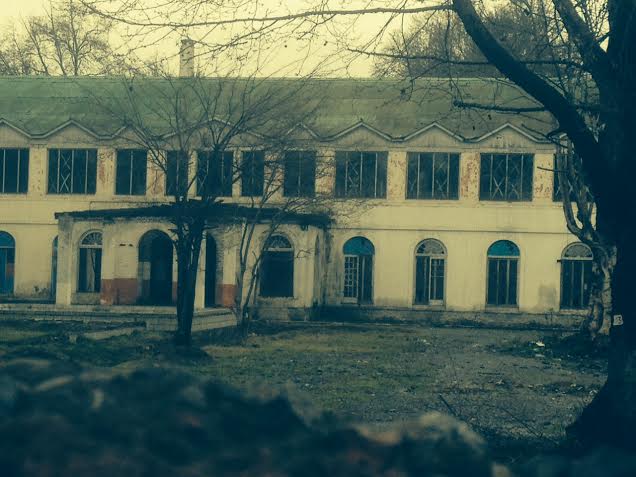 The entrance block of Nedou's, Srinagar as it is today 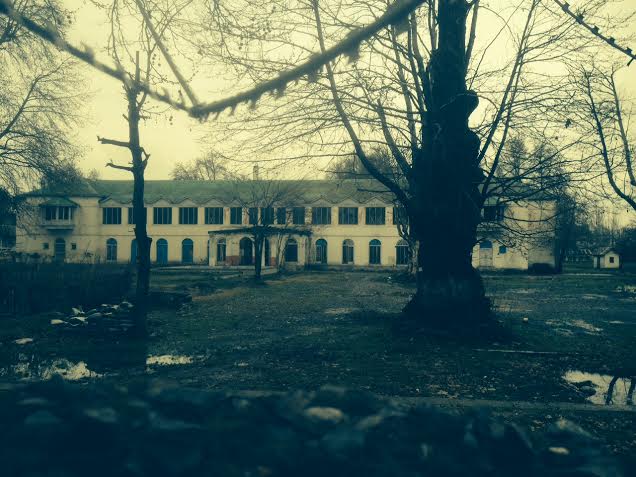 Nedou's was well placed to ride the wave of tourism and colonial-era 'rest and recreation' which enveloped Kashmir from the 1920s and hits its crest during the Second World War. In 1947, there were a few hundred all-the-year-round European residents of Srinagar. As a lashkar, an army of Pakistani tribesmen, advanced on Srinagar at the end of October 1947, Leela Pasricha told me how she fled from Baramulla to a well appointed lodge at Nedou's. It was where the foreign correspondents covering the conflict stayed. And in Nedou's bar, journalists got first-hand accounts from Indian army officers of the progress of the fighting and sought out the pilots who could hand carry their copy back to Delhi. In the National Army Museum in London, there's a letter written from Nedou's in early November 1947 by a British woman, Gwen Burton, who found herself unwittingly caught up in the first act of the enduring Kashmir crisis. 'We never thought we would be in the siege of Srinagar! Not at all pleasant + very nerve racking. Food is beginning to get scarce, no butter in the hotel now + flour very scarce. ... We have had lovely weather here so far + only hope it goes on.' She too found a pilot to carry the letter to Delhi and post it there. 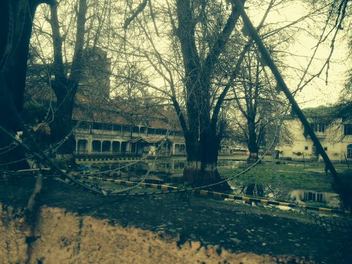 I am not sure whether Nedou's was still taking guests right up until the insurgency started at the end of the 1980s.By the time I first came to Kashmir in 1993, the site was under Indian military control. And that remained the case for about twenty years. Now the security forces have left Nedou's, there's an opportunity for renovation. And according to a contractor I was chatting to in Srinagar the other day, plans are taking shape. If I find out more, I'll update this post. A couple of other commercial institutions from the colonial era (technically Kashmir was a princely state, not part of the Raj, but let that pass) - the Suffering Moses handicrafts store,and onetime society photographers Mahatta's - are still in business on the Bund, the riverside walk, a short distance away. It would be nice to have Nedou's back. 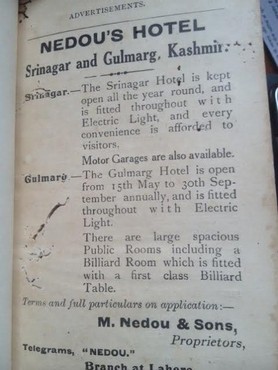 From a 1916 guide to Kashmir From a 1916 guide to Kashmir And as a footnote: the Nedou family married in to the premier political dynasty of modern Kashmir. Here's the story -
Harry Nedou married a Gujjar woman, Mir Jan. Their daughter Akbar Jehan (they had several sons too) married Sheikh Abdullah, the 'Lion of Kashmir', the foremost Kashmiri nationalist of his generation. (Tariq Ali has suggested that Akbar Jehan earlier entered into a brief marriage to T.E. Lawrence, but Lawrence experts are unconvinced). Sheikh Abdullah's grandson, Omar Abdullah, is currently the chief minister of the Indian state of Jammu and Kashmir. So the Nedou family have played quite a part in Kashmir's history. LATER - NEWS FROM NEDOU'S: A family member has got in touch to confirm that there are indeed plans to refurbish and reopen their Srinagar hotel. The intention is to keep the atmospheric colonial-era exteriors, and to thoroughly modernise the interiors. I'm told Nedou's still has a chandelier presented to the hotel by, of all people, the Soviet leader Nikita Khruschev - unlikely as it may seem, he and Bulganin visited the Kashmir valley in December 1955. The chandelier is apparently structurally sound, but bits of the glass have been smashed and splintered over the years. (Is that a metaphor for something?)
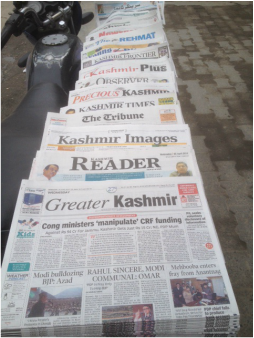
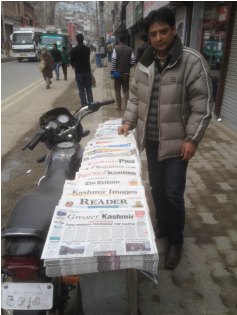
A news stand in downtown Srinagar - not all that much news, but no shortage of newspapers. Count them! I don't imagine there's any similarly sized city in South Asia which has anything like as vibrant an English language press.
I have had the privilege of spending a few days back in the Kashmir valley in the past week, my first time there for some years. In this blog in coming days, I am going to reflect on what I saw and heard. Not about the Kashmir issue, status, insurgency ... all those issues matter, a lot, but that's for another place, and my colleague Owen Bennett-Jones has written sparklingly on these themes here - these are simply some personal observations about the valley, and Srinagar in particular. As you can see, the news stands are heaving with local English language (and in other stalls Urdu language, and indeed a few Kashmiri language) papers. The Greater Kashmir is probably the brand leader, a well produced and independently minded newspaper. People also spoke highly of Rising Kashmir and Kashmir Images in particular. There are a few good magazines, and the digital landscape is also well served. Throughout the insurgency and Indian military response to it (oh dear, and I had said I wasn't going to talk about the status issue and the militancy) the journalists of the valley pursued their profession with courage and resolve. The papers kept publishing as best they could. In a slightly more relaxed environment, they appear to be thriving. Nothing brought me pleasure during this visit to Srinagar so much as the well-stocked newspaper stalls. 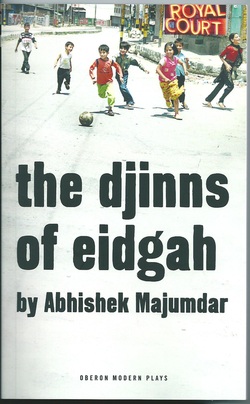 Everybody on every side has been damaged by the Kashmir conflict. Kashmir's youth - their parents - onlookers to violence - the Indian soldiers - the tiny band of mental health professionals who seek to deal with the overwhelming numbers suffering from trauma.
That's the unsettling message of Abhishek Majumdar's 'The Djinns of Eidgah', which has just finished a run at the Royal Court. I saw the final production last night, excellently acted and staged. A really powerful piece of theatre, all the more effective from being staged in the intimate setting of the Jerwood Upstairs. Djinns are spirits with a touch of the supernatural about them - linked to death, though not quite ghosts. An eidgah is a prayer ground. The eidgah in Srinagar - where some of the play is set - is the martyrs' graveyard, a burial place of those Kashmiris seen as having sacrificed their lives in the struggle for 'azaadi', freedom. The plot borrows a little from Ashvin Kumar's documentary film, Inshallah Football. At its heart is a hugely talented Kashmiri footballer who doesn't throw stones (or does he?) and is determined to weave his way round all the political and bureaucratic obstacles to get to Brazil. But this play, unlike the film, is dark and forbidding, at times macabre - there's a scene in the hospital morgue. It reminded me of Mirza Waheed's equally chilling novel of modern Kashmir, The Collaborator. Both suggest a more accomplished, and provoking, reflection of Kashmir's current agonies in high culture - and that can only encourage a wider awareness and discussion (we've already seen a bit of that) of how those agonies are best addressed and redressed. 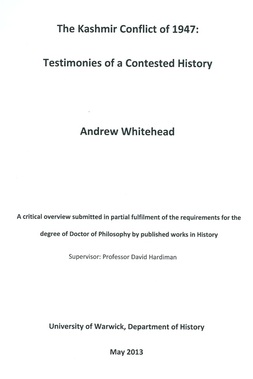 It's 35 years since I enrolled as a Ph.D. student at Warwick University - and at last, I am about to become a Doctor.
That first attempt at a doctoral thesis ('Popular Politics and Society in late-Victorian Clerkenwell', since you ask) never quite made it. But a while back, I started pursuing a Ph.D. by publication - based particularly on my book A Mission in Kashmir and a related academic article on the Kashmiri left in the 1940s - and with the support of the Warwick history department, and above all of my supervisor, David Hardiman, I've got there. I was up at Warwick for a viva in the past week - with two eminent scholars of south Asia, Ian Talbot and Yasmin Khan, as the examiners. That went well, and so - subject only to a few formalities (I hope) - I will at last get my Ph.D.. What will I do with it? No idea, but it is nice to have the recognition - and to tie up a loose end that's been flapping around for well over half a lifetime. ++ And the title of this blog - A&E are the 'accident and emergency' wards at British hospitals, and accidents and emergencies have been Kashmir's fate ever since some time before 1947. 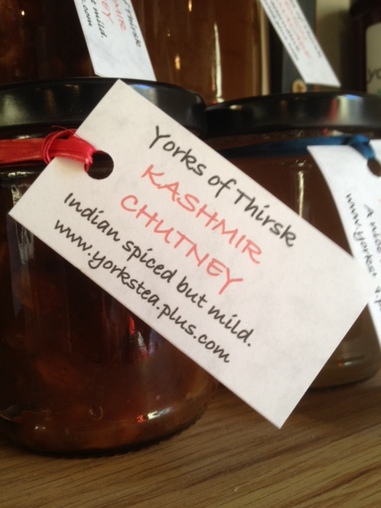 It is remarkable how Kashmir continues to have such a grip on the British imagination - even though hardly any Brits have visited the valley for the past twenty years or more.
Popping in at a North Yorkshire tea shop over Christmas, I came across a line of locally made chutneys and preserves - incuding this 'spiced but mild' Kashmir Chutney. There is no obvious link to Kashmir beyond the hint of the exotic, oriental, enticing ... but how that word 'Kashmir' stills bears a sense of wonder! |
Andrew Whitehead's blogWelcome - read - comment - throw stones - pick up threads - and tell me how to do this better! Archives
April 2024
Categories
All
|
 RSS Feed