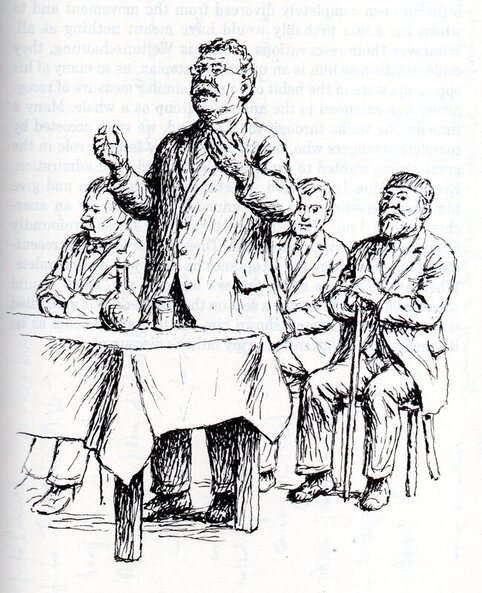
 This charming drawing of the anarchist Rudolf Rocker addressing a meeting is by his son, Fermin Rocker. Rudolf Rocker was the key figure in the flourishing anarchist movement in the East End of London in the years immediately before the outbreak of the First World War in 1914. He was German and a gentile, but mastered Yiddish and was the editor of a remarkable Yiddish weekly newspaper, the Arbeter Fraint (or Workers' Friend). 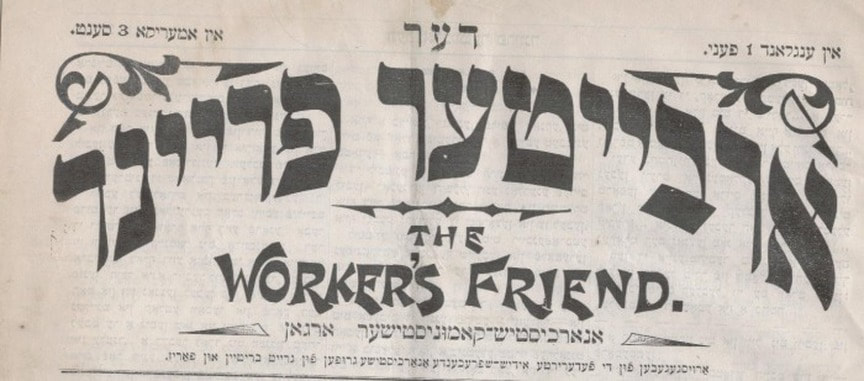 In the aftermath of two notorious shoot-outs - at Houndsditch in the City and at Sidney Street in Stepney - press attention focussed on the mainly Jewish anarchist movement in the East End. Those incidents involved Latvian political refugees, probably with anarchist synmpathies. In December 1910, a group were interrupted at Houndsditch while trying to break through a wall and rob a jeweller's shop - three police men were shot dead and two more police suffered bullet wounds. The following month, two alleged members of the gang were tracked down to a first floor room in Sidney Street. The house was surrounded by police, troops were brought in, and shots were exchanged over several hours. The two gunmen died. Rocker and most of his comrades deeply disapproved of this violence, and the 'expropriations' - armed robberies to fund the movement - which occasioned them. The Worker's Friend was published from an address in Jubilee Street, a stone's throw from Sidney Street. Next door was the anarchist Jubilee Street Club. Many of the Latvians involved in the Houndsditch incident had certainly visited the club. Journalists descended on the area, Some of their reporting was crude, inaccurate and sensationalist but a few among the reporters delivered vivid and well-informed accounts of East End anarchism. I'm posting a few of those pieces of journalism on this blog. Philip Gibbs and J.P. Eddy, in the immediate aftermath of the Siege of Sidney Street, moved into the East End and wrote a series of articles for the Daily Chronicle - this article, 'A Night with the Anarchists', appeared on 10 January 1911 and includes accounts of conversations with both Rudolf Rocker and his partner Milly Witcop: 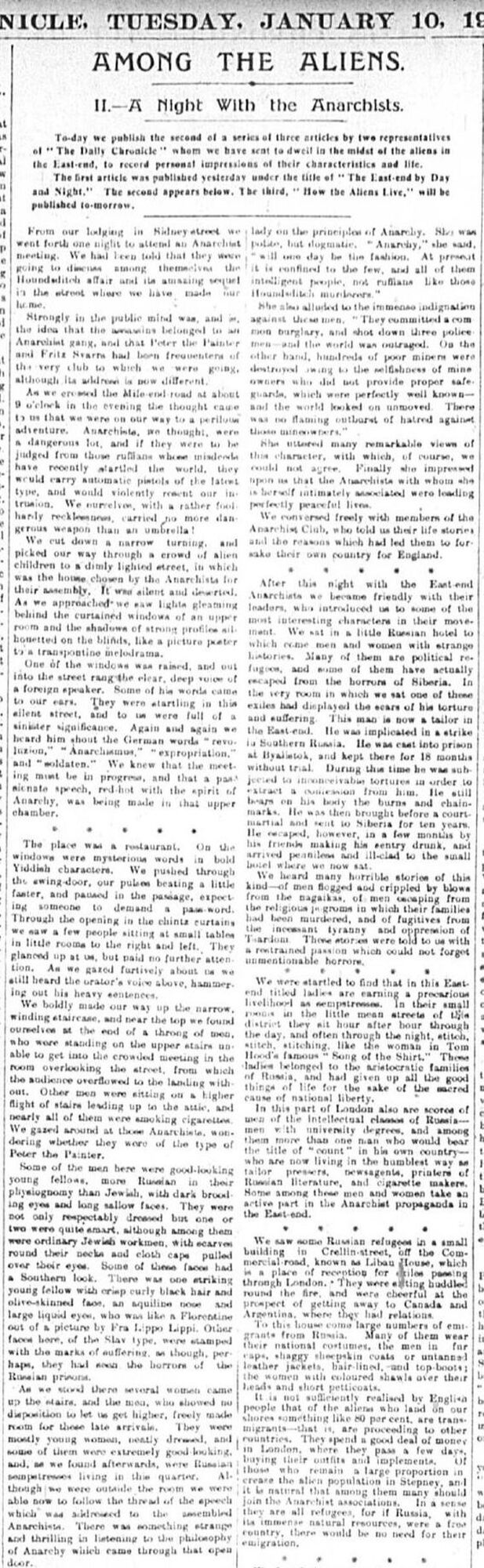 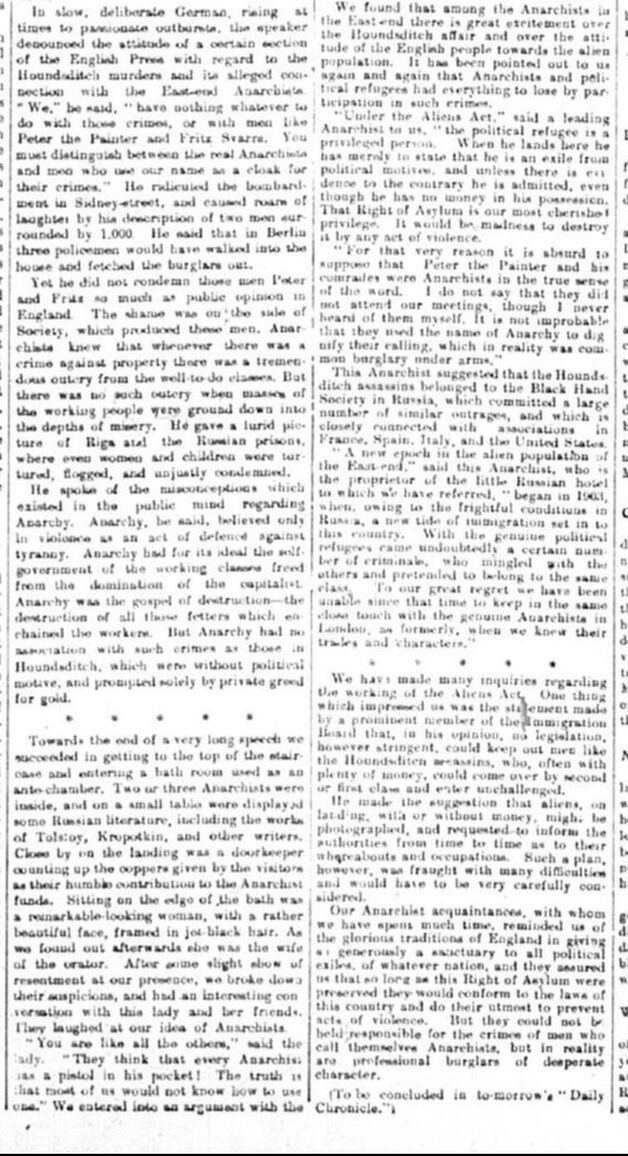 . Philip Gibbs made productive use of his sojourn in the East End - as well as his three co-authored articles for the Daily Chronicle, he also wrote two bylined pieces for the weekly Graphic, notably this account below of 'An Evening in an Anarchists' Club'. Again, Rocker is clearly the man that Gibbs heard speak. And the article's conclusion became renowned: 'These alien anarchists were as tame as rabbits. I am convinced they had not a revolver among them. And yet, looking back upon this adventure and remembering the words I heard, I am sure that this intellectual anarchy, this philosophy of revolution, is more dangerous to the state of Europe than pistols and nitro-glycerine. For out of that anarchist club in the East End come ideas more powerful in destruction than dynamite.' 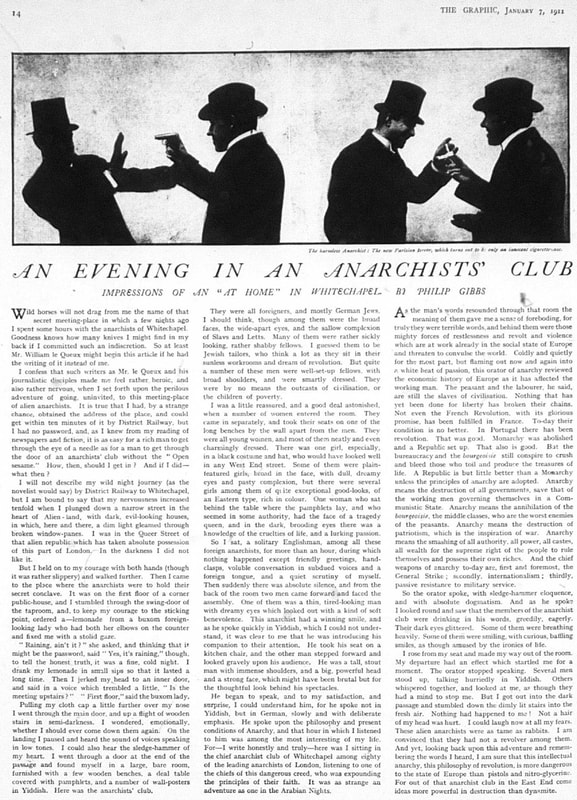 And I'm posting the columns of text individually here so it is more easily legible: 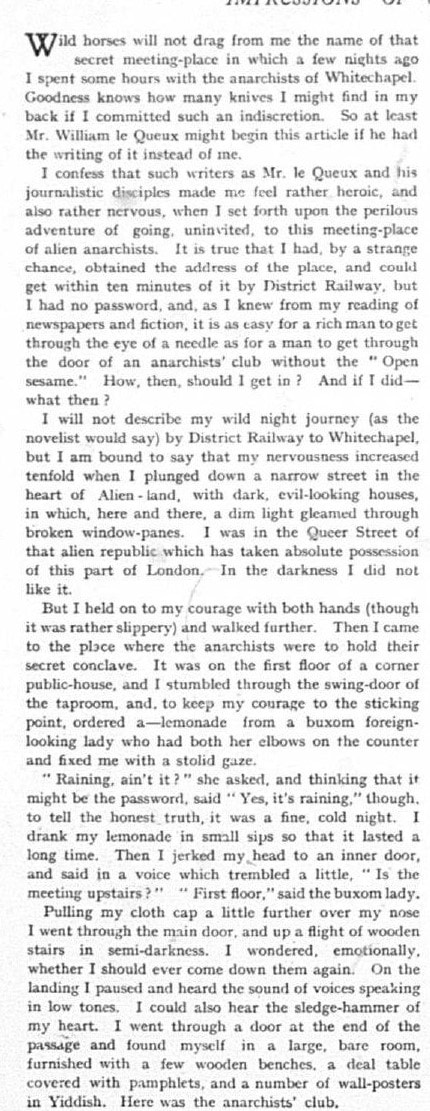 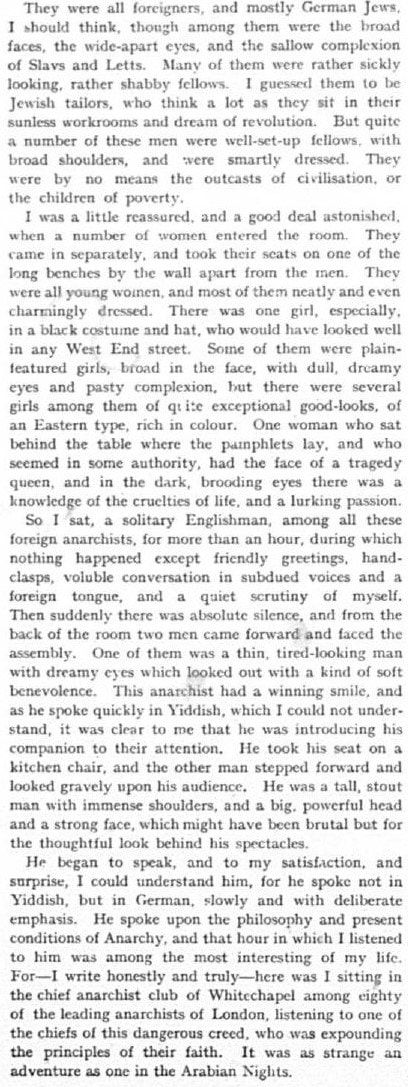 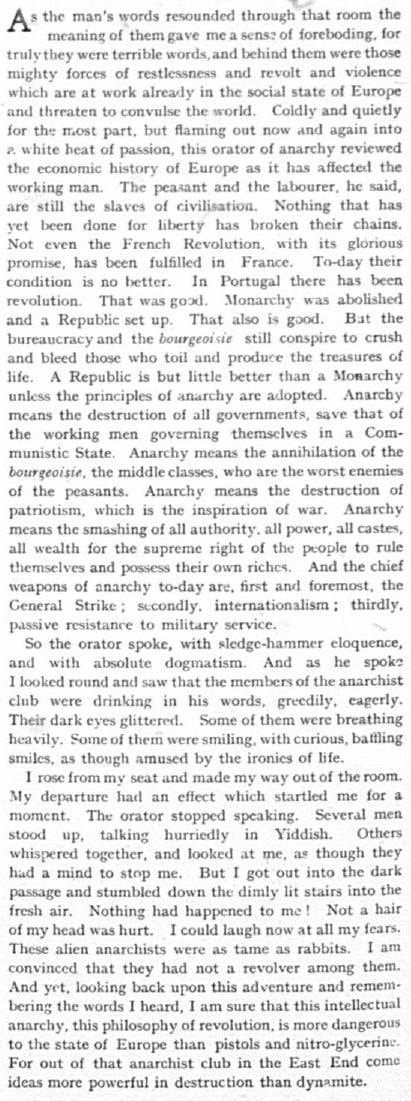 One at least of the mainstream papers took the trouble to talk at length to this prominent anarchist with 'sledge-hammer eloquence'. Rudolf Rocker expressed satisfaction with the write up of this interview he gave to the establishment minded Morning Post published in its issue of 7 January 1911 - here's the article with the title 'The Anarchist Leader':  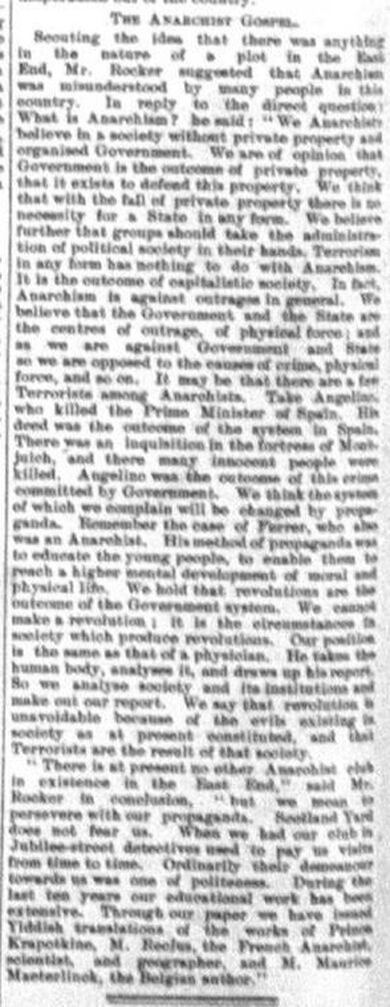 And let's close as we began, with one of Fermin Rocker's drawings of his father on the platform: 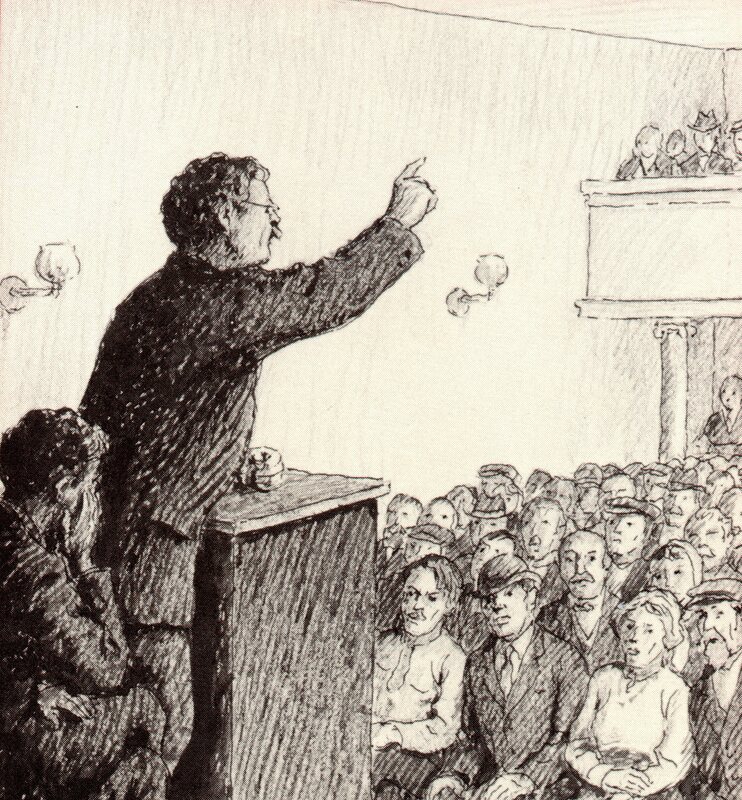 And a codicil, many years ago I interviewed Fermin Rocker (who was born in 1907) about his childhood memories of his father and the anarchist movement in the London of his childhood. Here it is:
1 Comment
 My New Year ramble has become an annual custom - this time (new camera in hand) there was a touch less serendipity about the route. I wanted to walk along Jubilee Street in Stepney, and visit one of the last surviving Jewish institutions in the old East End. The walk began at Aldgate tube station and took me along Commercial Road, the distinctly shabby main road heading east towards Canary Wharf. There are a few old mansion blocks still lining the street, but most of the businesses are given over to wholesale garment shops - and the cheap end of the business. Almost all are South Asian-run, but it's a continuation of what was the defining industry of the Jewish East End. Coincidence perhaps, but a curious and heartwarming one.
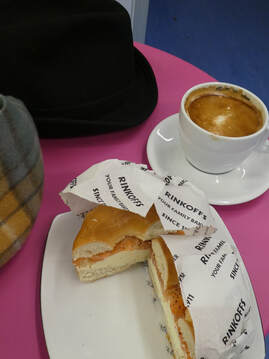
There's still a synagogue on Commercial Road - one of, I think, only three surviving in the East End where once were were 150 or more. The Congregation of Jacob dates back to 1903 though this building was consecrated only in 1921. It has an imposing frontage and by all accounts the interior is even more splendid - but this morning it was firmly shut. 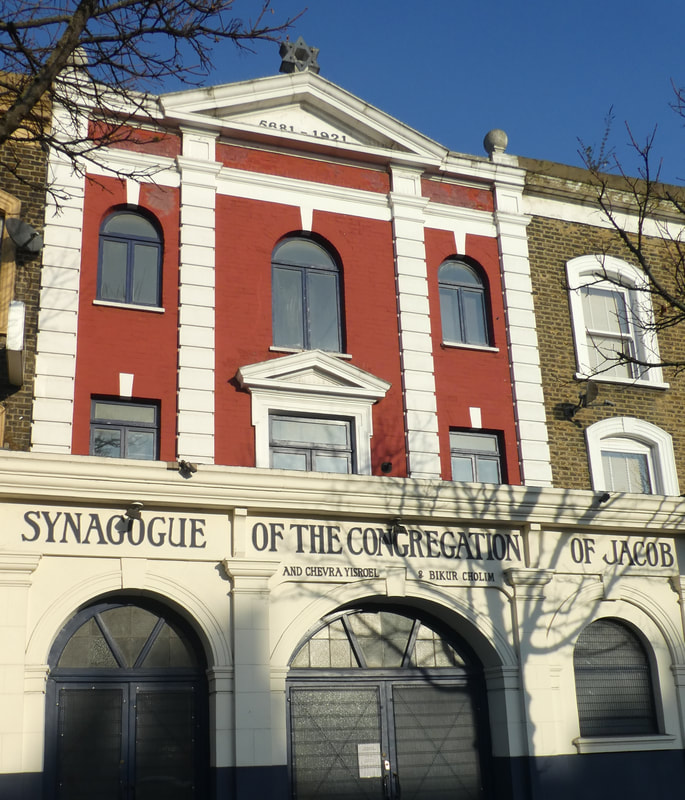 Jubilee Street runs from Commercial Road several hundred yards north to Whitechapel Road, and at the northern end is Rinkoff Bakeries. I'd never been there before. I'll certainly be going again. I had a coffee and a smoked salmon and cream cheese beigel. Excellent! And I brought back pastries for the family.
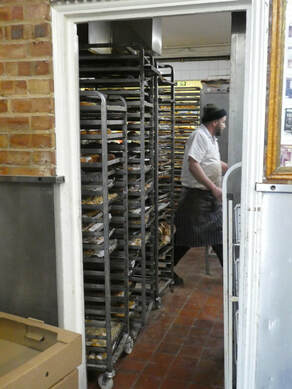
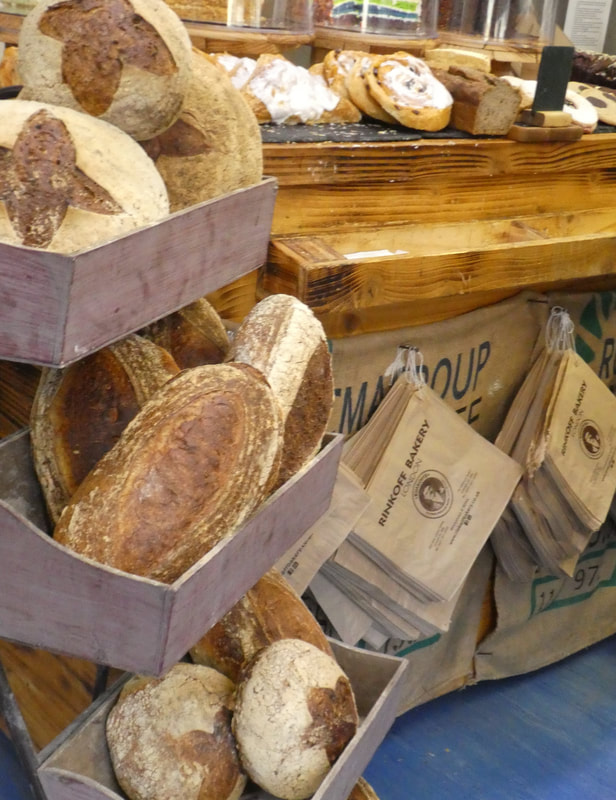
The place does good business. There are a few tables - both inside and out (and even on a nippy January morning most of the outside tables were taken) - and a steady stream of customers ... tourists, 'pilgrims', but mainly locals who want a take away cake, beigel or coffee. 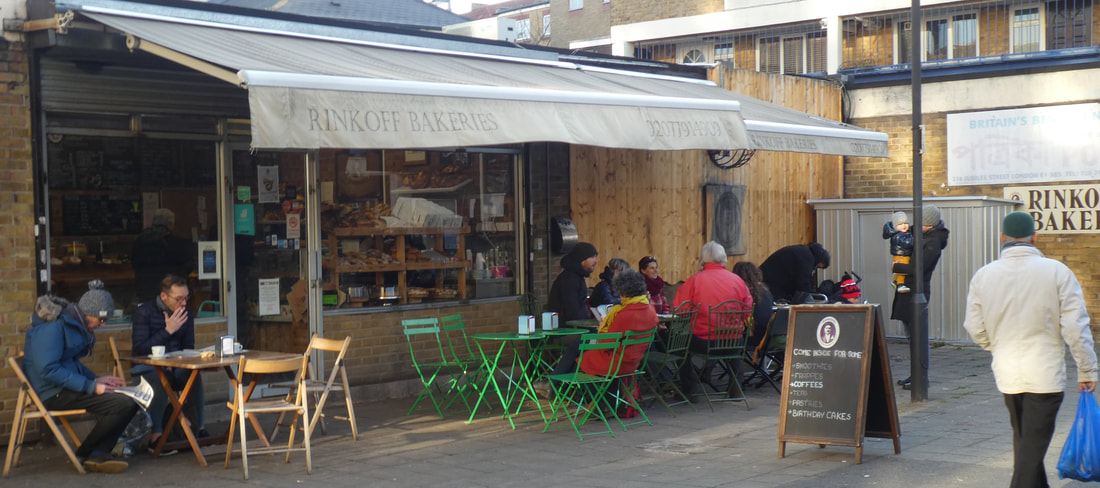
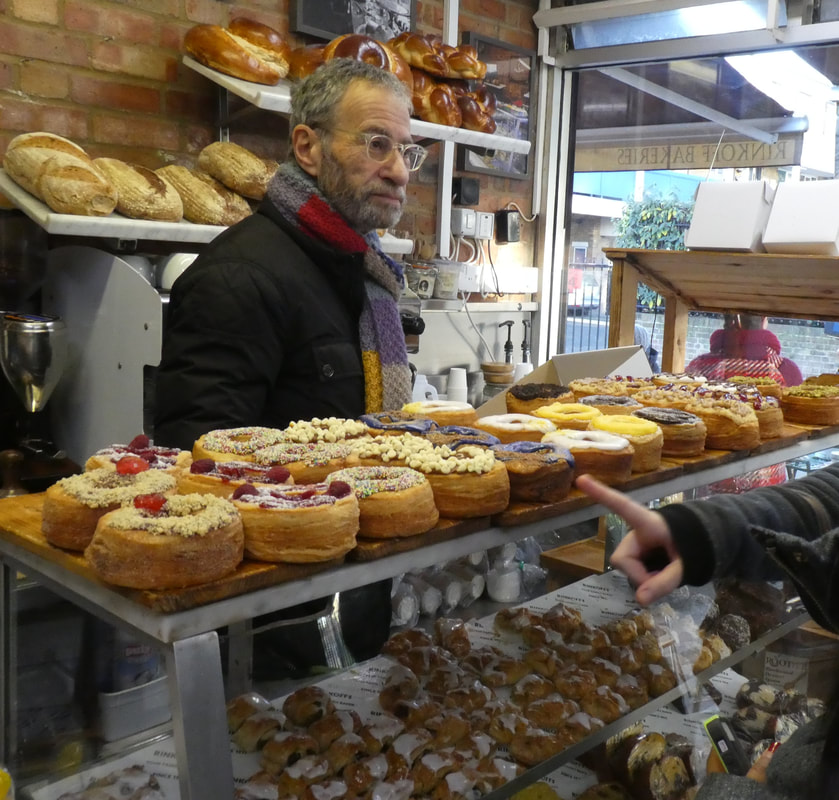
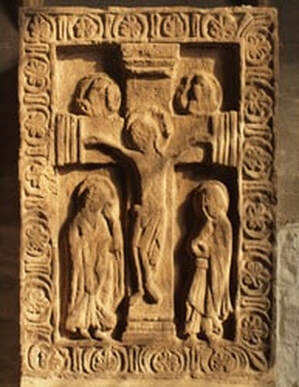
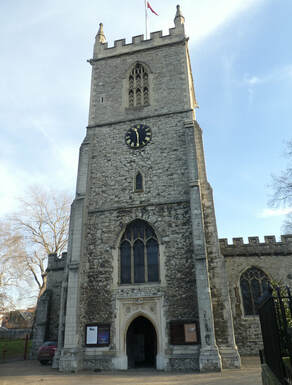
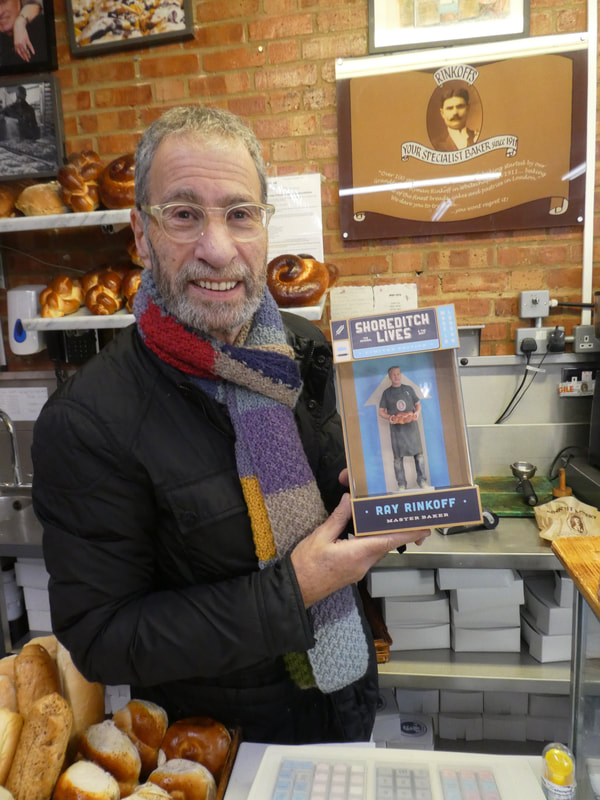  That's Ray above, with a model of himself in his days as a master baker. He trades a lot on tradition, but there's quality in the mix too. I had never heard of Rinkoffs until I started thinking about this walk - if you haven't been, do go! Jubilee Street has been knocked around a lot. There's only a short stretch towards the north end that looks a little as it would have done a century ago, when this area was overwhelmingly Jewish. 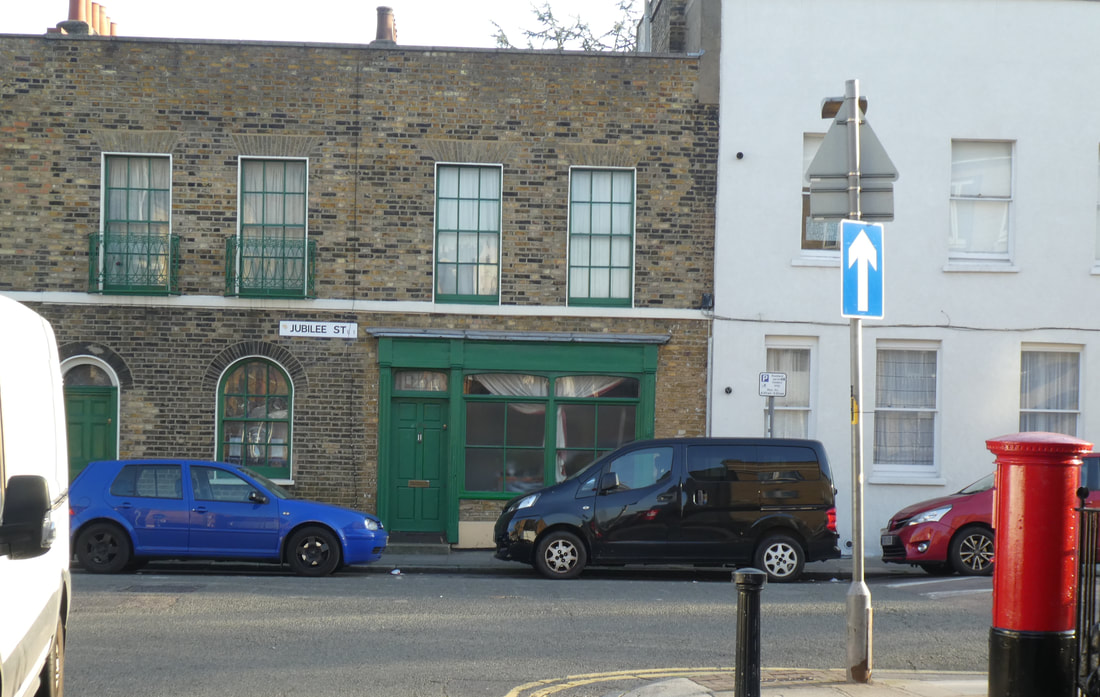 The street has a special place in the history of the East End - it was the epicentre of of the once formidable anarchist movement in this part of London. The Jubilee Street Club was established in 1906 and for eight years was both a social and educational centre. Rudolf Rocker was closely associated with the club, and such anarchist luminaries as Kropotkin and Malatesta spoke here. I once interviewed Nellie Dick (born Naomi Ploschansky) who as a young woman was active in the Jubilee Street Club and helped to organise a 'Modern School' here. There's a wonderful account of this and other London anarchist clubs, including a rather grainy photograph, in this research paper by the historian Jonathan Moses. It's worth a read. The old club building was demolished many decades ago and Jarman House, with its distinctive sky blue balconies, now stands on the site. 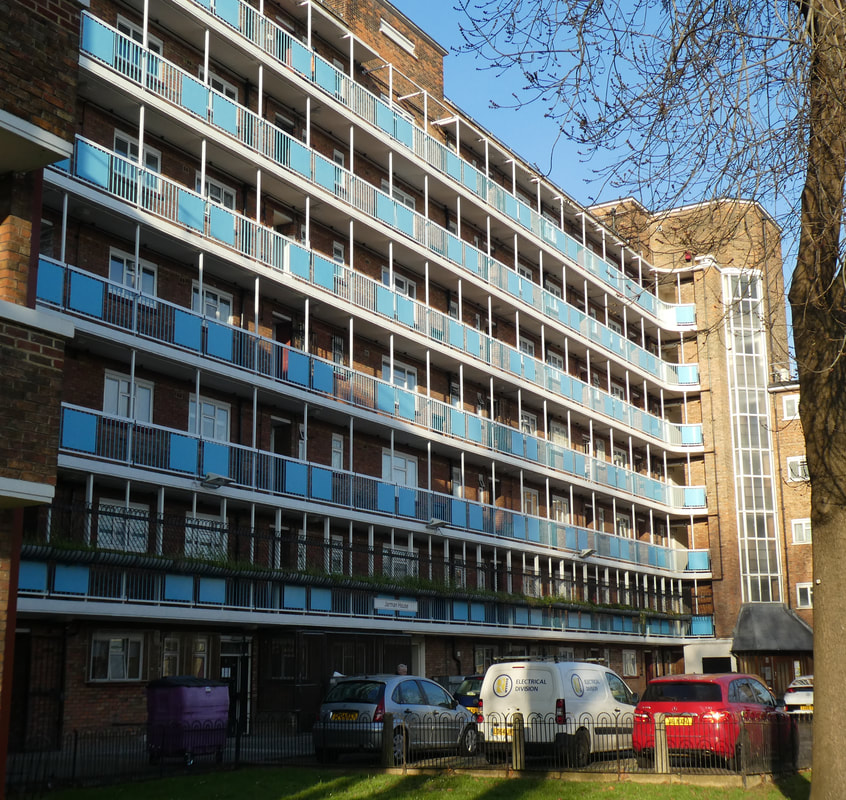 A little to the east lies Stepney Green, a wonderfully peaceful and historic spot. Rudolf Rocker and his family - including his younger son Fermin, an artist - once lived in a top floor flat here. By chance a few year ago, I had the opportunity to visit that same flat in Dunstan House when my friend Bill Schwarz was putting up here. Fermin's drawing of the building graced the cover of his memoir of his East End childhood, and you can see how little it has changed. 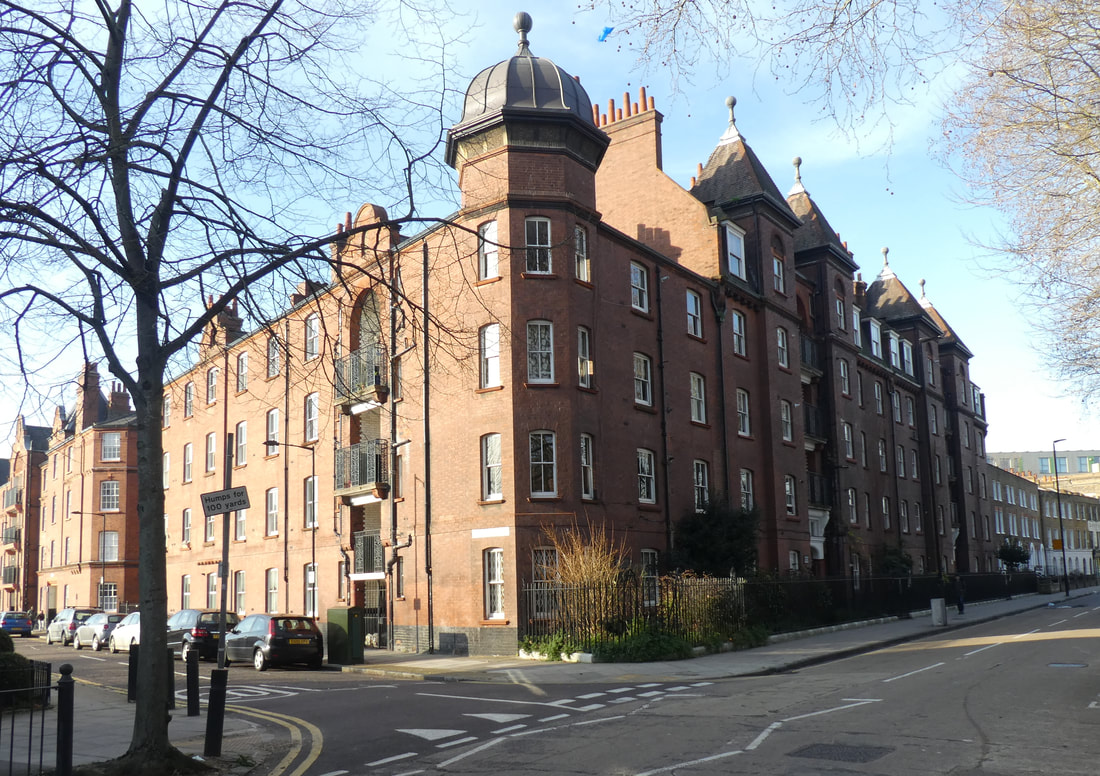 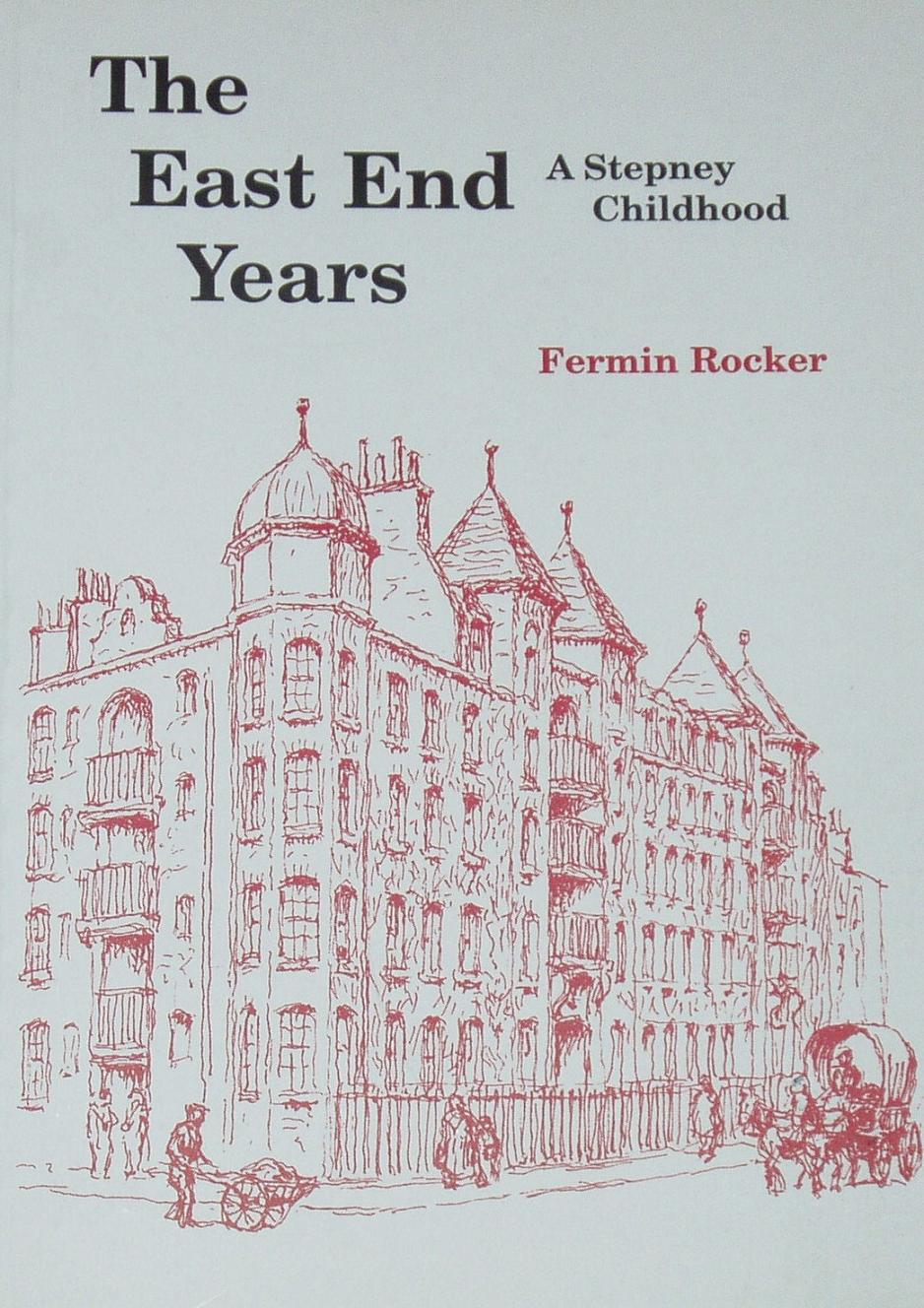 Just to the south is the church of St Dunstan and All Saints, Stepney - one of the few London churches which is genuinely medieval. In origin it is Anglo-Saxon and houses a tenth century rood, a representation of the crucifixion (the photo is from the church's website), which is believed to be a remnant of the church that St Dunstan himself may have founded here.
And as so often with old London churches, its memorials are testament to the human cost of Britain's Imperial ambitions. 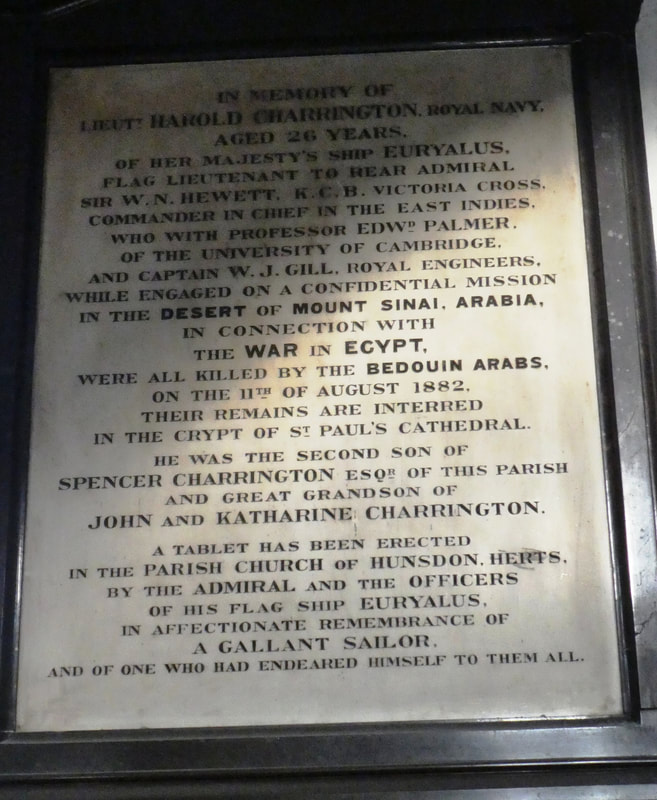 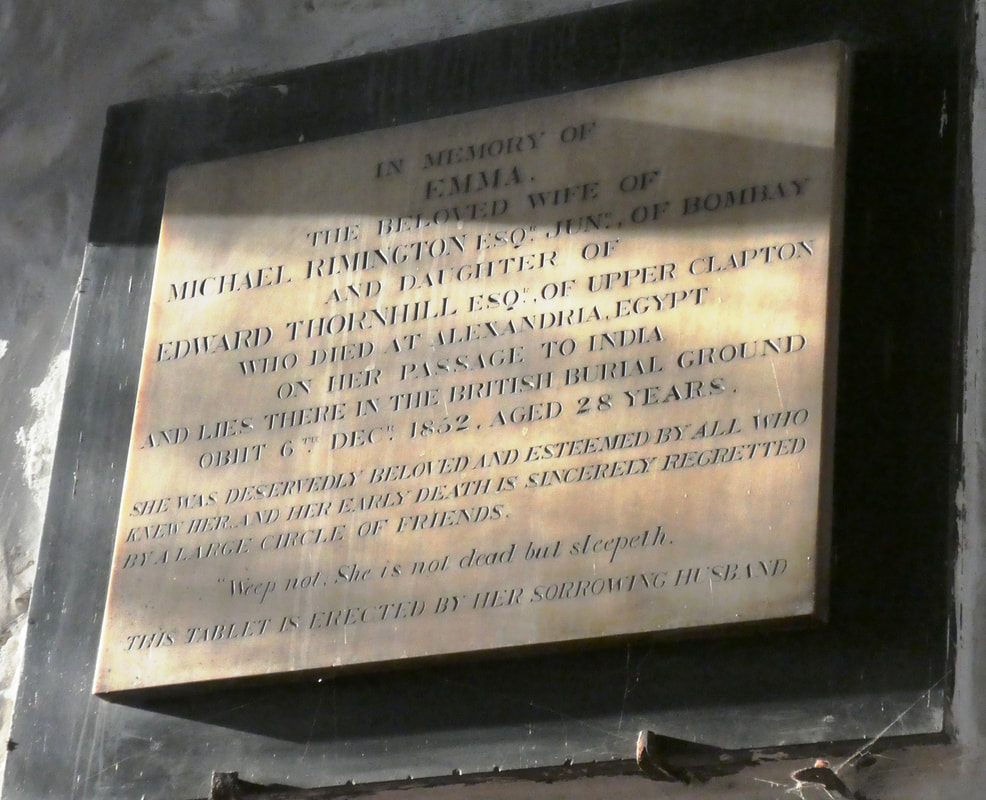 Just east of the church and its grounds, there's the sort of street that I just love - Durham Row, tiny post-war bungalows on one side, and (at a guess) mid-nineteenth century buildings on the other, several of which seem once to have been shops. And above one of these one-time shop windows, it's just possible to make out an inscription: E, Andrews, FLORIST. 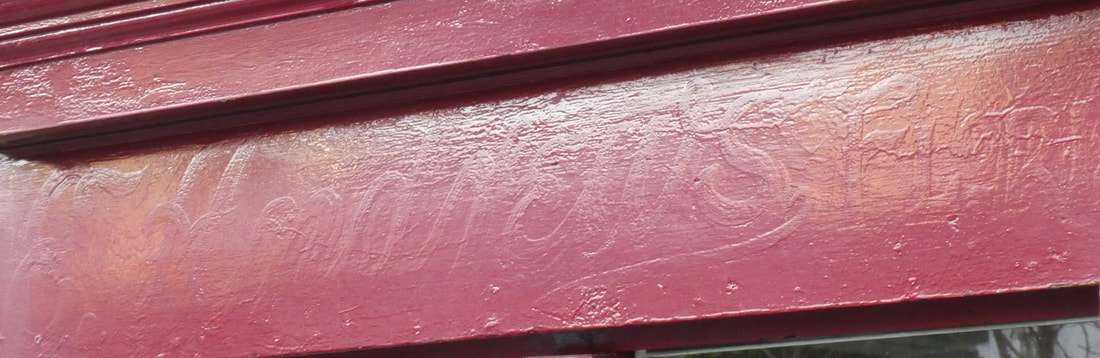 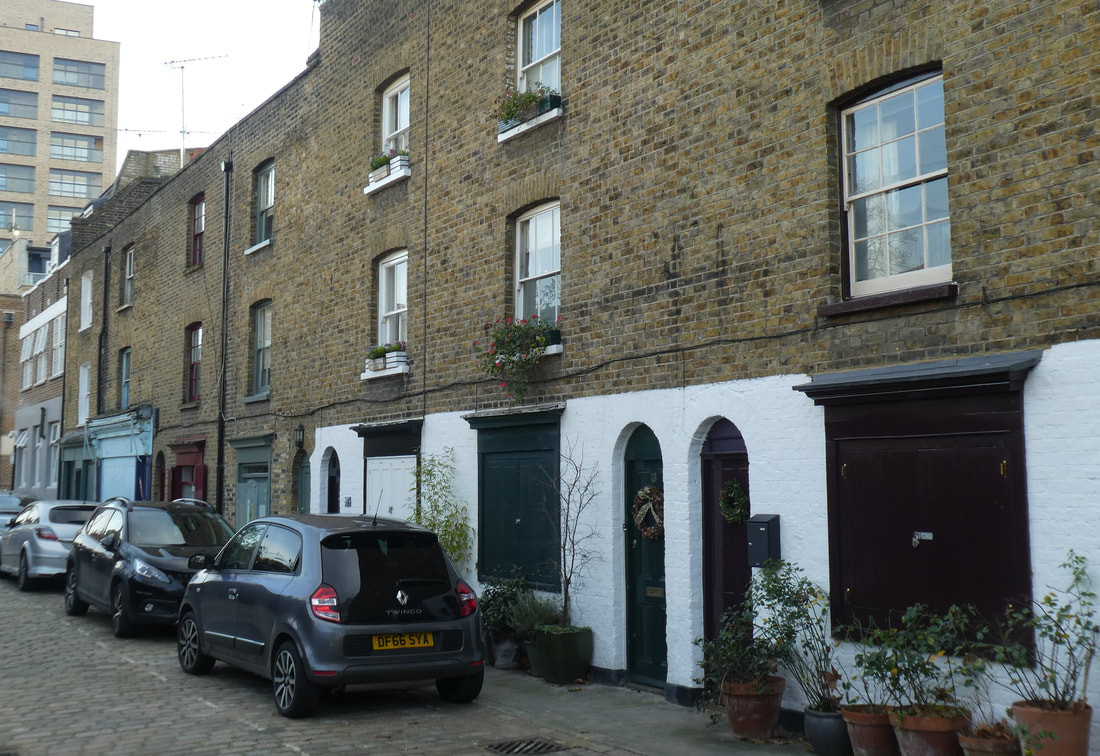 Another couple of hundred yards, and I reached the Regent's Canal - the end of my walk. Thanks for making the journey with me. And as I looked back, there was the City looming over the East End, looking almost enticing ... from a distance. 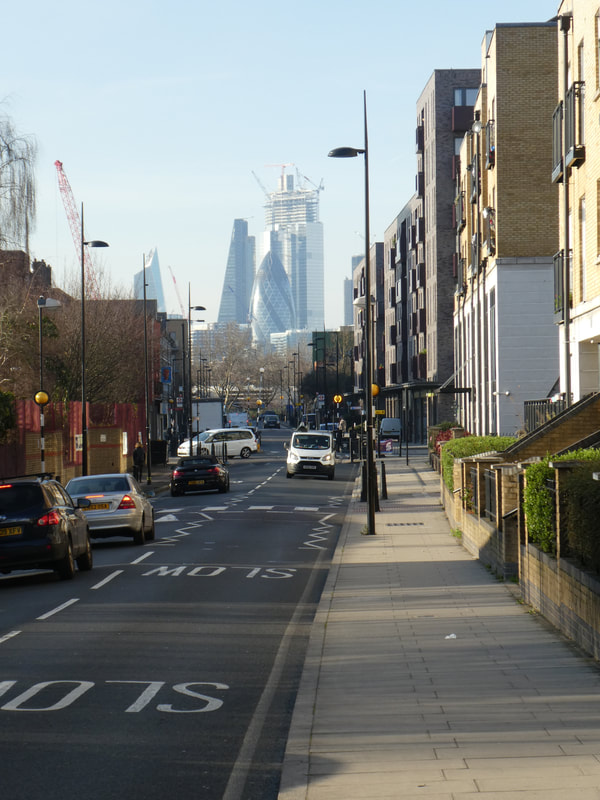 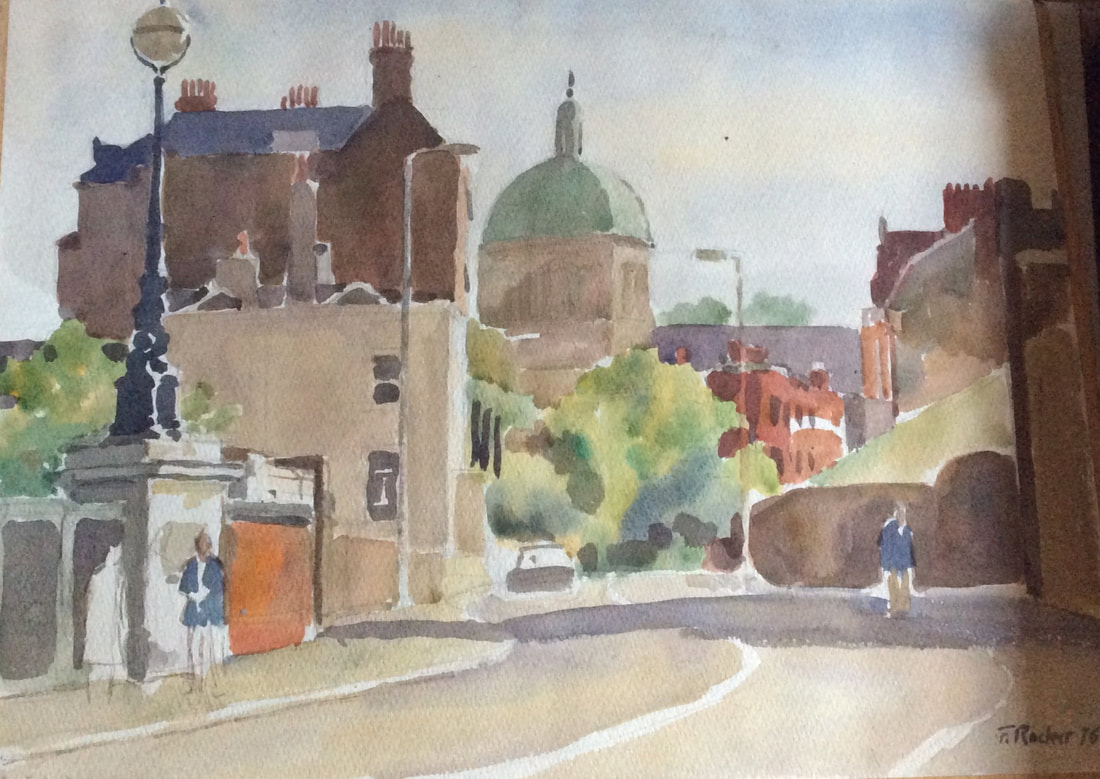 This lovely watercolour was painted on 'suicide bridge' looking west on Hornsey Lane, with the dome of St Joseph's Catholic church prominent. On the right, you can see the bank of the covered reservoir.
It's by Fermin Rocker (whose obituary I wrote for the Guardian) and dates from 1976. He lived in Tufnell Park for many years, and while he didn't paint many local streetscapes, his depiction of the newspaper kiosk outside Tufnell Park tube being an exception, he did on occasions venture out with watercolours and easel. I like this a lot! 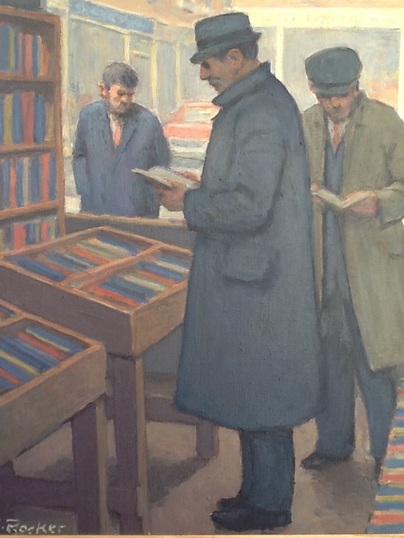
A wonderful - and very typical - painting by Fermin Rocker, which Ross is now using as his Facebook image and is posted here with his permission. This is undated - the style is 1950s, but it's probably more recent. The subject, an old-style second hand bookshop, fits well for Ross, who runs his own publishing house. And it uses Fermin's customary minor key palette, in which colours - here particularly slate blue, but also the reddy orange of the book spines - are repeated. And as is his style, none of the people on the canvas is engaging with any other.
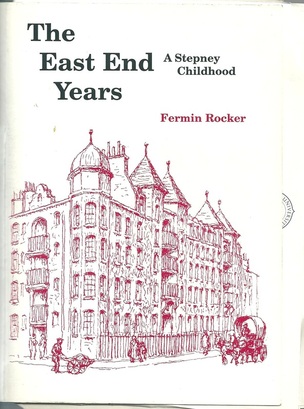 A very convivial lunch today at a friend's place - he's recently started renting a flat in Stepney Green. Dunstan Houses, to be precise. Top floor. In fact, the exact same flat where Rudolf Rocker - the leader of the influential Yiddish-speaking anarchist movement in the East End before the First World War - lived a century ago. 'Yes, this was the Rocker residence', he declared, with a distinct and entirely justifiable sense of pride. 'There used to be a portrait of Malatesta on that wall, and of Bakunin on that wall.' Hang on a moment - entirely credible but how does he know? Well, because Rudolf Rocker's son, the artist Fermin Rocker, wrote a wonderful memoir of growing up in Dunstan Houses - graced by his own drawing of the building. The family moved in in about 1910. 'Dunstan Houses', Fermin recalled, 'though hardly an abode for the affluent, nevertheless had its own class distinctions and offered a scale of accommodations for the poor, the poorer, and the poorest. ... No. 33 was in what might be termed the luxury wing of the building. We had such conveniences as a private kitchen and a private lavatory ...' 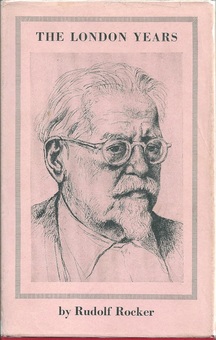 Fermin writes that he looked upon his father 'as a god' - a sentiment not entirely in spirit with the movement. Then again you could say that Rudolf Rocker's undoubted leadership of the Jewish anarchist movement (though he was himself a 'goy', a gentile) was also not entirely in step with the libertarian, 'no master, high or low', ethos.
Rocker's own memoir, The London Years, has a drawing of him by his son on its cover. Heading back from Stepney Green, we drove along Jubilee Street - the site of the anarchist club, which thrived from 1906 for almost a decade and was the beating heart of the movement. Nice to have a sense of proximity to a culture, a movement, which has now so utterly gone. 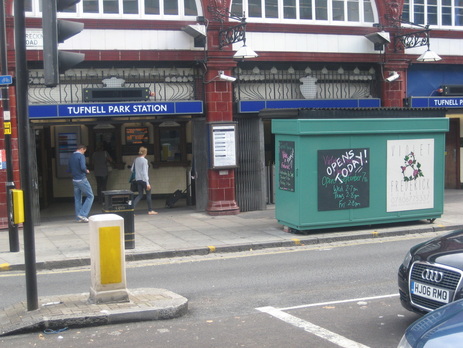 A rebirth. Just by Tufnell Park tube station. Just over a year ago, the newspaper stall outside Tufnell Park station closed abruptly. And with it went part of the routine of my - and many others - weekday mornings. I still miss it, and the cheery old guy who used to call me 'young man' (I'm in my 50s). This week, the kiosk has come back to life. As a flower stall. 'Violet and Frederick', it's called. Open from lunchtime to mid-evening. It adds a little life and colour to what is a fairly drab five-way junction. I'll be doing my best to keep the business afloat. And it's a good excuse to post again the picture which has generated far more interest than anything else I've put on this blog - Fermin Rocker's wonderfully evocative painting of the old newspaper kiosk. Enjoy! 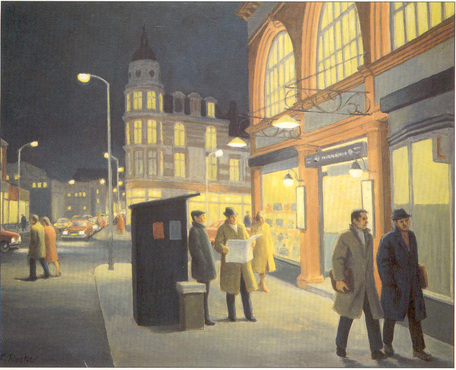 Fermin Rocker, 'Newspaper Kiosk, Tufnell Park' 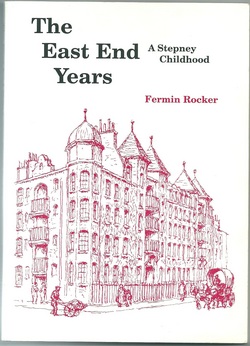 Every now and again, when I pop into a second hand bookshop, I buy something I've already got - just because it's a book I like so much, I can't leave without it. Yesterday, at the Oxfam bookshop in Kentish Town, I bought this title - Fermin Rocker's lively reminiscences of his East End childhood before and during the First World War. It cost £1.99. I've already got a copy - indeed I also have a copy in the original German, a language I don't read or speak. So, the first person to tell me as a comment on this blog that they want this book gets it. Gratis! I'll even pay the postage. And let me explain why you should want it. Fermin Rocker's father was Rudolf Rocker, a German gentile who was the leading figure in the very influential largely Yiddish-speaking anarchist movement in London's East End in the early years of the last century. Fermin's memoirs cover the period when that movement was at its zenith. Fermin grew up to be a considerable artist - and his painting of the paper kiosk at Tufnell Park tube, which I posted here some time ago, attracted a huge amount of interest. His memoirs have several of his drawings - including the one on the cover, of Dunstan Houses in Stepney where he grew up. There are also photographs such as the one below, Fermin with his parents, taken - at a guess - in the early 1930s. So, anyone interested? 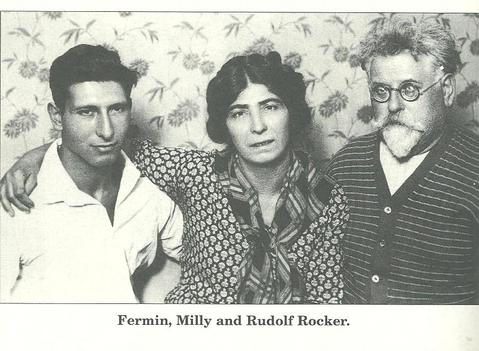 This site achieved a milestone yesterday - more than 500 page hits on a day. And all thanks to Twitter! Yesterday morning, someone I have never met, Alex Smith - though I am now following him on Twitter and he's in pursuit of me too - tweeted about a blog entry I wrote five months ago. It was a lament about the abrupt closure of the newspaper stall at Tufnell Park tube station - more than that, it was illustrated by a very fine painting of that stall by Fermin Rocker. I am posting that again below. Anyway, Alex (part of the Ed Miliband posse, which has adopted Tufnell Park - see here) has a large social media footprint, he was quickly retweeted, and by the end of the day the blog post had, almost, gone viral. Alex wants to know when Fermin painted this city scape, and whether any prints are available. And I'll be putting that about on Twitter too! STOP PRESS: Fermin's son Philip believes this painting was much later than one might imagine, and was sold at the Stephen Bartley gallery in Kensington in the 1980s or '90s. 'As everyone says - it looks more like the 1950's - but then my dad's work froze at about 1960 and if anything went slightly backwards in his last years.' And the amount of interest sent traffic to thie site soaring on Saturday to not far off 1,000 page impressions in a day! But then it is a terrific piece of art. 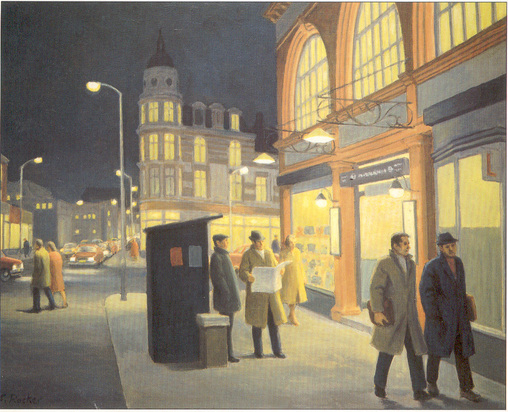 Fermin Rocker - 'Newspaper Kiosk, Tufnell Park' 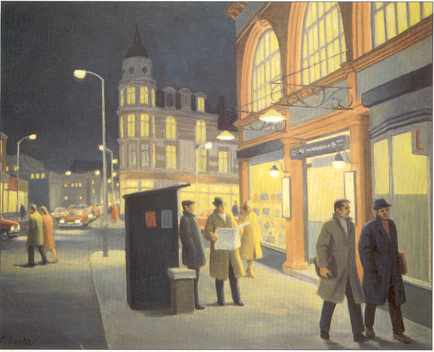 Fermin Rocker 'Newspaper Kiosk, Tufnell Park' Not many newspaper kiosks feature in works of fine art. The painting by my old friend Fermin Rocker - who died in 2004 - captures the wonderful paper stall outside Tufnell Park tube station. A stall I patronised every weekday on my way to work. Until the end of last week. The stall is now closed - 'until further notice', says the forbidding notice. The staff at the tube station say it has gone for good. Every morning, I handed over my pound coin for a copy of the 'Daily Telegraph'. "There you are, young man", the older assistant would say when on duty. No one else calls me young these days. And indeed, his tune had changed of late to "there you go, old mate", which is a touch more intimate but less motivating. You can make out the stall in its modern incarnation in the photo below. They never said it was about to close. It's a sudden death. Part of my routine lost. A much larger part of the stall holder and his colleagues' lives gone. I grieve its passing. 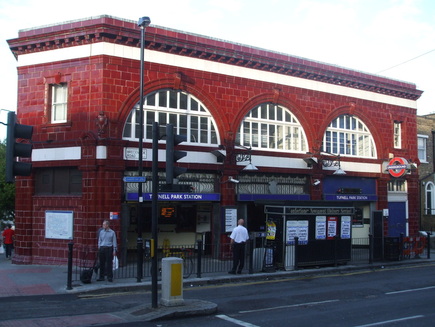 Photo: Sunil 060902 CreativeCommons |
Andrew Whitehead's blogWelcome - read - comment - throw stones - pick up threads - and tell me how to do this better! Archives
April 2024
Categories
All
|
 RSS Feed